Complete Guide...
October 15, 2026

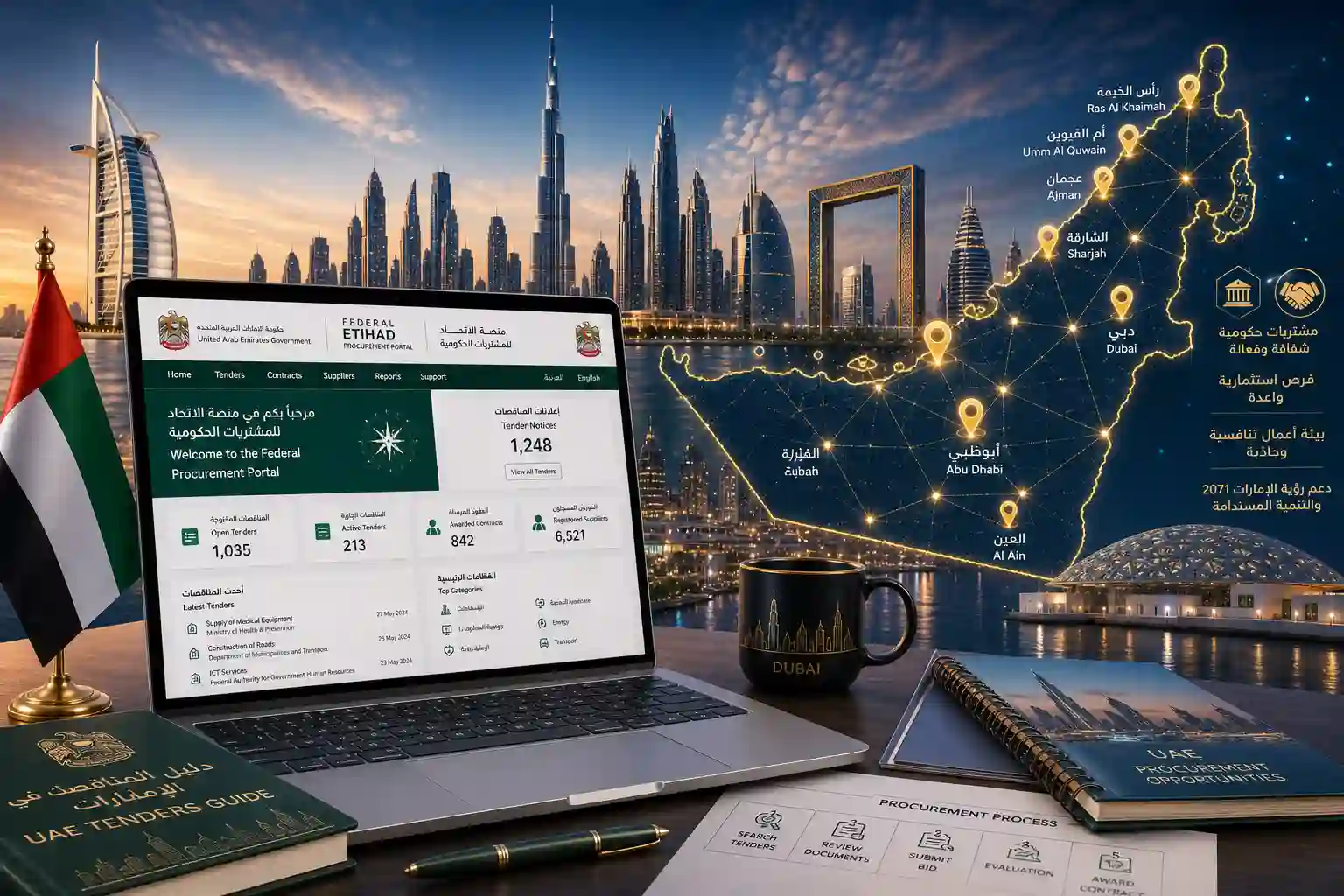
The United Arab Emirates represents one of the world's most sophisticated and dynamic procurement markets. As a federation of seven emirates and a cornerstone of the GCC, the Arab World and the Middle East, the UAE offers unparalleled opportunities across energy, infrastructure, technology, healthcare and logistics sectors under its progressive economic diversification strategy.
Whether you are a local contractor in Abu Dhabi, Dubai, or Sharjah, or an international supplier seeking to enter the UAE market, understanding Federal Law No. 11 of 2023, mastering the Digital Procurement Platform, obtaining ICV certification and complying with emirate-level regulations are essential for success. This comprehensive guide provides deep knowledge for contractors, suppliers and consultants on how to participate in UAE tenders.
The Federal Law No. 11 of 2023 on Procurement in the Federal Government, together with its Implementing Regulation under Cabinet Decision No. 122 of 2024, governs procurement and contracting by federal entities in the United Arab Emirates.
Key features of the new framework include:
The Ministry of Finance launched the Federal Government Procurement Procedures Guide in April 2026, a comprehensive framework designed to streamline procurement processes, enhance efficiency and facilitate the implementation of the Government Procurement Law across all federal entities.
The Digital Procurement Platform (DPP), administered by the Ministry of Finance through a Central Procurement Unit, is the UAE's central e-platform for federal government tenders and procurement.
What the Digital Procurement Platform offers:
Purchasing Methods under the New Framework:
Important Note for Bidders: Direct order or exclusive source procurement is NOT permitted in cases of absence of acceptable justification, insufficient planning where adequate time exists to tender, or recurrent procurement where other suppliers exist in the market.
The UAE operates a dual procurement system. While federal entities follow Law No. 11 of 2023, each emirate maintains its own procurement regulations:
Abu Dhabi: Decision No. 36 of 2021 on the Abu Dhabi Procurement Standards governs public procurements by the Abu Dhabi government and related public entities.
Dubai: Law No. 12 of 2020 on Contracts and Warehouse Management within the Dubai Government forms the legal framework for public procurement.
Sharjah: Law No. 8 of 2017 addressing Procurements, Tenders, Auctions and Warehouses of the Sharjah Government.
Ajman: Law No. 3 of 2025 (issued September 2025) regulating procurement, contracts and inventory management in the Ajman Government.
Other Emirates: Umm Al Quwain, Ras Al Khaimah and Fujairah each maintain their own procurement frameworks.
Procurement Centre of Excellence: The Ministry of Finance has established a Procurement Centre of Excellence with a clear governance framework defining the roles and responsibilities of regulatory units in federal entities.
The National In-Country Value (ICV) Program, formalized under Cabinet Resolution No. 91 of 2021 and administered by the Ministry of Industry and Advanced Technology (MoIAT), is arguably the most critical requirement for suppliers bidding on UAE government and ADNOC-linked contracts.
An ICV certificate measures how much economic value a company contributes to the UAE through local supplier spending, investment in UAE-based assets, Emiratization payroll contribution and operational allocation within the country.
Why ICV Certification is Essential:
The ICV score calculation follows a structured formula:
Core Formula: ICV Score = Local Economic Contribution ÷ Revenue + Approved Bonuses
Key Components:
Step by Step Process:
Step 1: Preparation & Data Gathering
Step 2: Register on MoIAT Digital Platform
Step 3: Select an Approved Certifying Body
Step 4: Submit Documentation for Audit
Step 5: Receive ICV Certificate
Pro Tip for New Companies: Companies under ten months old can obtain an ICV Certificate using management accounts, enabling immediate government bidding with proper MoIAT compliance.
ADNOC (Abu Dhabi National Oil Company) has launched its Industrial Resilience Programme at "Make it in the Emirates 2026," introducing five initiatives aimed at strengthening supply chains, accelerating local manufacturing and enhancing business continuity.
Key Initiatives for Suppliers:
ADNOC's ICV Impact:
The Executive Council of the Emirate of Dubai has approved the Dubai Government Joint Procurement Project (SHARAK), presented by the Department of Finance, to apply the principle of joint procurement to a group of public procurements.
SHAKAR Program Objectives:
Program Features:
Pilot Phase Results: In cooperation with Dubai Police, Dubai Health Authority, Dubai Airports and Dubai Smart Foundation, the pilot phase achieved savings between 10% and 32% for a range of procurement categories.
The UAE issues tenders at both federal and emirate levels. Understanding the issuing authorities across different emirates is crucial for targeted bidding.
Abu Dhabi Government (Decision No. 36 of 2021):
Dubai Government (Law No. 12 of 2020):
Sharjah Government (Law No. 8 of 2017):
Ajman Government (Law No. 3 of 2025):
Umm Al Quwain, Ras Al Khaimah, Fujairah:
Federal procurement regulations outline essential documentation for engaging in UAE government tenders:
Mandatory Documents for All Bidders:
Document Verification Note: Procuring entities verify ICV certificate validity directly through the MoIAT registry rather than relying solely on submitted documentation. An expired certificate may remove scoring weight during commercial evaluation.
The UAE has established clear sustainability standards in purchasing and contracting, particularly for digital products and services.
Green Procurement Requirements:
Innovation as Evaluation Criteria:
Article 28 of the executive regulations establishes innovation as a key evaluation criterion in bid assessments. This policy encourages suppliers to propose innovative solutions that enhance procurement efficiency and maximize added value, supporting the federal government's commitment to investing in modern technologies and innovative practices.
Yes, foreign companies can participate in UAE government tenders, but with important considerations:
Important for New Entrants: Companies under ten months old can obtain an ICV Certificate using management accounts, enabling immediate government bidding with proper MoIAT compliance. This is particularly valuable for newly established foreign entities entering the UAE market.
The Federal Government Procurement Procedures Guide establishes clear guidelines for grievance procedures, defining the responsibilities of grievance committees within federal entities and outlining updated mechanisms for handling disputes.
Additionally, the framework addresses practices that undermine competition and outlines the penalties associated with them, ensuring fairness for all participants.
Based on expert analysis, here are frequent mistakes that lead to bid disqualification in UAE tenders:
Note on Procurement-to-Pay (P2P): The UAE Ministry of Finance has successfully implemented 'Procure-to-Pay' (P2P) which expedites the procurement process and e-approval of purchase orders and requests at different levels. Understanding this digital workflow is essential for timely payment processing after contract award.
Based on procurement data, these sectors offer the highest volume of tenders:
Navigating the UAE's federal and emirate-level procurement landscape requires expertise, local knowledge and access to timely information. TendersArabia provides comprehensive tools and intelligence to help contractors, suppliers and consultants succeed in this competitive market:
Our platform aggregates tenders from federal entities, all seven emirates and major state-owned enterprises including ADNOC, DEWA, RTA and SEWA. You no longer need to monitor multiple portals separately.
We track tenders from Abu Dhabi (Decision No. 36/2021), Dubai (Law No. 12/2020), Sharjah (Law No. 8/2017) and Ajman (Law No. 3/2025) ensuring complete coverage across the federation.
With ICV certification now mandatory for federal and ADNOC tenders, our platform helps you identify tenders where your ICV score will be most competitive. We provide guidance on ICV requirements and score optimization.
Bilingual Support (English & Arabic)
While the Digital Procurement Platform operates in Arabic, TendersArabia provides English translations of key tender information, including titles, descriptions, deadlines and requirements.
Emirate-Level Filtering
Target specific emirates efficiently: filter tenders by Abu Dhabi tenders, Dubai tenders, Sharjah tenders, Ajman tenders, or Northern Emirates opportunities.
Sustainable Procurement Alerts
With the UAE's focus on green procurement and Net Zero 2050, our platform tracks sustainability requirements and alerts you to tenders with green procurement criteria.
Contract Awards Database
Analyze who won past tenders across all emirates, understand pricing benchmarks and identify subcontracting opportunities through our Contract Awards database.
Access checklists, documentation requirements and best practices specifically tailored for the UAE market, including ICV certificate renewal tracking and compliance checklists.
Ready to start winning UAE tenders? Register for free to explore opportunities, or subscribe for premium access to complete tender documents, daily alerts and advanced analytics.
1. What is Federal Law No. 11 of 2023 and why is it important?
Federal Law No. 11 of 2023 on Procurement in the Federal Government is the primary legislation governing federal procurement in the UAE. Together with its Implementing Regulation under Cabinet Decision No. 122 of 2024, it replaces the previous framework and introduces a unified Digital Procurement Platform, standardized processes and enhanced transparency measures.
2. What is an ICV certificate and why is it mandatory?
An ICV (In-Country Value) certificate measures how much economic value a company contributes to the UAE. Under the National ICV Program (Cabinet Resolution No. 91 of 2021), federal procurement regulations require ICV certification during commercial evaluation. Without certification, suppliers may lose scoring weight or risk disqualification from government contracts.
3. How do I obtain an ICV certificate in the UAE?
To obtain an ICV certificate: (1) Prepare audited financial statements from a UAE-licensed auditor, (2) Register on the MoIAT digital platform using UAE Pass, (3) Select an authorized certifying body, (4) Submit documentation for verification, (5) Receive system-generated certificate. The certificate is valid for 14 months from the date of audited financial statements.
4. What is the difference between federal and emirate-level procurement?
Federal Level: Governed by Federal Law No. 11 of 2023, applies to federal ministries and entities. Emirate Level: Each emirate maintains separate regulations: Abu Dhabi (Decision No. 36/2021), Dubai (Law No. 12/2020), Sharjah (Law No. 8/2017), Ajman (Law No. 3/2025).
5. Can free zone companies obtain ICV certification?
Yes. Free zone companies may obtain an ICV certificate. The certification applies to the UAE-registered legal entity submitting the tender. However, free zone companies must carefully track local vs. international spend as they do not receive the automatic "Mainland Bonus" (approx 10%) that mainland companies receive.
6. What is the Dubai Joint Procurement Project (SHARAK)?
SHARAK is Dubai's joint procurement initiative approved by the Executive Council. It aims to enhance spending efficiency, support SMEs and achieve savings of AED 250-400 million over three years. The pilot phase achieved 10-32% savings for certain procurement categories. An electronic platform enables suppliers to submit offers transparently.
7. What is ADNOC's Industrial Resilience Programme?
Launched at "Make it in the Emirates 2026," ADNOC's programme includes five initiatives: enhanced ICV model, "Local+" initiative requiring EPC contractors to prioritize local manufacturers, "ICV+" framework, "ADNOC Multiplier" tool and "Build-to-Demand" for long-term visibility. ADNOC targets local production of $24.5 billion (AED 90 billion) worth of products by 2030.
8. How does ICV score calculation work?
ICV = Local Economic Contribution ÷ Revenue + Bonus Points (max 5%). Components include: Local Procurement (up to 50%), UAE Investments (up to 25%), Emiratization (up to 15%), Expatriate Contribution (up to 10%). Bonus points for exports, Emirati headcount growth and new investments.
9. What are the green procurement requirements in the UAE?
Under Article 16 of the executive regulations, green procurement