Complete Guide...
October 15, 2026

Egypt is the largest country by population in the Arab world, with more than 110 million people and its public procurement footprint matches that scale. Government spending on infrastructure, housing, energy, healthcare and transport runs through a legal framework that has been substantially modernised over the past decade and, importantly for any bidder evaluating this market, through an electronic procurement portal that is already live and actively processing tenders, not a future initiative still waiting to launch.
This guide has been researched and written for contractors, suppliers and consultants preparing to bid on مناقصات مصر (Egypt tenders) whether Egyptian companies seeking to understand registration requirements under Public Contracts Law No. 182 of 2018, regional suppliers from across the GCC and wider Arab world exploring cross-border opportunities or international firms targeting Egypt's construction, energy, healthcare, transport and agricultural procurement sectors. It covers the legal framework, the institutions and platforms that administer it, the bidding procedures, bond requirements, foreign-bidder considerations and the practical realities of bidding without referencing any specific live tender, since active opportunities change daily and should always be verified directly on the official portal.
Public procurement in Egypt is governed primarily by Public Contracts Law No. 182 of 2018, together with its Executive Regulations issued under Minister of Finance Decision No. 692 of 2019. This law replaced the earlier Tenders and Auctions Law No. 89 of 1998, which had governed Egyptian government contracting for nearly two decades and was introduced specifically to modernise the procurement system, strengthen transparency and competition and bring Egyptian public contracting closer to international best practice.
Law No. 182 of 2018 applies broadly to entities financed by the state's general budget and to units of the state's administrative apparatus including ministries, departments and agencies with independent budgets, local administration units and public service or economic bodies, along with entities affiliated to these authorities. It also extends specifically to police and military contracts for the supply of provisions or equipment for national security uses, reflecting the comprehensive scope the legislature intended for the new framework.
The law's core objectives, as set out in its own stated purpose, are to guarantee balance between the interests of all parties to public contracts, enhance transparency and achieve economic efficiency avoiding unjustified spending, rationalising public expenditure, simplifying procedures, achieving decentralisation goals and broadening real and fair competition. President Abdel Fattah El-Sisi subsequently issued Law No. 187 of 2020, amending several provisions of Law No. 182 including the introduction of a new Article 15 bis extending the procedures used to set the basic or estimated value of real estate transactions and reinforcing measures against tax and customs evasion in public contracting.
Importantly, Law No. 182 of 2018 should be understood alongside, rather than in isolation from, several related pieces of legislation that frequently apply to the same contracts: the Public-Private Partnership Law No. 67 of 2010 (amended in 2021) for PPP and concession-based infrastructure projects and the Preference of Egyptian Products Law No. 5 of 2015, which gives qualifying bidders a price evaluation advantage tied to local content a provision with direct, practical consequences for foreign suppliers, explained in detail below.
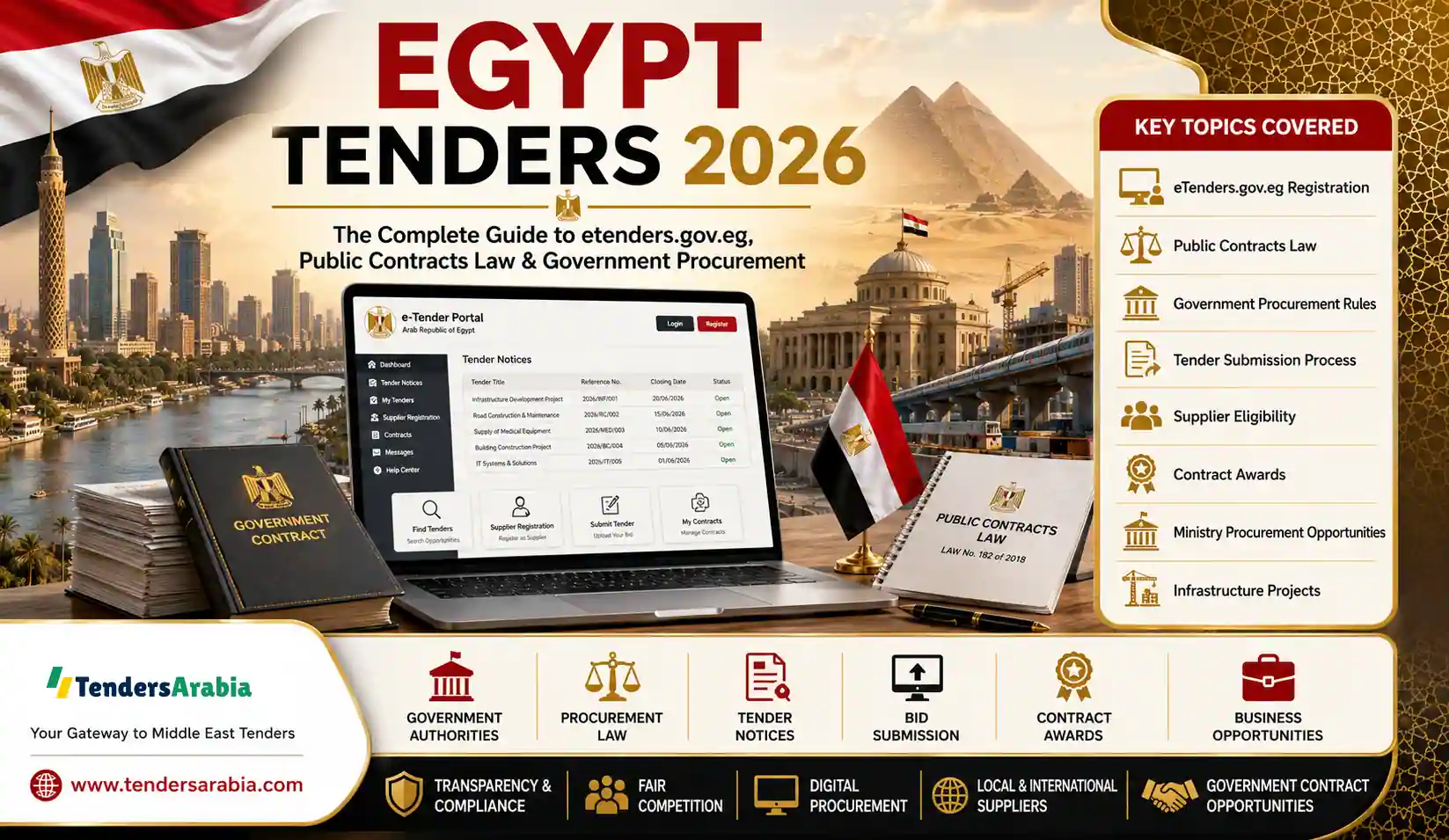
A critical point of clarity for any business researching Egypt's tender market: the official electronic procurement portal بوابة التعاقدات العامة (the Public Contracts Portal), accessible at etenders.gov.eg is already operational and actively publishing live tenders, not a platform still in development. The portal describes itself as the product of close cooperation between the Ministry of Planning and Administrative Reform and the General Authority for Government Services (GAGS) and presents itself as the first portal of its kind in the Middle East offering electronic services for government purchasing operations.
The portal is explicitly designed to help government entities publish procurement processes online across every field of government activity and to make it easier for suppliers and other parties to submit bids electronically so that they can be evaluated through an easy and efficient digital process. Suppliers are invited to register directly on the portal to take advantage of fully electronic bid submission. In practice, tenders published through this system carry individual reference numbers and dedicated tender pages covering categories spanning newly established school equipment supply, university research laboratory complexes, gas network maintenance contracts and many others confirming that the system is in active day-to-day use across a wide range of government entities, not limited to a single pilot ministry.
This does not mean every category of Egyptian public procurement is fully centralised on a single platform yet Egypt's procurement landscape, as detailed below, still includes sector-specific systems such as the Unified Procurement Authority's own digital infrastructure for healthcare. But the core, GAGS-administered electronic public contracts portal that handles the majority of general government tendering is a live, functioning system today and bidders should treat registration on it as a present-day operational requirement rather than something to "monitor for future launch."
The General Authority for Government Services (GAGS الهيئة العامة للخدمات الحكومية) is the central body most directly associated with administering the etenders.gov.eg portal and managing a substantial share of Egypt's general government procurement across sectors. For contractors and suppliers without a specific reason to engage a sector-specific authority directly, GAGS and its electronic portal represent the most consistent first point of engagement with the Egyptian public procurement system.
Egyptian public entities may contract using several distinct procurement methods, with the appropriate method determined by the nature, complexity and estimated value of the contract, within thresholds set under the law:
Tenders under Law No. 182 of 2018 are evaluated based on technical compliance, past performance, delivery capability and financial standing. Awards are made either to the lowest compliant offer or, increasingly, based on the Most Economically Advantageous Tender (MEAT) principle, applied through a points-based scoring system defined in the specific tender documents meaning technical quality and delivery capability can outweigh price alone when properly demonstrated in a bid.
One specific evaluation mechanism that materially affects pricing strategy, particularly for international suppliers, is the local content price preference under the Preference of Egyptian Products Law No. 5 of 2015. Bidders supplying products that meet the minimum stipulated local component percentage are granted a 15 percent price preference in the evaluation process meaning a foreign or non-compliant bidder must price meaningfully lower to remain competitive against an otherwise comparable bid that qualifies for this preference. Any business assessing its competitiveness in the Egyptian market should factor this preference into bid pricing strategy from the outset, not as an afterthought.
Financial security requirements apply at both the bidding and post-award stages of Egyptian public procurement:
Egypt's procurement framework explicitly permits foreign supplier participation in public tenders. Foreign bidders may submit prices in foreign currency, which is then converted into Egyptian Pounds using the Central Bank of Egypt's exchange rate on the technical opening date of the tender a detail that matters considerably for currency risk management when preparing a competitive bid in a market with notable exchange rate movement.
For contract execution and performance, foreign companies typically need to establish a branch or local entity in Egypt, since Law No. 182 of 2018 and its implementing framework are structured around contracting with entities that have a registered presence in the country once a contract proceeds to execution. International bidders should plan for this step early, rather than treating it as a post-award formality, since establishing a compliant local branch or entity involves its own registration and tax procedures that take time to complete.
Egypt's procurement landscape spans central ministries, major public companies, regional authorities and a substantial international donor and UN presence. A comprehensive directory of these issuing authorities is maintained on TendersArabia's authority listings, but the following reflects the principal categories of buyer that contractors and suppliers should track.
Key Ministries
Major Public Companies and Authorities
Other Key Entities
International and Development Organisations Operating in Egypt
Healthcare sector procurement in Egypt follows a distinct institutional path from general government tendering. The Unified Procurement Authority (UPA هيئة الشراء الموحد), established in 2019, manages public procurement for pharmaceuticals, medical devices and medical supplies across Egypt's public healthcare system, operating its own dedicated digital infrastructure including the MediQ system and a unified digital portal integrating UPA's procurement services.
Bidders and suppliers in the healthcare and pharmaceutical sector should be aware of an important structural development: under a tripartite contracting model that took effect on 1 July 2025, public healthcare procurement increasingly involves a three-way agreement between the UPA itself, the requesting public entity such as a specific hospital and the supplier. Under this model, the UPA issues purchase orders and maintains procurement oversight, while the requesting entity is responsible for paying the supplier directly, with the UPA charging the requesting entity a fee for its coordinating role. Suppliers in this sector should structure their commercial and invoicing processes with this three-party relationship clearly in mind, rather than assuming a simple two-party government buyer relationship.
Egypt is widely recognised as the world's largest wheat importer and its approach to securing strategic food supplies involves two distinct mechanisms that suppliers in this sector should understand clearly. The General Authority for Supply Commodities (GASC) has traditionally run formal wheat and supply commodity tenders. More recently, a separate entity Mostakbal Misr ("Future of Egypt") has taken on a growing share of wheat and strategic commodity procurement, using a combination of formal tenders and direct private purchase contracts with deferred payment terms, sourcing from a diversified supplier base. This shift toward a more commercially flexible procurement model has been noted in market commentary as offering faster execution than traditional tendering, though it has also been associated with reported financing and payment-timing challenges on certain transactions a practical consideration that suppliers in this specific sector should factor into their commercial risk assessment when contracting with this agency.
Search behaviour among procurement professionals tracking the Egyptian market reflects the country's bilingual administrative environment and its position as a hub connecting Arab, Middle Eastern and African procurement activity. In English, search activity clusters around terms including Egypt tenders, Egypt government tenders, etenders.gov.eg, GAGS Egypt, Egypt public procurement, Egypt Law 182, Egypt RFP, Egypt EOI, Egypt tender registration and increasingly specific terms tied to sector procurement such as UPA Egypt tenders and Egypt construction tenders. Long-tail variants frequently reference specific authorities directly Egyptian Electricity Holding Company tenders, Suez Canal Authority tenders, NUCA housing tenders reflecting that experienced bidders increasingly search by procuring entity once they are familiar with Egypt's institutional landscape.
In Arabic, the dominant search term is مناقصات مصر (Egypt tenders), with closely related and commercially important variants including مناقصات حكومية (government tenders), عطاءات (bids), بوابة التعاقدات العامة (the Public Contracts Portal) and كراسة الشروط (tender documents). A distinguishing feature of Egyptian search behaviour is the comparatively high and growing search volume specifically for the portal name itself reflecting genuine market demand for clarity on exactly where and how to access live government tenders electronically, a question this guide answers directly: at etenders.gov.eg, today.
Successfully navigating Egypt's procurement market requires monitoring multiple distinct channels simultaneously the GAGS-administered etenders.gov.eg portal for general government tendering, the UPA's separate healthcare procurement infrastructure, GASC and Mostakbal Misr's agricultural commodity channels and the individual procurement systems of major public companies and authorities such as the Egyptian Electricity Holding Company and the Suez Canal Authority, alongside the substantial volume of tenders issued by UN agencies and development banks operating in Egypt. For businesses without an established in-market presence, tracking this distributed landscape consistently in both Arabic and English represents a genuine and ongoing operational challenge.
TendersArabia addresses this by providing daily updates aggregated from etenders.gov.eg and all major Egyptian authorities, authority-specific alerts tailored to your sector for مناقصات مصر, bilingual Arabic and English tender summaries and contract award intelligence to support competitive bid preparation. For businesses evaluating Egypt alongside other regional markets, this sits within TendersArabia's broader coverage across 22 Arab world countries, the Middle East and Africa enabling a single bid management team to track opportunities across multiple jurisdictions without separately learning and monitoring each country's distinct institutional architecture.
Q1. What is the main law governing government tenders in Egypt?
Public procurement in Egypt is governed primarily by Public Contracts Law No. 182 of 2018, together with its Executive Regulations issued under Minister of Finance Decision No. 692 of 2019. This law replaced the earlier Tenders and Auctions Law No. 89 of 1998 and was subsequently amended by Law No. 187 of 2020. It applies to ministries, state administrative bodies, local administration units and public service and economic authorities, alongside related legislation such as the PPP Law No. 67 of 2010 and the Preference of Egyptian Products Law No. 5 of 2015.
Q2. Is Egypt's electronic procurement portal already operational or is it still launching?
It is already operational. The official Public Contracts Portal بوابة التعاقدات العامة, at etenders.gov.eg is a live system administered jointly by the Ministry of Planning and Administrative Reform and the General Authority for Government Services (GAGS), described as the first portal of its kind in the Middle East. It actively publishes individual tender notices with dedicated reference pages across categories including school supplies, university infrastructure and utility maintenance contracts and suppliers can register directly on the portal for electronic bid submission today.
Q3. What procurement methods are available under Egyptian law?
Law No. 182 of 2018 provides for Public Tender, Limited Tender, Local Tender, Two-Stage Tender, General or Limited Practice, Public or Sealed-Bid Auction, Direct Agreement and Framework Agreement. The Two-Stage Tender separating technical proposal evaluation from final pricing and the Framework Agreement mechanism were specific innovations introduced by the 2018 law to handle complex and recurring procurement needs more flexibly than the previous 1998 law allowed.
Q4. What is the local content price preference and how does it affect foreign bidders?
Under the Preference of Egyptian Products Law No. 5 of 2015, bidders supplying products meeting the minimum stipulated local component percentage receive a 15 percent price preference in tender evaluation. Foreign suppliers and those without qualifying local content must price competitively enough to overcome this evaluation advantage, making local sourcing or local partnership arrangements a meaningful strategic consideration for international bidders targeting the Egyptian market.
Q5. What are the bid bond and performance bond requirements in Egypt?
An initial or bid bond (تأمين ابتدائي), typically 1–2 percent of bid value, is required at submission as a bank guarantee or insurance certificate. Following award, a performance bond (تأمين نهائي) is required: 5 percent of contract value for goods, services, artwork or consultancy contracts, payable within 10 working days for Egypt-based bidders or 20 working days for bidders located outside Egypt; 3 percent for real estate purchases; and 30 percent of value for the sale of movables by a public entity.
Q6. Can foreign companies bid on Egyptian government tenders?
Yes. Foreign suppliers may participate in Egyptian public tenders and submit prices in foreign currency, which is converted at the Central Bank of Egypt's exchange rate on the technical opening date. However, foreign companies typically need to establish a branch or local entity in Egypt for the contract execution and performance phase, so this should be planned for early rather than addressed only after winning a bid.
Q7. How is healthcare procurement structured differently from general government tenders in Egypt?
Healthcare procurement runs through the Unified Procurement Authority (UPA), established in 2019, rather than through general government channels. The UPA operates its own digital infrastructure, including the MediQ system and since 1 July 2025 has applied a tripartite contracting model in which the UPA, the requesting public entity (such as a hospital) and the supplier all participate with the UPA issuing purchase orders and the requesting entity paying the supplier directly, while the UPA charges the requesting entity a coordination fee.
Q8. How are tenders evaluated and awarded in Egypt?
Tenders are evaluated based on technical compliance, past performance, delivery capability and financial standing. Awards are made either to the lowest compliant offer or under the Most Economically Advantageous Tender (MEAT) principle using a points-based scoring system defined in the tender documents meaning a technically stronger bid can win even where it is not the cheapest, provided the evaluation criteria are properly addressed.
Egypt's government procurement market combines genuine scale the largest population in the Arab world and government spending across virtually every infrastructure and social sector with a procurement law that has been deliberately modernised over the past several years and an electronic procurement portal that is already live and processing real tenders today. Success in this market depends on understanding the legal structure under Law No. 182 of 2018, registering correctly on etenders.gov.eg for general government tendering, engaging the UPA's separate system for healthcare procurement, pricing bids with a clear understanding of the 15 percent local content preference and planning early for the local entity requirements that apply to foreign bidders at contract execution stage.
For contractors, suppliers and consultants Egyptian, regional or international a systematic approach to portal registration, bond preparation and continuous monitoring across Egypt's distributed institutional landscape is the foundation of sustainable, long-term participation in one of North Africa and the Middle East's largest public procurement markets.
Ready to explore opportunities in Egypt? Register now or Subscribe for premium access and daily مناقصات مصر alerts.
This guide is intended for informational purposes only. Always verify current registration requirements, tender conditions and applicable legal provisions directly with the General Authority for Government Services, the etenders.gov.eg portal, the relevant procuring authority and qualified legal counsel familiar with Egyptian procurement law before submitting any bid.