Complete Guide...
October 15, 2026

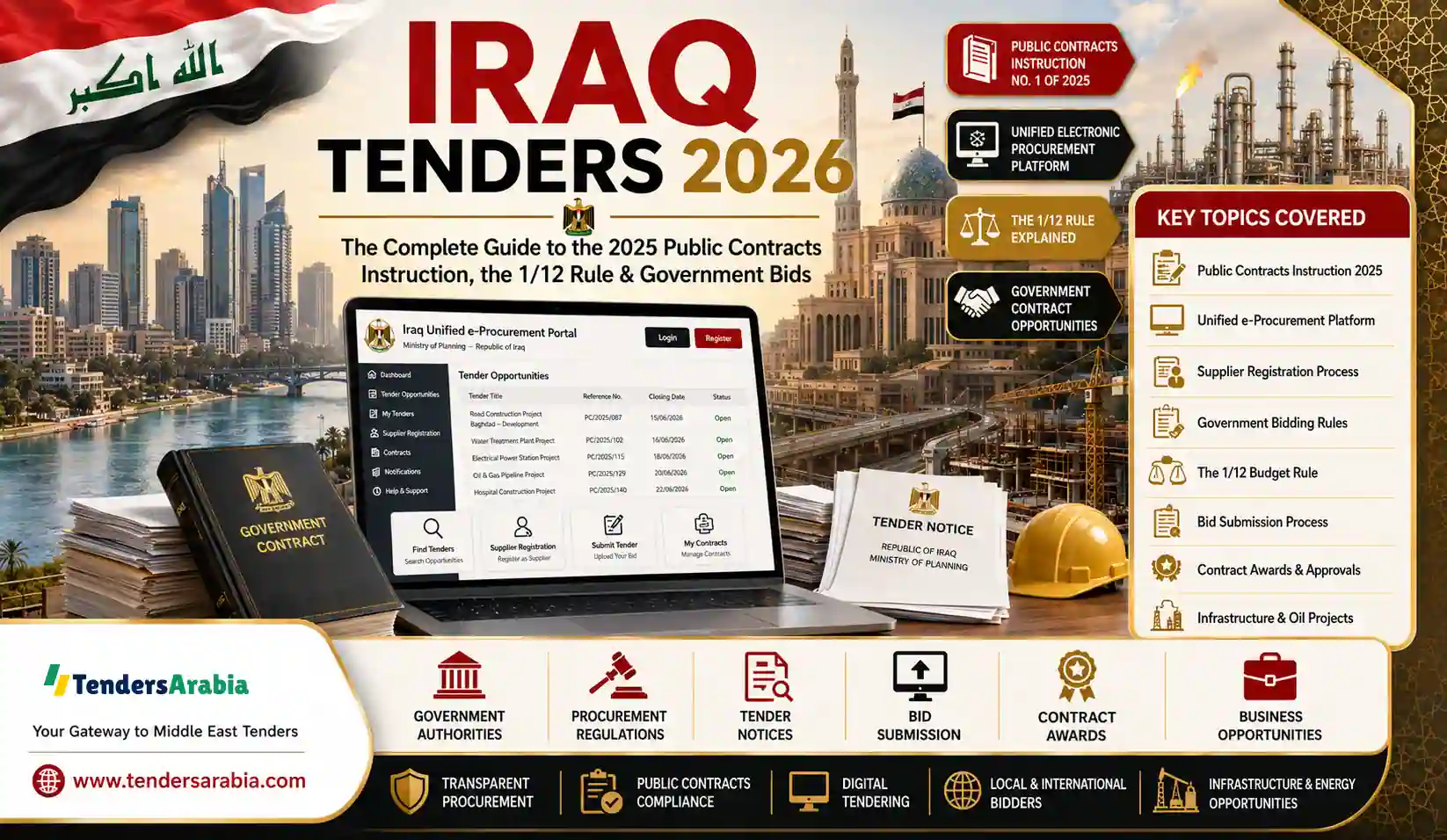
Iraq remains one of the Middle Easts most consequential and most operationally demanding public procurement markets. As OPEC's second-largest oil producer with a reconstruction and infrastructure agenda spanning power generation, healthcare, transport, water and housing, the scale of opportunity for contractors, suppliers and consultants is genuinely large. But 2026 has also brought two structural developments that any serious bidder must understand before committing resources to a tender: a fundamentally updated legal framework for public contracting and a deepening fiscal constraint that is actively freezing new project funding across federal ministries and provinces.
This guide has been researched and written for contractors, suppliers and consultants preparing to bid on مناقصات العراق (Iraq tenders) whether Iraqi companies based in Baghdad, Basra or the Kurdistan Region, regional suppliers from across the Arab world or international firms targeting Iraq's oil and gas, energy, healthcare and reconstruction sectors. It covers the new legal framework governing public contracts, the institutions and platform that administer it, the bidding procedures, foreign contractor requirements and critically the fiscal reality every bidder must verify before investing time in a bid, without referencing any specific live tender, since active opportunities change daily and should always be verified directly with the relevant authority.
Iraq's public procurement system underwent a genuine, substantive update with the introduction of the New Public Contracts Instruction No. 1 of 2025 (the "2025 Instruction"), issued by the Ministry of Planning following Council of Ministers approval on 3 June 2025 under Cabinet Decision No. 442 of 2025. The 2025 Instruction came into effect on 17 February 2026, replacing the previous Government Contracts Implementation Instruction No. 2 of 2014 (the "2014 Instruction"), which itself had succeeded the original Public Government Contracts Law No. 1 of 2008 framework that governed Iraqi contracting for many years prior.
A critical procedural point for any bidder to understand clearly: the 2025 Instruction has no retroactive effect. Contracts entered into while the 2014 Instruction was in force continue to be governed by that earlier framework for their full duration. The 2025 Instruction applies specifically to new tenders and contracts signed from 17 February 2026 onwards meaning bidders should always confirm explicitly which instruction governs a specific tender they are responding to, since the two frameworks differ in several material respects.
The 2025 Instruction has been described by legal practitioners advising on Iraqi government contracts as an evolution rather than a revolution building on, rather than wholly replacing, the principles established in 2014, with the explicit aims of improving transparency, efficiency and consistency in how Iraq's public bodies award and manage contracts. The reform is governed by familiar international procurement principles competitive bidding, transparency, equal treatment and value for money with anti-corruption oversight embedded through the Board of Supreme Audit and the Commission of Integrity.
It is also important to understand what the 2025 Instruction does not cover. The Instruction applies to contracts with government entities for public works and construction, consultancy services and the supply of goods and services. It explicitly excludes public companies executing purely internal government projects and excludes Ministry of Defence and security agency contracts relating to the supply of security and military equipment, devices or related training these categories continue to be handled through entirely separate channels.
One of the most significant features of the 2025 Instruction is the introduction of a unified electronic platform for tender announcements, administered by the Ministry of Planning. Invitations to tender are sent to approved companies that are registered on this unified electronic platform, while opportunities are also made available to the general public through publication on the public procurement portal and in newspapers preserving a degree of traditional public notice alongside the new digital infrastructure.
Alongside the platform itself, the Ministry of Planning's General Government Contracts Department has issued an active and ongoing stream of supporting circulars and controls throughout 2025 and into 2026 that materially affect how contracts are implemented in practice, including: a circular on the withdrawal of work from underperforming contractors and the conditions for re-tendering or reassignment; a mechanism for calculating late delivery penalties, introduced in September 2025; a clearer process, introduced in February 2025, for vetting foreign and Arab companies before contracting with Iraqi public entities, including compliance checks against Iraq's company blacklist; and, from September 2025, a digital query platform allowing contracting entities to check a company's blacklist and compliance status online in real time. Contractors should treat these circulars as a live, evolving compliance environment rather than a fixed rulebook staying current with Ministry of Planning announcements is now a genuine operational requirement, not an occasional check-in.
The 2025 Instruction establishes four principal methods through which Iraqi public entities can procure goods, works and services:
The 2025 Instruction maintains a tiered approval structure based on contract value and understanding this hierarchy is essential for realistic project planning, since each tier carries a materially different approval timeline:
For contractors evaluating whether to pursue a major contract, this tiered structure is a direct, practical input into project planning: the larger the contract value, the longer and more administratively layered the path to final award and execution authorisation is likely to be.
The 2025 Instruction sets out detailed contract administration procedures that materially affect risk allocation between Iraqi contracting authorities and their contractors or consultants:
Iraq imposes no general restriction preventing foreign entities from doing business in the country and foreign contractors and suppliers generally do not need to be separately registered with the Ministry of Planning simply to bid. However, to sign and execute a contract, a foreign entity must either open a branch in Iraq or incorporate an Iraqi company which the foreign parent may own up to 100 percent of. A representative office is explicitly not sufficient for this purpose and must be converted into a full branch before contracting can proceed.
Foreign and Arab companies should also expect to be vetted against Iraq's compliance and blacklist framework before being permitted to contract with a public entity a process formalised through February 2025 circulars and now supported by a digital query platform, launched in September 2025, that allows contracting authorities to check a company's status in real time.
Currency requirements are an important and frequently underestimated practical detail: government contract transactions in Iraq must generally be executed in Iraqi Dinars (IQD) unless backed by an external letter of credit, reflecting the country's broader de-dollarisation policy. International bidders should factor this directly into their financial planning and currency risk management from the outset of bid preparation.
Financial guarantees carry real consequences for non-performance: if a winning bidder refuses to sign a contract within 15 days of a valid offer being accepted, the penalty is forfeiture of the 1 percent preliminary (bid) guarantee, alongside the possibility of further legal action for additional damages. In cases of delayed or non-performance during contract execution, the contracting Iraqi entity can request that the defaulting contractor or supplier be added to the Ministry of Planning's blacklist and being blacklisted bars a company from any future government business for a minimum of two years.
For any contractor bidding on Iraqi government tenders, no legal framework matters more practically than understanding Iraq's current fiscal constraint and the situation is materially more serious and more prolonged, than a brief transitional gap between budgets.
Under Article 13 of the amended Federal Financial Management Law No. 6 of 2019, when no annual federal budget law has been approved, the Minister of Finance is empowered to authorise ministries and non-ministerial entities to spend only up to one-twelfth (1/12) per month of their actual baseline current expenditure from the previous fiscal year. This is what is widely referred to as the "1/12th Rule," and as of early 2026, Iraq is operating under this mechanism for the second consecutive year a sustained fiscal constraint, not a brief procedural gap.
The practical funding distinction for bidders is precise and consequential:
The real-world consequences of this prolonged constraint are well documented and significant. Contractors working for the Projects Directorate of the Baghdad Municipality have stopped work entirely due to lack of financing, directly affecting service levels in the capital. In Basra and Nineveh provinces, water treatment upgrades, school rehabilitation, electricity works and road projects remain suspended. Several economists and parliamentary finance committee members have warned that some companies and contractors have already declared bankruptcy or begun liquidating assets due to unpaid government dues stemming from the absence of an approved budget and that even payments to international oil companies have been postponed and field-development plans slowed as a direct consequence.
Practical advice for bidders: Before committing resources to any new Iraqi tender, RFP or RFQ, explicitly verify whether funding is confirmed from a secured prior-year allocation or existing contractual commitment or whether the project depends on fresh budget allocation that has not yet been approved. Given the prolonged nature of this constraint, contractors should also consider structuring proposed contracts with phasing arrangements aligned to realistic funding cycles and should seek to include budget contingency clauses addressing what happens if allocation is delayed a precaution that has become standard practice among experienced bidders in the current environment rather than an unusual request.
Iraq's procurement landscape spans the oil and gas sector, central ministries, state-owned enterprises and a substantial international donor and humanitarian presence. A comprehensive directory of these issuing authorities is maintained on TendersArabia's authority listings, but the following reflects the principal categories of buyer that contractors and suppliers should track.
Oil and Gas Sector Iraq's Most Active Procurement Source
Key Government Ministries
State Companies and Public Entities
International and Development Organisations Operating in Iraq
Donor-funded projects financed by institutions such as the World Bank, UNDP and UNOPS generally follow those institutions' own international procurement rules rather than the 2025 Instruction directly and notably tend to be far less exposed to the 1/12th Rule constraint described above, since their funding originates outside Iraq's federal budget cycle an important distinction for contractors seeking more predictable, less fiscally constrained opportunities in the current environment.
A distinction every bidder must understand clearly: federal Iraq tenders are governed by the Public Contracts Instruction No. 1 of 2025 and administered through the Ministry of Planning's unified electronic platform. The Kurdistan Regional Government (KRG), covering the provinces of Erbil, Sulaymaniyah and Dohuk, maintains an entirely separate procurement framework with its own approval thresholds and procedures, distinct from the federal system. Contractors and consultants targeting opportunities in the Kurdistan Region should not assume that federal registration, classification or compliance status automatically extends to KRG tenders these require separate engagement with the relevant regional authority.
Search behaviour among procurement professionals tracking the Iraqi market reflects both the country's bilingual administrative environment and the practical reality that local and international bidders tend to search quite differently. In English, search activity clusters around terms including Iraq tenders, Iraq government tenders, Iraq public procurement, Iraq construction tenders, Iraq RFP, Iraq RFQ, Iraq eprocurement and increasingly specific terms tied to the current regulatory and fiscal environment such as Iraq Public Contracts Instruction 2025 and Iraq 1/12 budget rule. Long-tail variants frequently reference specific authorities or regions directly Ministry of Oil Iraq tenders, Basra Oil Company tenders, Kurdistan Regional Government tenders, Erbil tenders reflecting that experienced bidders increasingly search by sector or region once they understand Iraq's fragmented institutional landscape.
In Arabic, the dominant search term is مناقصات العراق (Iraq tenders), with closely related variants including مناقصات حكومية العراق (Iraq government tenders) and مناقصات وزارة النفط العراقية (Iraq Ministry of Oil tenders) reflecting the outsized importance of the petroleum sector in Iraqi procurement search behaviour specifically. Local Iraqi contractors predominantly search using these Arabic terms, while international suppliers and consultants tend to default to English search terms, often appended with the specific authority or region name once they have identified Iraq as a target market.
Successfully navigating Iraq's procurement market requires monitoring several genuinely distinct channels at once the Ministry of Planning's unified electronic platform for federal tenders, the Kurdistan Regional Government's entirely separate system, the oil and gas sector's own company-level tendering processes and the substantial volume of donor-funded opportunities from UN agencies and international NGOs that follow their own procurement rules and are largely insulated from the 1/12th Rule constraint. For businesses without an established in-market presence, tracking this fragmented landscape consistently while also staying current on funding status and the evolving compliance circulars described above represents a genuine and ongoing operational challenge.
TendersArabia addresses this by aggregating tenders from all major Iraqi authorities, oil companies, governorates, the Kurdistan Regional Government and international donors into a single, daily-updated platform. We provide bilingual Arabic and English tender summaries, authority and region-specific alerts (Baghdad, Basra, Erbil, Mosul and beyond), full document access and contract award intelligence helping you focus on bidding and winning rather than searching multiple fragmented sources every day.
Q1. What is Iraq's New Public Contracts Instruction No. 1 of 2025 and when does it apply?
The 2025 Instruction is Iraq's updated public procurement framework, issued by the Ministry of Planning following Council of Ministers approval on 3 June 2025 and it came into effect on 17 February 2026, replacing the 2014 Instruction. It has no retroactive effect: contracts signed under the 2014 Instruction continue to be governed by it, while the 2025 Instruction applies to new tenders and contracts signed from 17 February 2026 onwards.
Q2. What is the unified electronic platform for Iraqi tenders?
The 2025 Instruction introduced a unified electronic platform, administered by the Ministry of Planning, through which approved and registered companies receive direct tender invitations, while opportunities are also published more broadly on the public procurement portal and in newspapers for general public access.
Q3. What procurement methods are available under the 2025 Instruction?
The 2025 Instruction provides for four methods: Limited Tender (minimum two qualified participants invited), Two-Stage Tender (technical solutions first, then commercial bids from at least two qualified parties), Direct Invitation (minimum three pre-qualified bidders, used for confidential, strategic or previously unsuccessful tenders) and Single Invitation (Central Committee approval required, used for OEM limitations, state security contracts or emergencies).
Q4. What is the "1/12th Rule" and how does it affect bidding on Iraq tenders?
Under Article 13 of the amended Federal Financial Management Law No. 6 of 2019, when no annual budget is approved, ministries may spend only one-twelfth of the previous year's actual expenditure per month, covering salaries, operational costs, existing contractual commitments and debt service only. New capital projects and new contract awards requiring fresh budget allocation are not fundable under this rule. Iraq is operating under this constraint for the second consecutive year and contractors should verify a project's funding status before investing in bid preparation.
Q5. What are the contract value approval tiers under Iraqi procurement rules?
Minor contracts below IQD 50 million can be approved at department head level; medium contracts between IQD 50 million and IQD 1 billion require Director General approval; major contracts above IQD 1 billion require Minister-level or Council of Ministers approval, a process that adds considerable time and complexity to the award timeline.
Q6. Can foreign companies bid on and execute Iraqi government contracts?
Yes. Foreign entities generally do not need separate Ministry of Planning registration simply to bid, but to sign and execute an awarded contract, a foreign company must open a branch in Iraq or incorporate a wholly or partly owned Iraqi company a representative office alone is not sufficient. Foreign and Arab companies are also vetted against Iraq's compliance and blacklist framework before contracting and government contract payments must generally be made in Iraqi Dinars unless backed by an external letter of credit.
Q7. What happens if a winning bidder refuses to sign an awarded Iraqi government contract?
If a winning bidder refuses to sign within 15 days of a valid offer being accepted, the 1 percent preliminary (bid) guarantee is forfeited and further legal measures may be pursued for additional damages. Separately, in cases of delayed or non-performance during contract execution, a contractor can be added to the Ministry of Planning's blacklist, which bars the company from any future government business for a minimum of two years.
Q8. Are Kurdistan Regional Government (KRG) tenders the same as federal Iraq tenders?
No. The Kurdistan Regional Government, covering Erbil, Sulaymaniyah and Dohuk, maintains an entirely separate procurement framework with its own approval thresholds and procedures, distinct from the federal Public Contracts Instruction No. 1 of 2025 and the Ministry of Planning's unified electronic platform. Bidders targeting the Kurdistan Region must engage with the KRG's own system directly.
Iraq's government procurement market sits at an unusual intersection: a genuinely modernised legal framework the Public Contracts Instruction No. 1 of 2025, with its unified electronic platform, clearer variation and suspension rules and quantified contractor protections operating alongside a deepening fiscal constraint that has frozen new project funding across federal ministries and provinces for a second consecutive year. Success in this market depends on understanding both halves of that picture equally: the procedural detail of the new Instruction and the hard fiscal reality of the 1/12th Rule that determines whether a technically excellent bid can actually be paid for.
For contractors, suppliers and consultants Iraqi, regional or international a systematic approach to platform registration, legal entity establishment, compliance vetting and rigorous funding verification before bid submission is the foundation of sustainable participation in one of the Middle East's most significant and most fiscally complex, public procurement markets.
Ready to explore opportunities in Iraq? Register now or Subscribe for premium access and daily alerts.
This guide is intended for informational purposes only. Always verify current registration requirements, the applicable legal instruction, project funding status and specific tender conditions directly with the Ministry of Planning's General Government Contracts Department, the relevant Kurdistan Regional Government authority where applicable and qualified legal counsel familiar with Iraqi procurement law before submitting any bid.