Complete Guide...
October 15, 2026

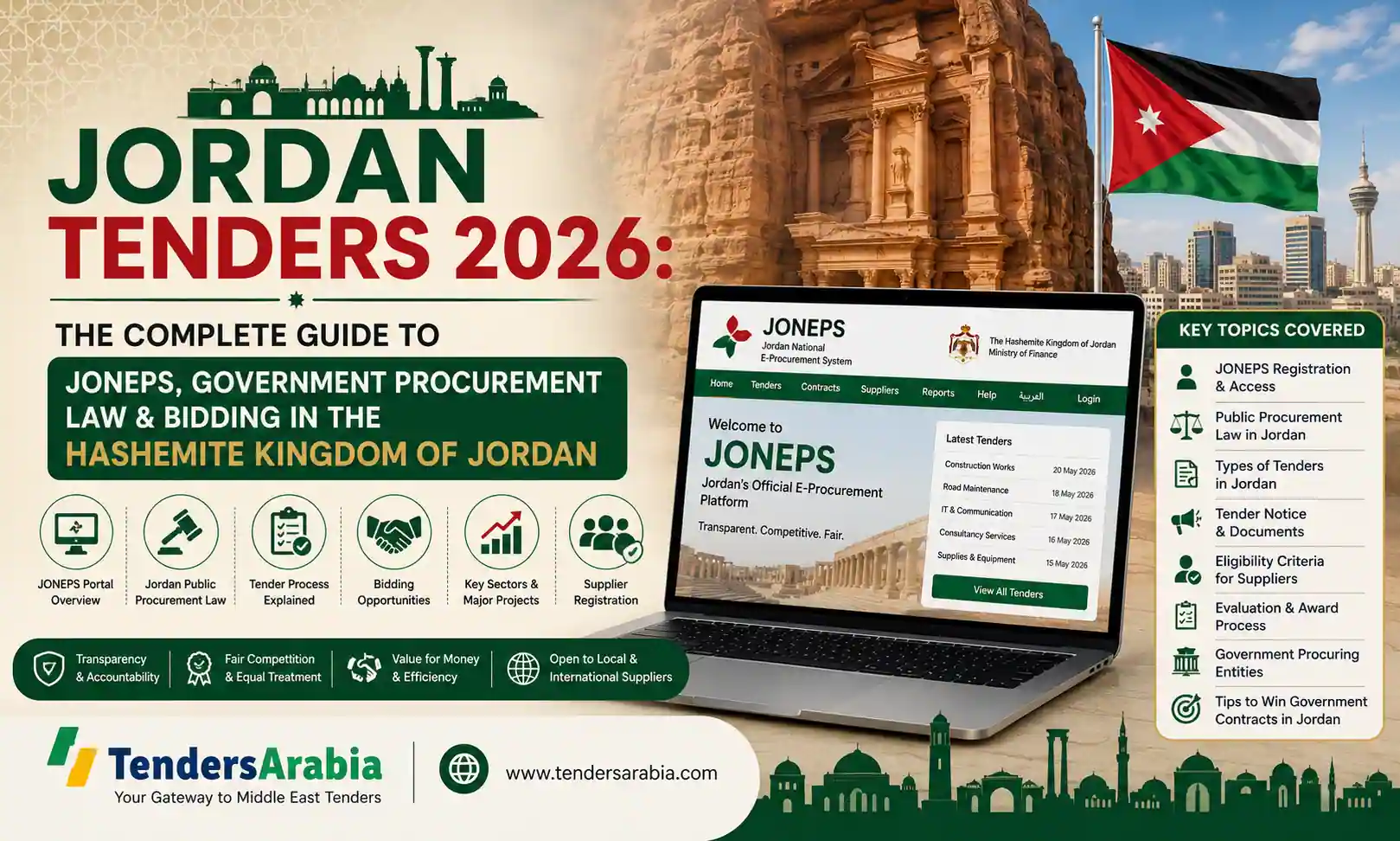
Jordan occupies a distinctive position among Levant and Middle East procurement markets. As a lower middle-income economy with a sustained reform agenda backed by the World Bank, the European Bank for Reconstruction and Development and other multilateral partners, the Hashemite Kingdom has spent the past several years systematically modernising its public procurement system culminating in a unified electronic platform, a consolidated legal framework and an increasingly assertive policy of channelling government contracts toward Jordanian micro, small and medium enterprises (MSMEs). For contractors, suppliers, consultants and international firms evaluating Jordanian government tenders, understanding this reform driven, institutionally structured environment is the foundation of every successful bid.
This guide has been researched and written for businesses preparing to bid on مناقصات الأردن (Jordan tenders) whether Jordanian companies seeking to understand the classification and registration process, regional suppliers from across the Levant and GCC exploring cross-border opportunities or international firms targeting Jordan's construction, water, energy, health, education and donor funded infrastructure sectors. It covers the legal framework governing public procurement, the institutions that administer it, the registration and classification process, the social and MSME policy objectives embedded in the law and the practical realities of bidding without referencing any specific live tender, since active opportunities change daily and should always be verified directly on the official JONEPS platform.
Public procurement law in Jordan is primarily governed by Government Procurement Bylaw No. 8 of 2022 and its accompanying Instructions for Regulating Government Procurement Procedures (2022). This bylaw replaced the earlier Bylaw No. 28 of 2019, which had itself been a landmark reform at the time of its issuance unifying more than 50 separate regulations that had previously governed different aspects of public procurement across Jordanian government entities into a single, standardised framework.
The current legal architecture defines clear and standardised procedural requirements that every bidder should understand before preparing a submission: advertisement periods are explicitly defined for each procurement instruction, bid validity periods are standardised consistently across goods, works and services categories, mandatory standstill periods apply uniformly across all contract categories before a contract can be formally signed and complaints are required to be resolved within an average period of 25 days a relatively fast turnaround compared to many regional procurement systems, reflecting Jordan's broader transparency and accountability reform objectives.
The legal framework also explicitly addresses procedures for emergency procurement and importantly, explicitly excludes certain donor-funded projects from standard national procurement rules where an agreed framework with the relevant funding institution applies. This is a critical practical point: government-funded projects financed by multilateral lending institutions such as the World Bank and the European Bank for Reconstruction and Development (EBRD) are typically conducted according to those funding agencies' own procurement regulations rather than purely under Bylaw No. 8 of 2022 meaning international firms targeting donor-funded Jordanian infrastructure should familiarise themselves with both the national framework and the specific funding agency's procurement guidelines for any given project.
Jordan's public procurement system operates through two principal central purchasing bodies, each with clearly defined and distinct mandates, supported by a growing set of dedicated oversight institutions established through Jordan's procurement reform programme:
Together, GTD and GPD function as central purchasing bodies with nationwide coverage, spanning sector wide responsibilities across agriculture, health, education, transport, water, energy, information and communications technology, public administration and social protection. Notably, the Jordanian Armed Forces (JAF) maintains its own separate procurement offices and holds sole jurisdiction over defence related procurement and sales to Jordan meaning defence sector suppliers must engage directly with JAF procurement channels rather than through GTD, GPD or JONEPS.
Beyond these two central bodies, Jordan's procurement reform programme has established a deliberate institutional architecture for policy oversight and dispute resolution:
JONEPS (the Jordan Online E-Procurement System), accessible at joneps.gov.jo, is Jordan's government-owned and operated digital procurement platform, originally launched in 2018 and substantially enhanced since the issuance of Bylaw No. 8 of 2022. JONEPS supports both Arabic and English languages and operates in multiple currencies including the Jordanian Dinar, US Dollar and Euro a notable feature reflecting Jordan's open posture toward both domestic and international bidder participation.
JONEPS is supported by the World Bank as part of Jordan's broader procurement modernisation programme, though it is important to note that it is not itself used as a World Bank procurement system donor-funded projects governed by World Bank or other multilateral procurement rules remain a distinct category, as outlined above. The platform has been progressively deployed across government entities, with documented utilisation rising from 47 percent to full 100 percent utilisation for major construction project tenders following a structured technical assistance and training programme for central purchasing body staff a transformation that the Government Tenders Department itself has publicly credited with significantly improving the transparency and efficiency of Jordan's largest infrastructure tenders.
JONEPS supports a structured two-envelope system for construction and works procurement, consistent with international best practice: the first envelope contains technical offers, which are opened and evaluated first; only contractors who pass technical evaluation proceed to the second stage, where their financial offers submitted in an encrypted format to maintain data security are subsequently opened and compared. Bidders who fail technical evaluation are given a defined window of five working days to raise formal objections before the financial envelopes of the remaining qualified contractors are opened, providing a transparent and auditable checkpoint within the evaluation process.
Before any company can participate in construction-related government tenders in Jordan, it must obtain a Contractor Classification Certificate issued by the Government Tenders Department. This certificate is the formal credential that allows a contractor to participate in construction tenders published by public sector institutions, calibrated specifically to that company's financial, technical and administrative capacity.
The classification process, administered under the framework of the GTD and informed by the Construction Contractors Law No. 13 of 1987, involves the following key requirements and steps:
Given the breadth of categories, classes and specialisations covered under this system, prospective applicants should review the GTD's official guidance carefully, as each specific category and specialisation carries its own particular documentation and eligibility nature that must be addressed precisely in the application.
One of the most significant and increasingly emphasised features of Jordan's modern procurement system is its explicit social and economic inclusion policy. Bylaw No. 8 of 2022 and its associated reform programme embed specific, quantified targets and mechanisms designed to channel public procurement spending toward underrepresented groups and smaller Jordanian businesses:
This policy framework is reinforced by practical, data-driven observations from Jordan's own procurement reform programme: the average value of individual contracts awarded to MSMEs has historically been relatively modest around JOD 10,000 per contract and a core objective of current reforms is to enable MSMEs to access larger contracts, thereby supporting their growth and job creation potential. Reform measures supporting this objective include mandatory MSME registration initiatives, the establishment of dedicated JONEPS alerts for upcoming opportunities relevant to MSMEs, active promotion of joint ventures and subcontracting arrangements that allow smaller firms to participate in larger contracts and ongoing work to integrate a formal MSME definition directly into the JONEPS platform so that MSME participation and contract awards can be properly tracked, monitored and publicly disclosed.
Jordan has also approved a green procurement policy, with active work underway to integrate green procurement criteria into Standard Procurement Documents for both works and goods categories an emerging consideration for suppliers in construction materials, energy efficiency and sustainable goods categories looking ahead to Jordan's procurement priorities through the remainder of the decade.
Jordan's public procurement market spans a genuinely broad range of contract types and sectors, reflecting the country's role in implementing infrastructure projects, delivering essential public services and supporting economic stability across key social and productive sectors:
It is worth noting explicitly that domestic Jordanian suppliers account for the majority of contract awards, while international participation tends to be more limited and is typically linked to specialised technical requirements or donor supported contracts where international competitive bidding is part of the funding agency's procurement rules. For foreign companies, working with a local Jordanian partner is generally recommended as a practical market entry strategy and foreign companies can bid for government-commissioned programmes specifically slated for international or mixed bidders.
Based on Jordan's published procurement framework and institutional guidance, businesses preparing to bid on Jordan government tenders should expect the following core considerations:
Search behaviour among procurement professionals tracking the Jordanian market reflects both Jordan's bilingual administrative environment and the structured, donor-engaged nature of its contractor and supplier base. In English, search activity clusters around terms including Jordan tenders, Jordan government tenders, JONEPS, Jordan eProcurement, Jordan Tenders Department, GTD Jordan, Jordan RFP, Jordan EOI, Jordan tender registration, Jordan contractor classification, and increasingly specific terms such as Jordan Bylaw 8 of 2022 and Jordan procurement complaints committee reflecting a search population that includes legal and compliance professionals researching Jordan's reform-driven regulatory environment in detail, alongside contractors and suppliers searching directly by procuring entity once they understand the GTD/GPD institutional split.
In Arabic, the dominant search term is مناقصات الأردن (Jordan tenders), with closely related variants including مناقصات حكومية الأردن (Jordan government tenders), دائرة المشتريات الحكومية (Government Procurement Department), دائرة العطاءات الحكومية (Government Tenders Department), تصنيف المقاولين الأردن (Jordan contractor classification) and نظام الشراء الحكومي الأردن (Jordan's government procurement system). A distinguishing feature of Jordanian tender search behaviour relative to some neighbouring Gulf markets is the relatively higher visibility of MSME and donor-funding-related search terms, reflecting both Jordan's active reform discourse and the genuine prominence of multilaterally financed projects within its overall public procurement landscape.
Successfully participating in Jordan's tender market requires monitoring several distinct channels simultaneously the central JONEPS platform covering both GTD works tenders and GPD/GSD goods and services procurement, the Jordanian Armed Forces' separate defence procurement channel and the distinct procurement rules that frequently apply to donor-funded infrastructure projects financed by the World Bank, EBRD and other multilateral institutions. For businesses without an established in-market presence, tracking this layered landscape consistently while also staying current on Jordan's actively evolving MSME, classification and green procurement reforms represents a genuine and ongoing operational challenge.
TendersArabia addresses this by aggregating tender notices, RFPs, RFQs, EOIs and contract award information from across Jordan's government and donor-supported procurement landscape into a single, searchable, regularly updated platform alongside equivalent coverage across the wider Levant, GCC and Arab world. For businesses evaluating Jordan alongside other regional markets, this comparative visibility allows a single bid management team to track opportunities across multiple jurisdictions without separately learning and monitoring each country's distinct institutional architecture, classification systems and donor-funding nuances.
Q1. What is the main law governing government tenders in Jordan?
Public procurement in Jordan is governed primarily by Government Procurement Bylaw No. 8 of 2022 and its accompanying Instructions for Regulating Government Procurement Procedures (2022). This bylaw replaced the earlier Bylaw No. 28 of 2019, which had itself unified more than 50 separate procurement regulations into a single framework. The current bylaw standardises advertisement periods, bid validity, standstill periods and sets an average complaint resolution period of 25 days.
Q2. What is JONEPS and how do I register on it?
JONEPS (the Jordan Online E-Procurement System), accessible at joneps.gov.jo, is Jordan's government-owned digital procurement platform, launched in 2018 and supporting both Arabic and English in multiple currencies including JOD, USD and EUR. Companies register directly on the platform to access published tenders, download Standard Bidding Documents and submit technical and financial bids electronically. JONEPS now operates at full utilisation for major construction tenders following Jordan's procurement modernisation programme.
Q3. What is the difference between the Government Tenders Department (GTD) and the Government Procurement Department (GPD)?
The GTD, operating under the Ministry of Public Works and Housing, is responsible for major public works and centralised construction tenders and administers the mandatory contractor classification system. The GPD, operating under the Ministry of Finance, is responsible for the procurement of goods and services. Both function as central purchasing bodies with nationwide, sector-wide coverage, while the Jordanian Armed Forces maintains entirely separate procurement jurisdiction for defence-related contracts.
Q4. How do I obtain a contractor classification certificate in Jordan?
Apply to the Government Tenders Department with proof of active Jordanian Contractors Association membership and a valid licence under Construction Contractors Law No. 13 of 1987. The application is reviewed for completeness, then presented to a multi-disciplinary classification committee chaired by the GTD Director General. The process typically takes about two weeks for complete applications and the resulting certificate issued free of charge and approved by the responsible Minister remains valid for three years.
Q5. What is the two-envelope system used in Jordan's construction tenders?
Jordan's works tenders processed through JONEPS use a two-envelope system: the first envelope contains technical offers, evaluated first; contractors who fail this evaluation have five working days to raise a formal objection. Only technically qualified bidders proceed to the second envelope, where encrypted financial offers are opened and compared a structure designed to maintain transparency, data security and a fair, auditable evaluation sequence.
Q6. Are there special provisions for MSMEs and women-owned businesses in Jordan's procurement system?
Yes. Jordan's procurement framework includes explicit minimum award targets of 2% for women-owned businesses and 1% for businesses owned by disadvantaged groups, alongside a 15% local sourcing requirement for core components in qualifying categories. Reform initiatives further support MSME participation through mandatory registration, dedicated JONEPS alerts, promotion of joint ventures and subcontracting and ongoing integration of a formal MSME definition into the JONEPS platform for tracking and disclosure purposes.
Q7. Can foreign companies bid on Jordan government tenders and is a local partner required?
Foreign companies can bid on government-commissioned programmes specifically open to international or mixed bidders, though working with a local Jordanian partner is generally recommended as a practical market entry approach. Domestic suppliers account for the majority of contract awards, while international participation is typically more limited and often linked to specialised technical requirements or donor-funded contracts governed by the relevant multilateral institution's own procurement rules.
Q8. What happens if I want to file a complaint about a Jordan tender process?
Jordan established a Public Procurement Complaints Review Committee in 2023 specifically to decide on bidders' complaints and other stakeholder grievances. The Committee was restructured in 2025 to include private sector representatives for the first time and the procurement framework sets an average complaint resolution period of 25 days giving bidders a relatively fast, increasingly balanced avenue for resolving procurement disputes.
Jordan's government procurement market reflects one of the more deliberate, reform-driven transformations in the Middle East procurement landscape moving from a fragmented set of more than 50 separate regulations to a unified bylaw, from partial to full JONEPS utilisation on major construction tenders and from an absence of dedicated complaint and policy oversight bodies to an actively functioning Public Procurement Policy Unit and a privately-represented Complaints Review Committee. For contractors, suppliers and consultants, success in this market depends on understanding the institutional split between GTD and GPD, securing the correct contractor classification where applicable, registering properly on JONEPS and building a genuine awareness of the MSME, local content and donor-funding considerations that increasingly shape how contracts are awarded.
For businesses Jordanian, regional or international a systematic approach to classification, JONEPS registration and continuous tender monitoring across both the national procurement framework and Jordan's donor-funded project pipeline is the foundation of sustainable, long-term participation in this steadily modernising public procurement market.
This guide is intended for informational purposes only. Always verify current classification requirements, JONEPS registration procedures and specific tender conditions directly with the Government Tenders Department, the Government Procurement Department, the JONEPS platform and qualified legal counsel familiar with Jordanian procurement law before submitting any bid.