
Complete Guide...
October 15, 2026

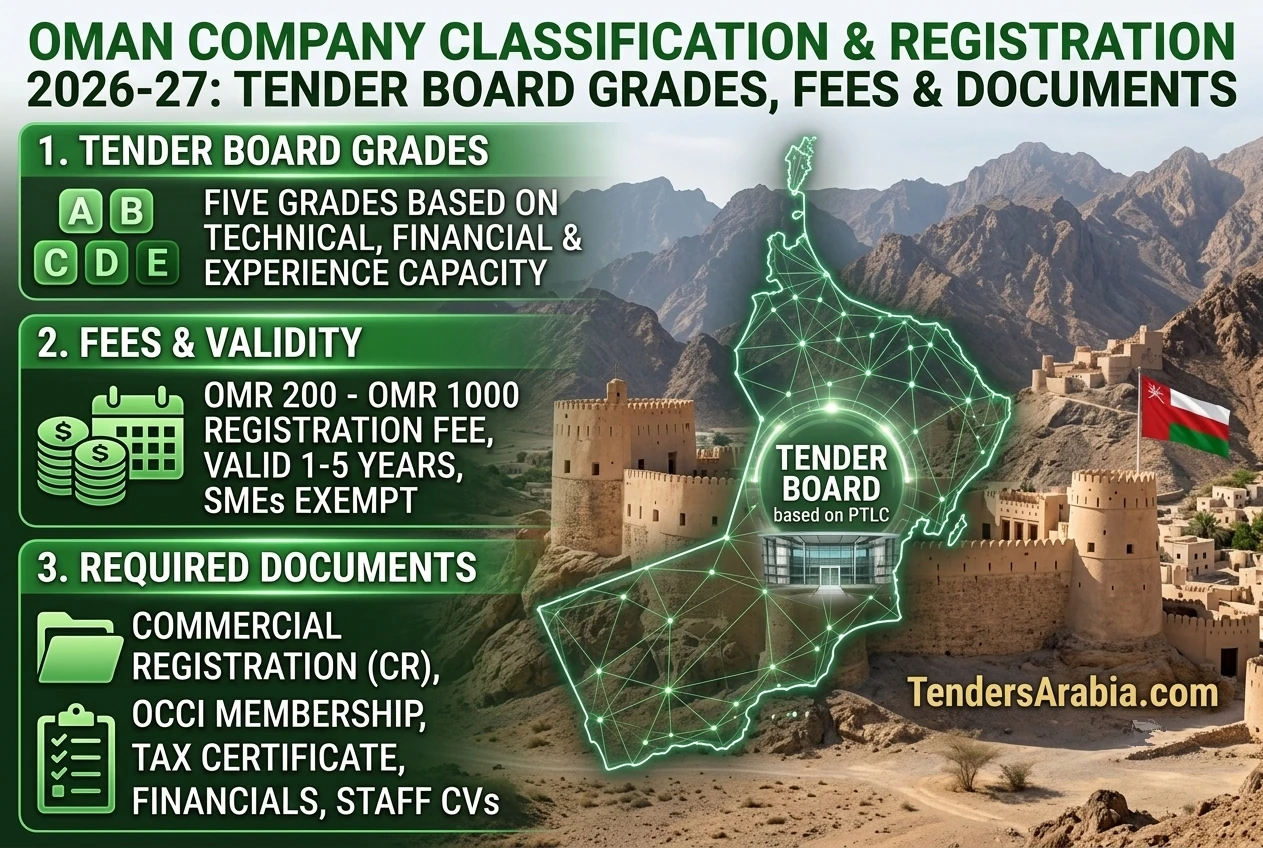
Company classification and registration with the Tender Board is the single most important prerequisite for any business seeking to win government contracts in Oman. Without a valid classification grade, a company cannot bid for graded tenders. Without active registration on the Isnad platform, it cannot access tender documents or submit bids electronically. The classification system determines the size and value of the projects a company is eligible to compete for, while registration ensures that the company's documents and credentials are verified and maintained in the government's approved supplier database. Together, these two processes form the gateway to Oman's public procurement market.
This guide provides a complete explanation of the company classification and registration system in Oman. You will learn about the legal framework established by Ministerial Decision 104/2022, the classification grades and their requirements, the step-by-step process for applying, the documents you must prepare, the fees involved, and the special provisions available to small and medium enterprises. Whether you are registering a new company for the first time or renewing an existing classification, this article gives you the practical knowledge needed to navigate the process efficiently and avoid the delays that can hold back your bidding plans.
Company classification and registration is the process by which the Projects, Tenders and Local Content Authority (PTLC), formerly the Tender Board, evaluates a supplier's, contractor's, or consulting office's technical, financial, and administrative capacity and assigns it a specific grade and sector. The classification certificate issued by the Authority is the document that enables a company to compete for government project and procurement tenders.
The system operates in two connected stages. Classification determines the sector and grade for which the company qualifies, based on its capabilities and experience. Registration then enters the company into the official register maintained by the Authority, confirming that its documents and credentials meet the required standards. Both stages are governed by Ministerial Decision 104/2022, which issued the regulatory framework for the classification and registration of suppliers, contractors, and consulting offices.
The classification and registration system is based on the concept of Al Tasnif wa Al Tasjil, which is defined as the field and grade prescribed for entry in the register of suppliers, contractors, and consulting offices at the General Secretariat. The certificate issued by the Secretariat is the official document that allows the holder to compete for government project and procurement tenders.
Ministerial Decision 104/2022 was issued on 12 December 2022 by the Tender Board, under the authority of the Tender Law (Royal Decree 36/2008) and its Executive Regulations. The decision replaced the earlier Decision 2/91 and introduced a comprehensive regulatory framework for the classification and registration of suppliers, contractors, and consulting offices in Oman.
The decision consists of four articles. Article One adopts the attached regulatory framework. Article Two requires all suppliers, contractors, and consulting offices to bring their status into compliance with the new regulations within six months of the framework coming into effect. Article Three repeals the previous Decision 2/91 and any provisions that conflict with the new framework. Article Four provides for publication in the Official Gazette and sets the effective date six months after publication.
The regulatory framework attached to the decision is divided into chapters covering definitions and general provisions, classification and registration procedures, and the obligations of registered entities. It establishes the Department of Registration and Evaluation within the General Secretariat as the body responsible for processing classification and registration applications.
| Aspect | Details |
|---|---|
| Legal Basis | Royal Decree 36/2008 (Tender Law) and its Executive Regulations |
| Decision Number | Ministerial Decision 104/2022 |
| Issuing Authority | Tender Board (now Projects, Tenders and Local Content Authority) |
| Date of Issue | 12 December 2022 |
| Effective Date | Six months after publication in the Official Gazette |
| Repealed Decision | Decision 2/91 |
Oman's classification system assigns companies to one of five grades based on their technical capability, financial capacity, and past experience. The grade determines the maximum value and complexity of the tenders a company is eligible to bid for. Higher grades qualify companies for larger and more complex projects, while lower grades are reserved for smaller or less specialised contracts.
| Grade | Arabic | Typical Eligibility |
|---|---|---|
| Excellent | الممتازة | Largest and most complex projects; highest technical and financial capacity requirements |
| First | الأولى | Large-scale projects; substantial technical staff, equipment, and financial resources |
| Second | الثانية | Medium to large projects; moderate technical and financial capacity |
| Third | الثالثة | Small to medium projects; basic technical and financial capacity |
| Fourth | الرابعة | Smallest projects; minimum requirements, primarily OCCI membership |
For companies licensed in accordance with the Foreign Capital Investment Law, classification and registration are limited to the Excellent and First grades only. This restriction means that foreign investment companies cannot be classified below First grade, reflecting the higher expectations for foreign entities operating in Oman.
To maintain their grade, companies must continue to meet the requirements of that grade throughout the registration period. The Department of Registration and Evaluation reviews compliance and can adjust a company's grade if its capabilities no longer match the requirements.
Classification is sector-specific. A company is classified not only by grade but also by the sectors and sub-sectors in which it is eligible to operate. Companies must register in each sector they wish to bid in, and separate fees apply for additional fields or sub-sectors.
| Main Sector | Sub-Sectors |
|---|---|
| Urban Contracting and Maintenance | Buildings, housing, public facilities, maintenance works |
| Port Contracting | Port infrastructure, marine works, terminal operations |
| Roads and Bridges | Highways, bridges, interchanges, road maintenance |
| Railways and Dams | Rail infrastructure, dam construction, water management |
| Pipeline Networks and Well Drilling | Oil and gas pipelines, water networks, well drilling |
| Electromechanical Contracting | Electrical systems, mechanical installations, HVAC |
| Communications and Maintenance | Telecommunications infrastructure, network maintenance |
| Consulting and Professional Offices | Engineering consultancy, architectural services, project management |
| Public Service | Facility management, cleaning, catering, security services |
| Information Technology Services | Software development, IT infrastructure, digital transformation |
| Supplies | Goods, equipment, materials, medical supplies, vehicles |
The registration steps are shared across all urban contracting, maintenance, electromechanical, communications, port, road, bridge, railway, pipeline network, and well drilling sub-sectors. Companies select the main sector and then the specific sub-sectors in which they wish to be registered.
The classification and registration regulations apply to suppliers, contractors, and consulting offices licensed in Oman. They do not apply to foreign companies and institutions whose competition is limited to international tenders under the Tender Law.
Two important categories receive equal treatment with Omani companies under the regulations:
These entities are treated as Omani companies for the purposes of classification and registration, provided they meet the applicable requirements.
Global companies registered in Oman's special economic zones or free zones are treated as foreign companies when conducting any business in Oman outside the scope of the special economic zone or free zone. This distinction is important for companies operating in zones such as Duqm, Sohar, or Salalah that wish to bid for tenders outside their zone.
The documents required for classification and registration vary depending on the grade and sector. Higher grades require more comprehensive documentation, while the Fourth grade has minimal requirements.
| Document | Excellent / First / Second / Third | Fourth Grade |
|---|---|---|
| Commercial Registration (CR) | Required; must be valid for at least 60 days at the time of application | Required |
| OCCI Membership Certificate | Required | Required |
| Tax Certificate | Required | Required |
| Technical Staff Attachments | Required; CVs, qualifications, and experience records of technical staff | Not required |
| Practical Experience Records | Required; evidence of completed projects | Not required |
| Financial Solvency Evidence | Required; audited financial statements | Not required |
For consulting offices, the required attachments include the OCCI membership certificate, tax card, and technical staff attachments. For contracting companies, the requirements extend to OCCI membership, tax card, technical staff attachments, practical experience records, and financial solvency evidence. The Fourth grade requires only the OCCI membership certificate.
The registration application must include the grade the applicant wishes to be classified and registered in, provided all conditions of that grade are met. The Department of Registration and Evaluation reviews the application and decides on it within fifteen working days from the date all required documents and data are completed.
The classification and registration process follows a defined sequence of steps, from initial application to certificate issuance. Understanding each step helps companies prepare thoroughly and avoid delays.
During the review process, the Department may request additional information or clarification. Companies should respond promptly to such requests to avoid delays in the processing of their applications.
Registration and renewal fees are determined by the company's classification grade and the number of sectors in which it is registered. The fees are set out in Decision 92/2019 and are payable in Omani Rials.
| Grade | Application Fee (OMR) | Additional Sub-Field Fee (OMR) | 1 Year (OMR) | 2 Years (OMR) | 3 Years (OMR) | 4 Years (OMR) | 5 Years (OMR) |
|---|---|---|---|---|---|---|---|
| Excellent | 10 | 5 | 200 | 400 | 600 | 800 | 1,000 |
| First | 10 | 5 | 150 | 300 | 450 | 600 | 750 |
| Second | 10 | 5 | 75 | 150 | 225 | 300 | 375 |
| Third | 5 | Not applicable | 50 | 100 | 150 | 200 | 250 |
| Fourth | 5 | Not applicable | 50 | 100 | 150 | 200 | 250 |
The application fee is payable when submitting the classification application. The registration fee is payable after approval, within thirty days of notification. Failure to pay within this period results in automatic cancellation of the application, and the application fee is not refunded.
Oman provides significant support to small and medium enterprises through the classification and registration system. SMEs holding a valid Riyada card from the Small and Medium Enterprises Development Authority benefit from fee exemptions and dedicated tender opportunities.
Key SME benefits include:
Approximately 2,400 SMEs with Riyada cards are registered with the Authority, including 1,600 micro-enterprises, 730 small enterprises, and 75 medium-sized enterprises. The PTLC has also introduced a comprehensive guide to assist SMEs in registering and utilizing the Isnad platform effectively.
Classification and registration certificates are issued for a specified period and must be renewed before expiry. The renewal process ensures that the company continues to meet the requirements of its grade and sector.
| Renewal Requirement | Details |
|---|---|
| Application Timing | Company must submit the renewal application at least one month before the certificate expires |
| Email Requirement | Company must have its own active email address |
| Data Accuracy Declaration | Company must declare the accuracy of the data submitted and maintain confidentiality of its information |
| Required Documents (Consulting) | OCCI membership certificate, tax card, technical staff attachments |
| Required Documents (Contracting) | OCCI membership certificate, tax card, technical staff attachments, practical experience records, financial solvency evidence |
| Fourth Grade Requirement | OCCI membership certificate only |
The renewal application is submitted through the Isnad platform. Companies should prepare their renewal documents well in advance to avoid any gap in their registration status, as an expired certificate prevents bidding on government tenders.
In addition to classification and registration, companies can register their products in the Mandatory List through the Isnad platform. The Mandatory List is a key component of Oman's local content policy, requiring government entities to procure certain products exclusively from local suppliers.
The General Secretariat of the Tender Board has issued the mandatory list, which in its first phase includes 9 categories of products: 57 items in construction materials, electrical materials, petroleum and chemical materials, oil equipment, iron and plastic equipment, food items, paper goods, and furniture.
Local companies can register products with national identity in the mandatory list through the Esnad platform. Small and medium enterprises with a Riyada card can also register their services in the mandatory list. Registration in the mandatory list provides local suppliers with exclusive access to government procurement for the listed products and services.
Companies frequently make errors during the classification and registration process that lead to delays, rejection, or cancellation. Being aware of these mistakes helps avoid them.
Navigating Oman's classification and registration system requires careful preparation, accurate documentation, and an understanding of the grade and sector requirements that apply to your business. TendersArabia.com provides specialised bid consultancy support through a team that understands the classification process, the documents required for each grade, and the practical steps needed to complete registration successfully. From advising on the appropriate grade and sector to reviewing your application documents before submission, the consultancy team helps suppliers, contractors, and consultants avoid the mistakes that cause delays and rejection.
Beyond consultancy, TendersArabia.com operates a comprehensive tender discovery platform that aggregates live opportunities from Oman and across the Arab region, including Saudi Arabia, the UAE, Qatar, Kuwait, and Bahrain. The platform provides tender alerts, document access, and market intelligence that help businesses identify relevant opportunities once their classification and registration are complete. Whether you are registering a new company, upgrading your classification grade, or renewing an existing certificate, TendersArabia.com offers the expertise and tools to support your success in Oman's public procurement market.
Ready to get classified and start bidding? Visit TendersArabia.com today to explore live Oman tenders, request classification and registration support, and get expert guidance on preparing your application for the Tender Board.
Company classification and registration is the essential first step for any business seeking to win government contracts in Oman. The system, governed by Ministerial Decision 104/2022, determines the sectors and grades in which a company can compete, and ensures that only qualified and verified suppliers have access to public tenders. From preparing the required documents and selecting the right grade to paying the registration fees and renewing before expiry, each step must be completed with care. SMEs with a Riyada card benefit from significant exemptions and dedicated opportunities, while foreign investment companies are limited to the Excellent and First grades. By understanding the classification system, preparing thoroughly, and using professional consultancy support where needed, suppliers, contractors, and consulting offices can secure their place in Oman's public procurement market and position themselves for long-term success.
Related Resources: This article is part of our comprehensive Oman Tenders guide series. Explore our detailed guides on the Isnad platform, registration and bid submission, the Tender Law, tender procedures, and JSRS registration to build a complete understanding of Oman's procurement system.


Company classification and registration is the process by which the Projects, Tenders and Local Content Authority (PTLC) evaluates a supplier's, contractor's, or consulting office's technical, financial, and administrative capacity and assigns it a specific grade and sector. The classification certificate issued by the Authority enables the company to compete for government project and procurement tenders.
Ministerial Decision 104/2022 was issued on 12 December 2022 by the Tender Board under the authority of Royal Decree 36/2008. It issued the regulatory framework for the classification and registration of suppliers, contractors, and consulting offices in Oman. The decision replaced the earlier Decision 2/91 and came into effect six months after publication in the Official Gazette.
Oman's classification system has five grades: Excellent, First, Second, Third, and Fourth. The Excellent grade qualifies for the largest and most complex projects, while the Fourth grade covers the smallest projects. For companies licensed under the Foreign Capital Investment Law, classification is limited to the Excellent and First grades only.
The documents required vary by grade. For Excellent, First, Second, and Third grades, the required documents include Commercial Registration (valid for at least 60 days), OCCI membership certificate, tax certificate, technical staff attachments, practical experience records, and financial solvency evidence. For Fourth grade, only the OCCI membership certificate is required.
Registration and renewal fees depend on the classification grade and registration period. For example, the Excellent grade costs OMR 200 for one year or OMR 1,000 for five years. The First grade costs OMR 150 for one year or OMR 750 for five years. The Third and Fourth grades cost OMR 50 for one year or OMR 250 for five years. An application fee of OMR 10 or OMR 5 also applies.
The Department of Registration and Evaluation decides on the classification and registration application within fifteen working days from the date all required documents and data are completed. If approved, the registration fee must be paid within thirty days of notification, or the application is automatically cancelled.
Yes, small and medium enterprises holding a valid Riyada card from the Small and Medium Enterprises Development Authority are exempt from registration and classification fees. SMEs are also exempt from tender document fees on certain platforms and benefit from a 10% government tender quota and direct awards for contracts up to OMR 25,000.
To renew your classification and registration, submit the renewal application through the Isnad platform at least one month before the certificate expires. Required documents include OCCI membership certificate, tax card, and technical staff attachments for consulting offices, with additional experience and solvency documents for contracting companies. The Fourth grade requires only the OCCI membership certificate.
Companies can register in sectors including Urban Contracting and Maintenance, Port Contracting, Roads and Bridges, Railways and Dams, Pipeline Networks and Well Drilling, Electromechanical Contracting, Communications and Maintenance, Consulting and Professional Offices, Public Service, Information Technology Services, and Supplies. Separate fees apply for additional sub-sectors.
The Mandatory List is a key component of Oman's local content policy, requiring government entities to procure certain products exclusively from local suppliers. The list in its first phase includes 9 categories of products: 57 items in construction materials, electrical materials, petroleum and chemical materials, oil equipment, iron and plastic equipment, food items, paper goods, and furniture. Local companies and SMEs can register their products and services in the mandatory list through the Esnad platform.
Foreign companies and institutions whose competition is limited to international tenders under the Tender Law are not subject to the classification and registration regulations. However, companies licensed under the Foreign Capital Investment Law can be classified, but only in the Excellent and First grades. Global companies registered in free zones are treated as foreign companies when operating outside the zone.
If the registration fee is not paid within thirty days of notification of approval, the application is automatically cancelled, and the application fee is not refunded. It is important to pay the fee promptly to secure the classification certificate and begin bidding on government tenders.
Classification determines the sector and grade for which a company qualifies based on its technical, financial, and administrative capacity. Registration enters the company into the official register maintained by the Authority, confirming that its documents and credentials meet the required standards. Both stages are required before a company can bid for government tenders.
TendersArabia.com provides specialised bid consultancy support for Oman government tenders, including guidance on classification grades, required documents, application preparation, and fee requirements. The platform also aggregates live tenders from Oman and across the Arab region into a single searchable database with customized alerts, helping suppliers, contractors, and consultants compete effectively once their classification and registration are complete.
Bidding without valid classification in a sector or grade for which the company is not registered results in automatic rejection of the bid. Classification is a legal prerequisite for participating in graded tenders, and the Isnad platform verifies classification status before allowing document purchase and bid submission. Companies must maintain valid classification and registration at all times to remain eligible.