
Complete Guide...
October 15, 2026

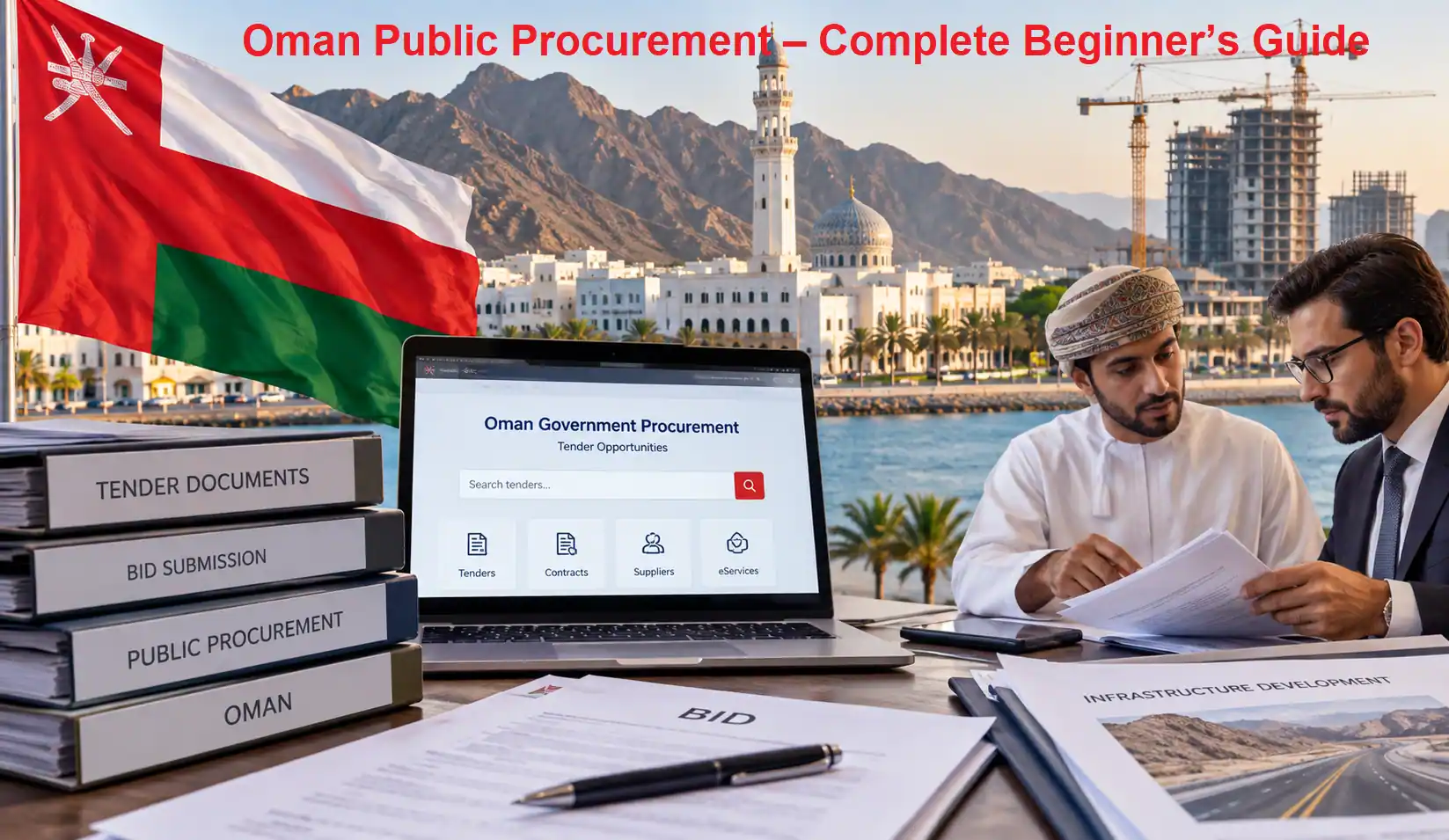
Public procurement in Oman is the cornerstone of how the Sultanate acquires goods, works and services for its government entities, ministries and public institutions. With an annual tender pipeline exceeding OMR 1.5 billion and thousands of active opportunities across infrastructure, healthcare, technology and energy, Oman represents one of the most dynamic public procurement markets in the Gulf region. For local suppliers, international contractors and consulting firms, understanding this system is the first step toward accessing a steady stream of government contracts. This beginner's guide provides a complete overview of how procurement works in Oman, from the legal framework and governing authorities to the electronic platforms, registration requirements and bidding procedures that every supplier must know.
Whether you are an Omani SME looking to benefit from the 10% government tender quota or an international company seeking to enter the Omani market, this guide will walk you through the essential components of the procurement ecosystem. You will learn about Royal Decree 36/2008, the Isnad platform, the roles of the Projects, Tenders and Local Content Authority (PTLC) and the practical steps for registering, bidding and winning government contracts. By the end of this article, you will have a solid foundation to navigate Oman's public procurement landscape with confidence and to identify the opportunities that best match your business capabilities.
Public procurement in Oman refers to the process by which government entities, ministries, authorities, public institutions and state-owned companies acquire goods, works and services from private sector suppliers, contractors and consultants. It is the backbone of how Oman executes its national development plans, delivers public infrastructure and maintains essential government services.
Every year, the Omani government allocates billions of Omani Rials to procurement across sectors including construction, healthcare, information technology, oil and gas, education, transportation and public utilities. In 2026 alone, the government revealed a tender pipeline exceeding OMR 1.5 billion spanning more than 57 government entities and 10,000 planned tenders. This makes Oman one of the most active public procurement markets in the Gulf region.
For suppliers, contractors and consultants, whether local Omani companies or international firms, understanding how Oman's procurement system works is the first step toward winning government contracts. The system is governed by a clear legal framework, operates through a centralized electronic platform and follows structured procedures designed to ensure transparency, fairness and value for public money.
Oman's economy is undergoing significant diversification under Oman Vision 2040, reducing dependence on oil revenues and investing heavily in infrastructure, logistics, tourism, manufacturing and technology. Government procurement is the primary vehicle through which these investments flow into the private sector.
Key indicators of the market's scale:
For any supplier or contractor seeking sustainable revenue streams, Oman's public procurement market offers substantial and recurring opportunities.
Oman's public procurement system is governed by the Tender Law issued under Royal Decree 36/2008, along with its Executive Regulations. This law has been amended several times, most notably by Royal Decree 19/2011, Royal Decree 120/2011, Royal Decree 60/2013 and Royal Decree 83/2020, to adapt to the evolving needs of the national economy.
The Tender Law applies to:
Exceptions: Security and defence units and units operating under special laws, are excluded from the Tender Law's scope.
The law establishes fundamental principles including:
Under the Tender Law, a minimum bid period of 40 days must be given from the date of first advertisement. The Tender Board may reduce this period upon request, but never to less than 15 days.
The procurement system is overseen by two key institutions:
| Institution | Role | Key Functions |
|---|---|---|
| Projects, Tenders and Local Content Authority (PTLC) | The regulatory authority formerly known as the General Secretariat of the Tender Board (GSTB) | Oversees procurement policy, manages the Isnad platform, promotes local content, regulates supplier classification and ensures compliance with the Tender Law |
| Tender Board | The decision making body for major tenders | Awards tenders above specified thresholds, approves procurement strategies and handles appeals |
The PTLC operates under the leadership of a Chairman and Secretary General and works closely with the Ministry of Finance, the Ministry of Commerce, Industry and Investment Promotion and sector specific regulators.
The Isnad platform (also spelled Esnad) is Oman's first unified electronic interface for managing all government tenders and procurement. Launched by the General Secretariat of the Tender Board (now PTLC), it represents a fundamental shift from fragmented, paper based procurement to a centralized, transparent and fully digital system.
The platform is designed to establish systematic and transparent management of tenders across all units of the state's administrative apparatus, regardless of whether they are subject to the Tenders Law. It provides a fair and competitive environment for all registered institutions.
Key features of the Isnad platform include:
Important: The PTLC has also announced plans to launch the Takamul system, a next generation procurement platform that will eventually replace Isnad. Suppliers should monitor official PTLC announcements for transition timelines.
Oman's procurement system organizes tenders into specific sectors. Institutions and companies must register in one or more of these sectors to be eligible to participate in relevant tenders. The sectors are:
| Sector | Examples of Works/Services |
|---|---|
| Urban Contracting and Maintenance | Buildings, housing, public facilities, maintenance works |
| Port Contracting | Port infrastructure, marine works, terminal operations |
| Roads and Bridges | Highways, bridges, interchanges, road maintenance |
| Railways and Dams | Rail infrastructure, dam construction, water management |
| Pipeline Networks and Well Drilling | Oil and gas pipelines, water networks, well drilling |
| Electromechanical Contracting | Electrical systems, mechanical installations, HVAC |
| Communications and Maintenance | Telecommunications infrastructure, network maintenance |
| Consulting and Professional Offices | Engineering consultancy, architectural services, project management |
| Public Service | Facility management, cleaning, catering, security services |
| Information Technology Services | Software development, IT infrastructure, digital transformation |
| Supplies | Goods, equipment, materials, medical supplies, vehicles |
According to the Government Projects Forum 2026, the largest share of approved tenders is in port, road, bridge, railway and maintenance contracting, accounting for 58.29% of the pipeline. This reflects Oman's continued focus on infrastructure development as a driver of economic growth.
To participate in Oman government tenders, an entity must be one of the following:
For most national tenders, prior registration and classification with the Tender Board (now managed through PTLC and the Isnad platform) is mandatory. International companies may participate in designated international tenders without full domestic classification, but often must partner with a registered Omani entity or establish a local presence.
Understanding the full procurement lifecycle helps suppliers prepare effectively and avoid disqualification. The typical lifecycle for a government tender in Oman follows these stages:
Registration on the Isnad platform is mandatory for any institution or company wishing to compete for government tenders. The registration process requires submitting several key documents:
| Document | Details |
|---|---|
| Commercial Registration (CR) | Valid CR with a remaining validity of at least 60 days at the time of registration |
| Oman Chamber of Commerce and Industry (OCCI) Membership | Valid membership card (except for individual professionals with professional licenses) |
| Omanization Certificate | Certificate showing the company's Omanization percentage, issued by the Ministry of Labour |
| Tax Certificate | Valid tax registration and compliance certificate |
| Riyada Card (for SMEs) | Required for SMEs to access the 10% SME quota and benefit from reduced registration fees |
| VAT Certificate | If applicable |
| Company Profile | Overview of the company's activities, experience and capabilities |
| Economic Activities License | License covering the activities the company intends to bid for |
After completing registration, companies receive a username and password to access the Isnad platform, where they can search for tenders, download documents and submit bids electronically.
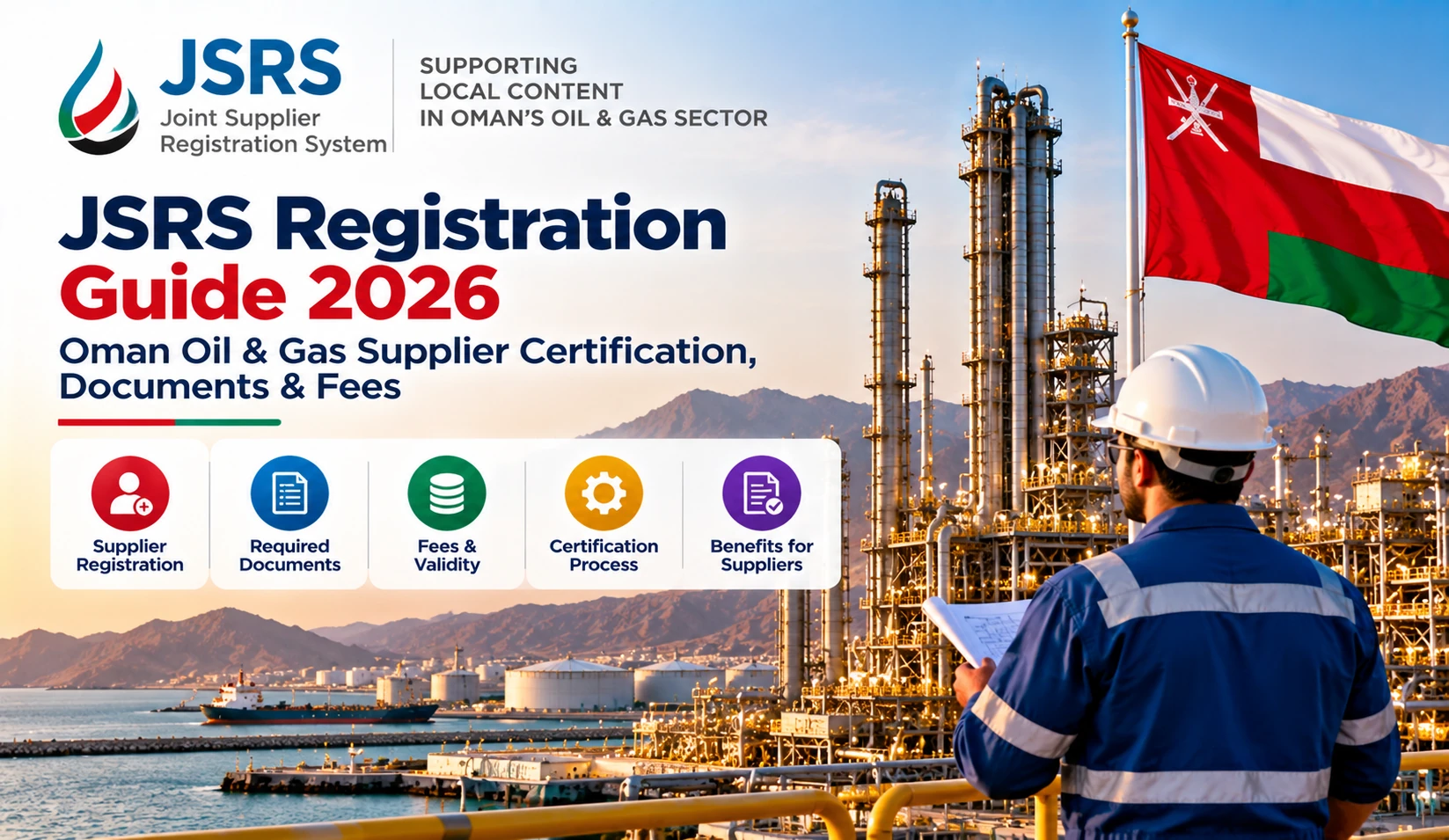
For companies in the Oil & Gas sector, a separate mandatory registration is required through the Joint Supplier Registration System (JSRS), which is a single window supplier registration and certification system implemented by Business Gateways International on behalf of the Ministry of Energy and Minerals. JSRS certification is mandatory for all suppliers, national and international, wanting to connect with Oman's Oil & Gas and other key industries.
When submitting a bid for an Oman government tender, bidders must typically provide financial guarantees to demonstrate seriousness and financial capacity:
| Guarantee Type | Requirement | Validity Period |
|---|---|---|
| Temporary Bid Security (Bid Bond) | Minimum 1% of bid value, in the form of a bank guarantee from a bank registered in Oman | Typically 90 days from bid submission date |
| Performance Guarantee | 5% of contract value for winning bidders (or professional insurance for consulting firms) | Submitted within 10 working days of award notification (20 days for international contractors) |
Bid bonds must be issued by a local bank in Oman and addressed in favor of the contracting authority. For consulting companies and professional offices, a professional insurance policy may substitute for the performance guarantee. The Tender Board has also established criteria for exempting eligible companies from providing the 1% temporary bid security for a period of one year.
In addition to the national procurement system managed through Isnad, Oman has several free zones and special economic zones that operate their own procurement mechanisms:
| Free Zone / SEZ | Procurement Mechanism |
|---|---|
| Special Economic Zone at Duqm (SEZAD) | Operates its own tender law for contracts under OMR 3 million; has an internal tender committee; for contracts above OMR 3 million, approval from both the Tender Board and MOLA is required. SMEs can register through the OPAZ e service portal (eoss.duqm.gov.om) |
| SOHAR Port and Freezone | Regularly invites qualified vendors, contractors and service providers to participate in competitive tenders for infrastructure, engineering, logistics and other essential services through its own tender portal |
| Salalah Free Zone | Operates its own procurement mechanisms for zone specific projects and services |
Suppliers should monitor both the national Isnad platform and individual free zone portals to capture the full range of opportunities.
Oman places strong emphasis on local content and In Country Value (ICV) in public procurement. Key policies include:
These policies create significant advantages for Omani SMEs and local suppliers, while encouraging international companies to partner with local firms and contribute to economic development.
Oman government tenders are classified into two main categories:
| Tender Type | Eligibility | Typical Scope |
|---|---|---|
| Local Tenders (عامة / Local) | Open to companies registered and classified with the Tender Board/PTLC | Most government procurement; requires full domestic registration |
| International Tenders (دولية / International) | Open to international companies, often in partnership with local firms | Large scale infrastructure, specialized works and projects requiring international expertise |
By mid 2025, the Isnad platform had floated 2,145 local tenders, 90 international tenders and over 1,127 tenders exclusively for SMEs. Local companies secured 818 tenders, while international firms won 6 tenders and SMEs were awarded 740 tenders.
Understanding the local procurement vocabulary is essential for navigating tender documents and communicating effectively with government entities:
| English | Arabic | Meaning |
|---|---|---|
| Tender | مناقصة (Munaqasa) | A formal invitation to bid for a government contract |
| Bid / Offer | عطاء (Ataa) | The proposal submitted by a bidder |
| Bidder | مقدم العطاء (Muqaddim al Ataa) | A company or individual submitting a bid |
| Contracting Authority | الجهة المعنية (Al Jiha Al Ma'niya) | The government entity issuing the tender |
| Tender Documents | وثائق المناقصة (Wathaiq Al Munaqasa) | The complete set of specifications, conditions and forms |
| Bid Bond | التأمين المؤقت (Al Ta'min Al Mu'aqqat) | Temporary financial guarantee submitted with the bid |
| Performance Guarantee | ضمان حسن التنفيذ (Daman Husn Al Tanfidh) | Financial guarantee submitted by the winning bidder |
| Award | إسناد (Isnad) | The act of awarding a tender to the winning bidder |
| Classification | تصنيف (Tasnif) | The grade assigned to a supplier/contractor based on capabilities |
| Omanization | التعمين (Ta'meen) | The percentage of Omani nationals employed by a company |
New entrants to Oman's procurement market frequently make mistakes that lead to disqualification or lost opportunities. Avoid these:
Navigating Oman's public procurement system can be complex, especially for first-time bidders or international companies unfamiliar with local regulations, registration procedures and tender documentation requirements. This is where TendersArabia.com becomes an invaluable partner. With a dedicated bid consultancy team that understands the Omani procurement landscape in depth, TendersArabia.com provides end to end support to suppliers, contractors and consultants at every stage of the bidding process. Whether you need help with Isnad platform registration, JSRS certification, tender document preparation, bid bond arrangements or understanding local content requirements, the expert team ensures your submissions are compliant, competitive and submitted on time.
Beyond consultancy, TendersArabia.com offers a comprehensive tender discovery platform that aggregates live opportunities from Oman and across the Arab region, helping businesses identify relevant tenders faster and more efficiently. From initial tender search to final bid submission, the platform and its consultancy team work together to reduce the complexity of public procurement and increase your chances of winning government contracts. For suppliers and contractors who want to focus on their core business while experts handle the bidding process, TendersArabia.com offers the perfect combination of technology, local knowledge and hands on support.
Ready to win your next Oman government contract? Contact or register today to explore live tenders, request bid consultancy support and take the first step toward growing your business through public procurement.
Oman's public procurement market is large, growing and increasingly digital. With a clear legal framework under Royal Decree 36/2008, a centralized electronic platform in Isnad, dedicated free zone procurement systems and strong local content and SME policies, the Sultanate offers substantial opportunities for suppliers, contractors and consultants who invest time in understanding the system. From completing registration and obtaining classification to preparing competitive bids and arranging financial guarantees, every step matters. Whether you are an Omani SME, a regional contractor or an international firm exploring the Gulf market, Oman's government tenders represent a reliable and recurring source of business. With the right knowledge, preparation and support from platforms like TendersArabia.com, you can navigate the procurement landscape successfully and turn public tenders into long term growth for your business.
Related Resources: This article is part of our comprehensive Oman Tenders guide series. Explore our detailed guides on the Isnad platform, JSRS registration, tender procedures and regional procurement portals to deepen your understanding.
To register for Oman government tenders, a company must complete the registration process on the Isnad platform website. The required documents include a valid Commercial Registration (CR), a membership card from the Oman Chamber of Commerce and Industry (OCCI), an Omanization certificate, and a tax certificate. After successful registration, the company receives a username and password to access the platform.
Yes, for the vast majority of local tenders, registration on the Isnad platform is mandatory. The Tender Law requires that local tenders are limited to entities registered in Oman's commercial register or approved professional registers. International companies may participate in designated international tenders but must complete registration within a specified period after their bid is accepted.
JSRS stands for the Joint Supplier Registration System. It is a mandatory single-window registration and certification system for all suppliers, both national and international, who want to participate in Oman's Oil & Gas sector and other key industries. It is managed by Business Gateways International (BGI) on behalf of the Ministry of Energy and Minerals. While it is not required for all government tenders, it is essential for any company targeting opportunities in the oil and gas sector.
Bidders must typically submit a temporary bid security (bid bond) of no less than 1% of the total bid value. This must be in the form of a bank guarantee from a bank registered in Oman and is usually valid for 90 days from the date of bid submission. The winning bidder must then provide a performance guarantee of 5% of the contract value.
Yes, foreign companies can participate, but primarily in designated international tenders. To participate in local tenders, they must partner with a registered Omani entity or establish a local presence. Under the Tender Law, international companies may participate in international tenders provided they complete registration within 30 working days from notification of acceptance of their bids. International companies must also demonstrate sound financial standing.
The main procurement sectors in Oman include Urban Contracting and Maintenance, Port Contracting, Roads and Bridges, Railways and Dams, Pipeline Networks and Well Drilling, Electromechanical Contracting, Communications and Maintenance, Consulting and Professional Offices, Public Services, Information Technology Services, and Supplies. Companies must register in one or more of these sectors to be eligible to bid.
Under the Tender Law, a minimum bid period of 40 days must be given from the date of the first advertisement. The Tender Board may reduce this period upon request, but it can never be less than 15 days. This period is designed to give bidders sufficient time to prepare their technical and commercial offers.
Oman has a policy that reserves 10% of government tenders and procurement for Small and Medium Enterprises (SMEs). To benefit from this quota, SMEs must hold a valid Riyada card and be registered on the Isnad platform. This policy is part of Oman's efforts to support local entrepreneurship and economic diversification.
The Tender Law is issued under Royal Decree 36/2008 and its Executive Regulations. It governs all public procurement activities for units of the State's administrative apparatus, public authorities, and government companies. The law establishes principles of transparency, equal treatment, competition, and value for money. It has been amended several times, most recently by Royal Decree 83/2020, to adapt to the evolving needs of the national economy.
The Takamul system is a next-generation procurement platform announced by the PTLC that will eventually replace the current Isnad platform. It is designed to further enhance transparency, efficiency, and digital transformation in Oman's public procurement. Suppliers should monitor official PTLC announcements for transition timelines and any new registration requirements that may come with the new system.
Common reasons for bid rejection in Oman include: submitting expired documents (CR, Chamber membership, Omanization certificate, tax certificate); failing to provide the required 1% bid bond; registering in the wrong procurement sector; not meeting local content requirements; and submitting bids after the deadline. It is also important to address all technical specifications and commercial conditions outlined in the tender documents.
Yes, several free zones and special economic zones in Oman operate their own procurement mechanisms alongside the national Isnad platform. For example, the Special Economic Zone at Duqm (SEZAD) operates its own tender law for contracts under OMR 3 million and has an internal tender committee. SOHAR Port and Freezone and Salalah Free Zone also regularly invite qualified vendors and contractors through their own tender portals. Suppliers should monitor both the national platform and individual free zone portals to capture all opportunities.
The PTLC is the regulatory authority that oversees Oman's public procurement system. It was formerly known as the General Secretariat of the Tender Board (GSTB). Its key functions include overseeing procurement policy, managing the Isnad platform, promoting local content, regulating supplier classification, and ensuring compliance with the Tender Law.
TendersArabia.com provides comprehensive support for suppliers, contractors, and consultants targeting Oman government tenders. Its dedicated bid consultancy team assists with Isnad platform registration, JSRS certification, tender document preparation, bid bond arrangements, and understanding local content requirements. The platform also aggregates live opportunities from Oman and across the Arab region, helping businesses identify relevant tenders faster and increase their chances of winning government contracts.