
Complete Guide...
October 15, 2026

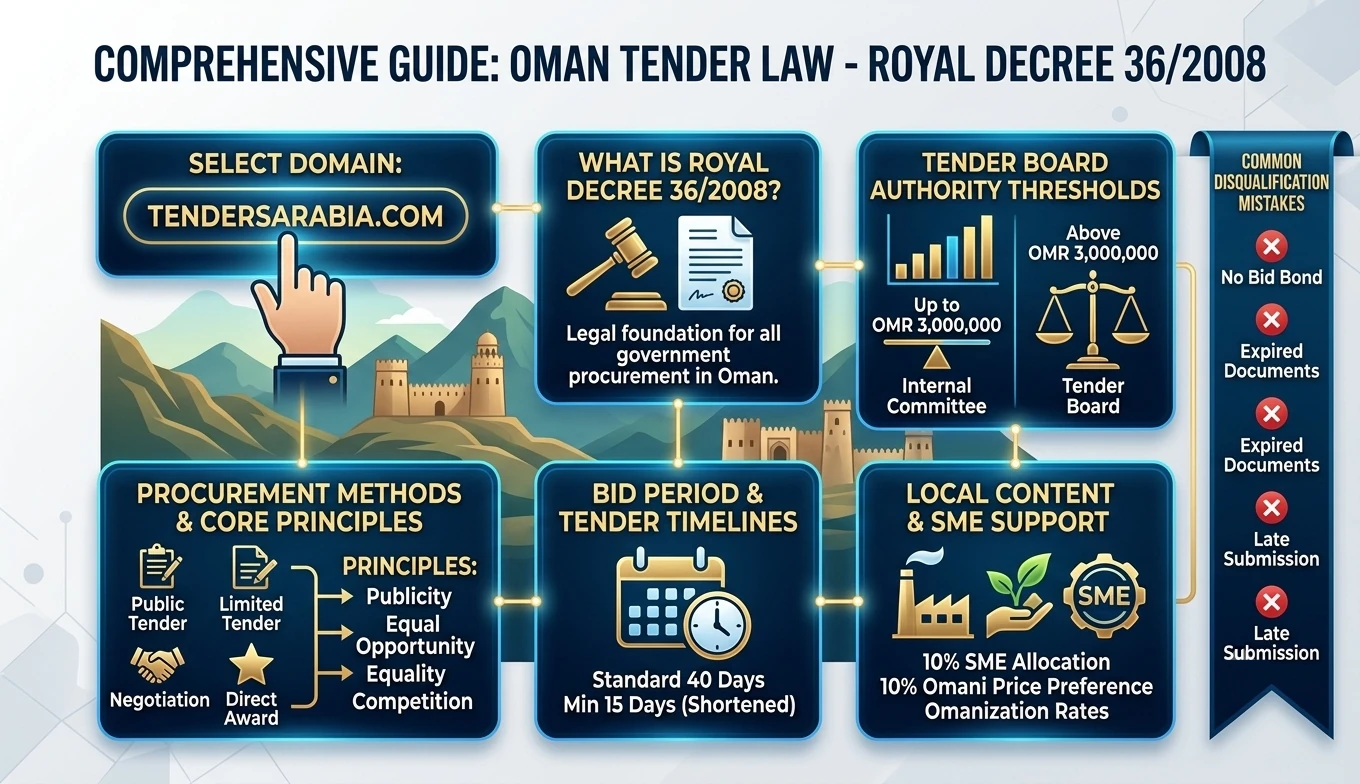
The Tender Law issued by Royal Decree 36/2008 is the legal foundation upon which every Oman government tender is built. It governs how ministries, public authorities, and government-owned companies acquire goods, works, and services, and it establishes the rights and obligations of both the procuring entities and the bidders who compete for public contracts. For any supplier, contractor, or consultant seeking to do business with the Omani government, a working knowledge of this law is not optional. It determines who can bid, how bids must be prepared, what guarantees are required, and what remedies exist when disputes arise.
This guide provides a comprehensive explanation of Royal Decree 36/2008 and its amendments, breaking down the law into practical sections that matter most to bidders. You will learn about the scope of the law, the procurement methods it authorises, the rules on bid periods and bid bonds, the classification of tenders, the provisions on local content and Omanization, and the common legal pitfalls that lead to disqualification. Whether you are preparing your first bid or reviewing your compliance obligations, this article gives you the legal knowledge needed to navigate Oman's procurement system with confidence.
Royal Decree 36/2008 was issued by Sultan Qaboos bin Said on 24 March 2008 and came into force six months after its publication in the Official Gazette. The decree promulgated the Tender Law, which replaced the earlier Government Tender Law and Regulations issued under Royal Decree 86/84. The law was introduced to establish a more modern, transparent, and structured framework for public procurement in Oman, aligning the country's procurement practices with international standards and the requirements of a growing economy.
The decree consists of four articles that enact the law, authorise the Chairman of the Tender Board to issue executive regulations, repeal the previous law, and set the effective date. The Tender Law itself is divided into parts covering definitions and general provisions, the Tender Board and its competencies, procurement methods, tendering procedures, bid evaluation and award, and contract administration.
The Tender Law applies to a defined set of government entities. Understanding whether a particular procurement falls under the law is essential for bidders, because the legal requirements and procedures differ depending on the entity and the nature of the procurement.
| Applies To | Exempted From |
|---|---|
| Units of the State's administrative apparatus (ministries and government authorities) | Security and defence units |
| Public authorities and public institutions | Units subject to the special law governing the Financial System Law of the Diwan of Royal Court |
| Government-owned companies (fully owned by the government) | Any other government entity explicitly exempted by a provision in another law |
Under the original 2008 text, government-owned companies were included within the scope of the law. However, Royal Decree 60/2013 amended Article 2 to provide that the Tender Law would continue to apply to independent corporate companies wholly owned by the Government until their special tendering systems were issued. During this transitional period, internal tender units in these companies assume the competencies of the Tender Board.
Article 3 of the Tender Law establishes the primary rule that procurement of supplies, execution of works, transportation, consultancy services, studies, technical works, and the purchase or lease of real property must be carried out by public tender. However, the law recognises that public tender is not always the most appropriate method and permits contracting through four alternative methods.
| Method | Description | When Used |
|---|---|---|
| Public Tender | Open competition advertised publicly | Default method for most government procurement |
| Limited Tender | Participation restricted to pre-qualified suppliers, contractors, or consultants | For highly specialised goods, works, or services |
| Procurement by Negotiation (Practice) | Direct negotiation with one or more suppliers | When public tender is not feasible or when urgency requires |
| Direct Award | Contract awarded to a specific supplier without competition | In exceptional circumstances defined by the law and regulations |
| Competition | A competitive process for selecting designs, ideas, or proposals | For architectural, engineering, or other creative works |
Article 5 of the law prohibits splitting similar supplies, works, or services for the purpose of evading the law's provisions. This anti-splitting rule prevents procuring entities from dividing large contracts into smaller ones to avoid the thresholds and procedures that would otherwise apply.
Article 4 of the Tender Law establishes four fundamental principles that govern all public tenders, limited tenders, procurement by negotiation, and competitions in Oman. These principles are the legal basis for challenging procurement decisions that are not conducted fairly.
These principles apply not only to the announcement and submission stages but also to the evaluation, award, and contract administration phases. Any procurement decision that violates these principles can be challenged through the appeal mechanisms established under the law and its executive regulations.
Since its enactment in 2008, the Tender Law has been amended several times to address evolving procurement needs and to strengthen the legal framework. Bidders must be aware of the current consolidated text, as the amendments have changed key provisions including the scope of the law, the threshold for internal committee authority, and the provisions on local content and Omanization.
| Decree | Year | Key Changes |
|---|---|---|
| Royal Decree 19/2011 | 2011 | Amended Article 2 of the Tender Law regarding the scope of application |
| Royal Decree 120/2011 | 2011 | Further amendments to the law |
| Royal Decree 60/2013 | 2013 | Amended Article 2 and Article 15; introduced the OMR 3 million threshold for internal committee authority; provided transitional provisions for government-owned companies |
| Royal Decree 83/2020 | 2020 | Replaced the opening text of Article 8; repealed Articles 10, 10bis, and 10bis 1; introduced further reforms to the Tender Board's structure and competencies |
The cumulative effect of these amendments is that the current Tender Law must be read as a consolidated text incorporating all changes. Bidders should always refer to the most recent version of the law and its executive regulations when preparing bids or assessing compliance.
One of the most important practical provisions of the Tender Law concerns the division of authority between the Tender Board and internal committees within individual government entities. This threshold determines which body awards a tender and, consequently, the procedural requirements that apply.
Under Article 8 of the Tender Law, as amended by Royal Decree 60/2013 and Royal Decree 83/2020, the Tender Board exercises its competencies over tenders that exceed a specified financial threshold. For tenders whose value does not exceed three million Omani Rials (OMR 3,000,000) , an internal committee in the concerned entity assumes the competencies of the Board. This threshold was introduced to streamline procurement for smaller contracts and to reduce the administrative burden on the central Tender Board.
| Tender Value | Awarding Authority | Competencies |
|---|---|---|
| Up to OMR 3,000,000 | Internal Committee in the concerned entity | Assumes the competencies of the Tender Board, except for signing contracts and financial obligations |
| Above OMR 3,000,000 | Tender Board | Full competencies under the Tender Law |
It is important to note that while internal committees assume the Board's competencies for tenders under OMR 3 million, they do not have the authority to sign contracts or create financial obligations. Those actions remain with the appropriate authority within the entity. Bidders should verify the applicable threshold and awarding authority for each tender they intend to pursue.
Article 19 of the Tender Law establishes the minimum bid period for public tenders. This provision is designed to give bidders sufficient time to prepare and submit competitive offers and is a key protection for fair competition.
The standard bid period under the Tender Law is forty (40) days from the date of the first advertisement of the tender. The Tender Board may, upon the request of the concerned entity, reduce this period if the circumstances of the tender require it, but the reduced period must never be less than fifteen (15) days . The law also sets a minimum of fifteen days in certain specific cases where a shortened period is justified.
For bidders, the practical implication is that tender documents must be reviewed immediately upon publication, and bid preparation must begin without delay. The 40-day period includes weekends and public holidays, so the effective working time available for preparation is often less than six weeks.
The Tender Law and its executive regulations require bidders to provide financial guarantees at two stages of the procurement process. These guarantees protect the procuring entity against bidders who withdraw their offers or fail to execute the contract after award.
| Guarantee | Value | Form | Validity |
|---|---|---|---|
| Temporary Bid Security (Bid Bond) | Not less than 1% of the total bid value | Bank guarantee or certified cheque from a bank registered in Oman | Typically 90 days from the bid submission date |
| Performance Guarantee | 5% of the contract value | Bank guarantee or professional insurance for consulting firms | Submitted within 10 working days of award notification (20 working days for foreign contractors) |
The bid bond must be addressed to the contracting authority and must be valid for the full period specified in the tender documents. A bid submitted without the required bid bond, or with a bid bond from a bank not registered in Oman, will be rejected. The Tender Board has also established criteria for exempting eligible companies from providing the 1% temporary bid security for a period of one year, aimed at facilitating bid submission and increasing SME participation.
The performance guarantee must be submitted within the specified period after award notification. Failure to submit the performance guarantee can result in cancellation of the award and forfeiture of the temporary bid bond, without prejudice to the procuring entity's right to compensation. The periods for submitting the performance guarantee may be extended by up to an additional 10 days in certain circumstances.
The Tender Law sets out clear eligibility requirements and grounds for exclusion. Bidders must satisfy these requirements to have their bids considered, and procuring entities must exclude bidders who fall within the prohibited categories.
Under Article 6 of the Tender Law, employees of entities subject to the law, together with their spouses and relatives up to the second degree, are barred from submitting bids or offers to those entities, whether directly or indirectly. They are also prohibited from contracting with those entities for the purchase of items or the execution of works or services. This provision is designed to prevent conflicts of interest and ensure that public procurement decisions are made in the public interest.
Bidders may also be excluded or debarred on the following grounds:
The Tender Board has the authority to debar a supplier, contractor, or consulting office from dealing with entities subject to the Tender Law for a specified period. Debarment decisions are published and have significant consequences for a company's ability to win government contracts.
The Tender Law distinguishes between local tenders and international tenders, with different eligibility rules for each. This distinction is critical for bidders, particularly foreign companies seeking to enter the Omani market.
| Tender Type | Eligibility | Registration Requirement |
|---|---|---|
| Local Tenders | Entities registered in Oman's commercial register or approved professional registers | Must be registered with the Tender Board in the relevant grade |
| International Tenders | International companies and institutions not registered in Oman may participate | Must complete registration within 30 working days from notification of acceptance of their bids |
International tenders are subject to worldwide bidding and are typically used for large infrastructure projects or specialised works requiring international expertise. Successful international bidders are required to enrol in the Commercial Register and become members of the Oman Chamber of Commerce and Industry within the specified period. For international companies participating in international tenders, compliance with Omanization obligations is monitored post-award and during contract execution, in alignment with the local content plan.
Local content and Omanization are central pillars of Oman's procurement policy and are embedded in the Tender Law and its implementing regulations. These requirements are designed to maximise the economic benefit of government spending for the national economy and to support the development of Omani businesses and workforce.
Key local content provisions include:
Under Circular No. 2/2025 issued by the Tender Board, all ministries and government units subject to the Tender Law are required to refrain from contracting with companies that do not comply with the approved Omanization rates. This requirement extends to foreign companies participating in international tenders, who must adhere to local Omanization commitments even though they are not registered in Oman. Compliance is monitored post-award and during contract execution in alignment with the local content plan.
Article 42 of the Tender Law governs change orders and contract amendments. The provision allows the concerned authorities to issue change orders to increase or decrease the duration, scope, or value of a contract, subject to the conditions and limits set out in the law and its executive regulations.
Under the amendments introduced by Royal Decree 60/2013, entities subject to the law are permitted to make a change order greater than OMR 100,000 or 10% of the value of a contract without having to re-tender, provided the change is within the scope of the original contract and complies with the legal requirements. This provision gives procuring entities flexibility to address unforeseen circumstances during contract execution without the delay and cost of a new tender process.
For contractors, change orders represent both an opportunity and a risk. They can lead to additional revenue if properly documented and approved, but disputes over change order entitlement are common. Contractors should ensure that all change orders are issued in writing by the authorised authority and that they maintain detailed records of the additional work performed.
Many bid disqualifications in Oman are caused by legal and procedural errors rather than technical deficiencies. Understanding these common mistakes helps bidders avoid them.
Understanding the Tender Law and applying its provisions correctly to every bid is a complex task, particularly for companies new to the Omani market or those bidding across multiple sectors. TendersArabia.com provides specialised bid consultancy support through a team that understands Royal Decree 36/2008, its amendments, and the executive regulations in practical detail. From advising on eligibility and classification requirements to reviewing bid documents for legal compliance, the consultancy team helps suppliers, contractors, and consultants avoid the legal mistakes that lead to disqualification.
Beyond legal guidance, TendersArabia.com operates a comprehensive tender discovery platform that aggregates live opportunities from Oman and across the Arab region, including Saudi Arabia, the UAE, Qatar, Kuwait, and Bahrain. The platform provides tender alerts, document access, and market intelligence that help businesses identify relevant opportunities and prepare competitive bids. Whether you need help interpreting a specific provision of the Tender Law, preparing a compliant bid submission, or understanding your obligations under local content and Omanization rules, TendersArabia.com offers the expertise and tools to support your success in Oman's public procurement market.
Ready to bid with legal confidence? Visit TendersArabia.com today to explore live Oman tenders, request bid consultancy support, and get expert guidance on Tender Law compliance for your next government contract.
Royal Decree 36/2008 and its amendments form the legal backbone of Oman's public procurement system. The law establishes the principles of openness, equal opportunity, equality, and freedom of competition that govern every government tender, and it sets out the procedural requirements that bidders must meet to participate and win. From the scope of application and procurement methods to bid periods, bid bonds, eligibility rules, and local content requirements, the Tender Law touches every aspect of the bidding process. Bidders who invest time in understanding the law and its practical implications are better positioned to avoid disqualification, protect their legal rights, and compete effectively for Oman's growing pipeline of government contracts. With the support of expert bid consultancy services like TendersArabia.com, suppliers and contractors can navigate the legal framework with confidence and turn compliance into a competitive advantage.
Related Resources: This article is part of our comprehensive Oman Tenders guide series. Explore our detailed guides on the Isnad platform, Oman tender portals, registration and bid submission, and tender procedures to build a complete understanding of Oman's procurement system.



Royal Decree 36/2008 is the decree issued by Sultan Qaboos bin Said on 24 March 2008 that promulgated the Tender Law. It is the primary legal framework governing public procurement in Oman, establishing the rules for government tenders, the powers of the Tender Board, procurement methods, bid requirements, and contract administration.
The Tender Law applies to units of the State's administrative apparatus (ministries and government authorities), public authorities and institutions, and government-owned companies. Security and defence units and entities subject to special laws, such as the Financial System Law of the Diwan of Royal Court, are exempt, along with any other entity explicitly exempted by law.
The Tender Law requires public tender as the default method for government procurement. It also permits four alternative methods: limited tender (restricted to pre-qualified suppliers), procurement by negotiation (practice), direct award, and competition. The choice of method depends on the nature of the procurement and the circumstances defined in the law and regulations.
Under Article 8 as amended, an internal committee in the concerned entity assumes the competencies of the Tender Board for tenders whose value does not exceed OMR 3,000,000. Tenders above this threshold are handled by the Tender Board. Internal committees do not have authority to sign contracts or create financial obligations.
Article 19 of the Tender Law establishes a minimum bid period of 40 days from the date of the first advertisement. The Tender Board may reduce this period upon request, but it can never be less than 15 days. The 40-day period includes weekends and public holidays, so bidders should begin preparation immediately.
Each bid must be accompanied by a temporary bid security of not less than 1% of the total bid value. The bid bond must be in the form of a bank guarantee or certified cheque from a bank registered in Oman and must be valid for 90 days from the bid submission date. A bid without the required bid bond will be rejected.
The successful bidder must submit a performance guarantee of 5% of the contract value within 10 working days of award notification, or 20 working days for foreign contractors. Both periods may be extended by up to 10 additional days. Failure to submit the performance guarantee can result in cancellation of the award and forfeiture of the bid bond.
The Tender Law has been amended by Royal Decree 19/2011, Royal Decree 120/2011, Royal Decree 60/2013, and Royal Decree 83/2020. The key amendments include changes to the scope of application, the introduction of the OMR 3 million threshold for internal committee authority, transitional provisions for government-owned companies, and reforms to the Tender Board's structure and competencies.
Employees of entities subject to the Tender Law, along with their spouses and relatives up to the second degree, are prohibited from submitting bids or offers to those entities, directly or indirectly. They are also barred from contracting with those entities for the purchase of items or execution of works or services. This conflict of interest provision applies without exception.
Local tenders are limited to entities registered in Oman's commercial register or approved professional registers. International tenders are subject to worldwide bidding, and international companies not registered in Oman may participate provided they complete registration within 30 working days from notification of acceptance of their bids. Successful international bidders must enrol in the Commercial Register and join the Oman Chamber of Commerce and Industry.
The Tender Law and its regulations require that no less than 10% of government procurement value be allocated to SMEs. Products on the mandatory list must be procured locally, and Omani products receive a 10% price preference over foreign products. Contracts exceeding OMR 3 million include local content requirements, and the General Directorate of Local Content reviews requirements for contracts between OMR 500,000 and OMR 3 million.
All entities subject to the Tender Law must comply with government-approved Omanization rates. Under Circular No. 2/2025, ministries and government units are required to refrain from contracting with companies that do not meet these rates. The requirement extends to foreign companies participating in international tenders, with compliance monitored post-award and during contract execution.
Yes, under Article 42 and the amendments introduced by Royal Decree 60/2013, entities subject to the law may issue change orders greater than OMR 100,000 or 10% of a contract's value without re-tendering, provided the change is within the scope of the original contract and complies with legal requirements. Contractors should ensure all change orders are documented and approved in writing.
Bidders may be debarred from government contracts on grounds including bankruptcy or insolvency, submission of false information, fraudulent conduct, breach of previous government contracts, failure to demonstrate sound financial standing, and failure to comply with Omanization requirements. Debarment decisions are published and can significantly affect a company's ability to win future contracts.
TendersArabia.com provides specialised bid consultancy support for Oman government tenders, including guidance on Tender Law compliance, eligibility requirements, classification, bid bond arrangements, local content and Omanization obligations, and bid document review. The platform also aggregates live tenders from Oman and across the Arab region into a single searchable database with customized alerts, helping suppliers and contractors compete effectively and win more contracts.