
Complete Guide...
October 15, 2026

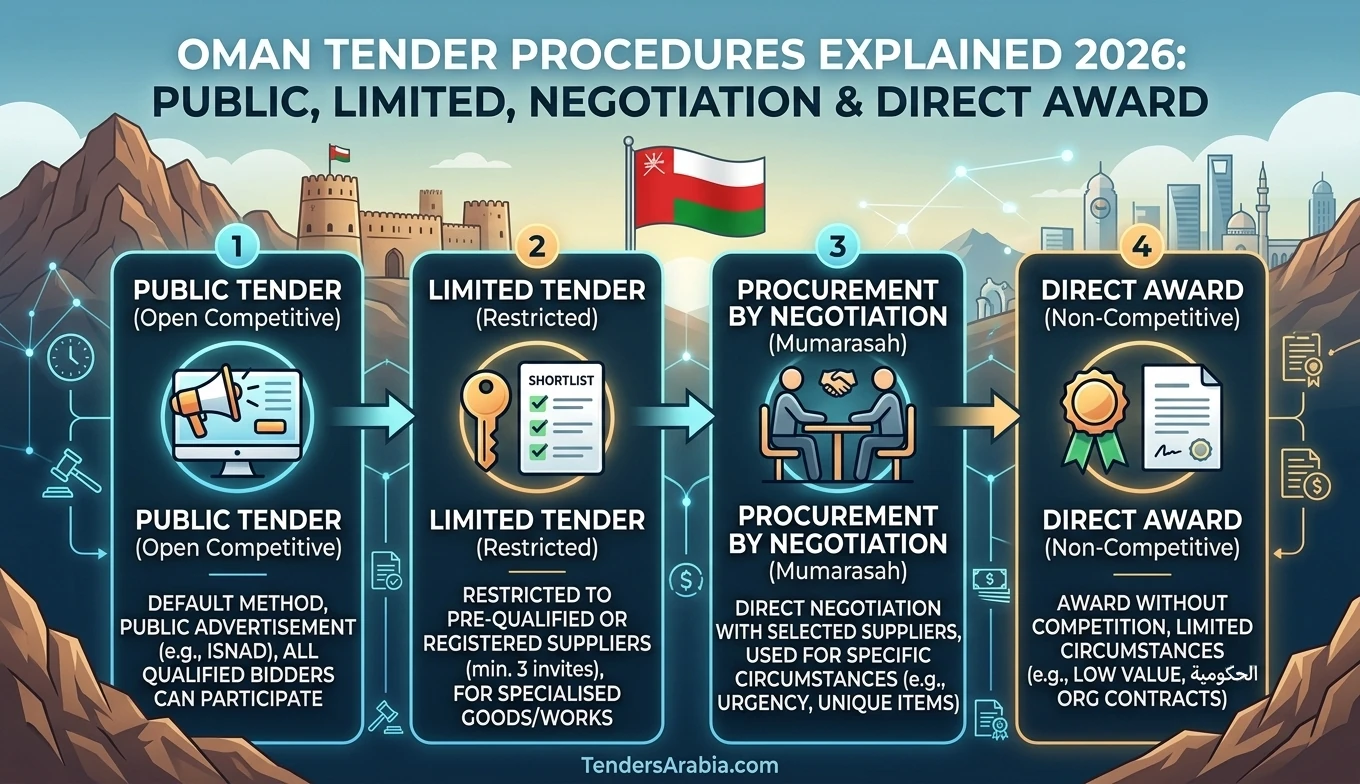
Oman's public procurement system operates on a clearly defined set of tender procedures that determine how government contracts are advertised, how bidders are invited, how offers are evaluated, and how contracts are ultimately awarded. The Tender Law (Royal Decree 36/2008) establishes public tender as the default method for government procurement, but it also recognises four alternative procedures that may be used in specific circumstances. Understanding which procedure applies to a given tender, and what each procedure requires from bidders, is essential for anyone seeking to win government contracts in the Sultanate.
This guide explains every tender procedure available under Omani law, from open public tenders and limited tenders to procurement by negotiation, direct award, and competition. You will learn the legal basis for each procedure, the circumstances in which it is used, the step-by-step process from tender announcement to contract award, and the evaluation criteria that determine the winning bid. Whether you are preparing your first bid or refining your strategy for a specific procurement method, this article gives you a practical understanding of how Oman tender procedures work from start to finish.
The Tender Law establishes five procedures through which government entities may contract for supplies, works, services, consultancy studies, technical works, and the purchase or lease of real property. Article 3 of the law states that all such procurement shall be carried out by public tender as the default method. However, contracting may also be executed using any of the following alternative methods:
Article 4 of the law establishes that public tenders, limited tenders, procurement by negotiation, and competitions are all subject to the principles of publicity, equal opportunity, equality, and freedom of competition. Article 5 prohibits splitting similar supplies, works, or services for the purpose of evading the law's provisions, a rule designed to prevent procuring entities from dividing large contracts into smaller ones to avoid the thresholds and procedures that would otherwise apply.
| Procedure | Legal Basis | When Used |
|---|---|---|
| Public Tender | Article 3 (default method) | Most government procurement |
| Limited Tender | Article 3(a) | Specialised goods, works, or services requiring pre-qualified suppliers |
| Procurement by Negotiation (Practice) | Article 3(b) | Specific circumstances defined by the law |
| Direct Award | Article 3(c) | Exceptional circumstances and low-value contracts |
| Competition | Article 3(d) | Designs, studies, layouts, models, or artistic works |
Public tender is the primary and most commonly used procurement procedure in Oman. It is an open competitive process in which the tender is publicly advertised, and any qualified supplier, contractor, or consultant may participate. Public tenders may be local, open to companies registered in Oman, or international, open to companies within and outside the Sultanate.
Tender notices are published in widely circulated Arabic and English language newspapers and, in modern practice, through the Isnad electronic platform. Purchases of at least OMR 500,000 must also be published in the Official Gazette. This broad publication requirement ensures maximum visibility and supports the principle of equal opportunity for all potential bidders.
The public tender process follows a structured timeline that includes tender preparation, announcement, document sale, inquiry period, bid submission, bid opening, evaluation, and award. Under Article 19 of the Tender Law, a minimum bid period of 40 days is granted from the date of the first advertisement, giving bidders sufficient time to prepare competitive offers. The Tender Board may reduce this period upon request, but never to less than 15 days .
A limited tender is a procedure in which participation is restricted to specific suppliers, contractors, or consultants who meet the required conditions. This procedure is used when the nature of the procurement requires limiting participation to a defined group of qualified bidders, either within Oman or outside it.
Under the Executive Regulations, the invitation to a limited tender is directed to suppliers, contractors, or consultants who specialise in the relevant activity and whose names are recorded in the approved register of suppliers, contractors, and consulting offices. These entities must have demonstrated technical and financial competence and meet the conditions of good reputation. A minimum of three companies or establishments must be invited to participate.
Invitations to submit offers in limited tenders are sent through direct registered letters or by electronic means. All other provisions governing public tenders apply equally to limited tenders. The tender committee may recommend converting a limited tender to procurement by negotiation if it determines that this would achieve better contracting conditions for the entity.
Procurement by negotiation, known in Arabic as Mumarasah (الممارسة), is a procedure in which the tender committee negotiates directly with one or more suppliers to obtain the best offers at the lowest prices. This method is permitted only in specific circumstances defined by the Tender Law.
The circumstances in which procurement by negotiation may be used include:
The negotiating committee works to obtain the best offers at the lowest prices, comparing proposals and selecting the most advantageous one for the procuring entity. Procurement by negotiation is subject to the same principles of transparency, equal opportunity, and freedom of competition that govern public tenders.
Direct award is a procedure in which a contract is awarded to a specific supplier, contractor, or consultant without a competitive tendering process. This is the most restrictive procurement method and is permitted only in the limited circumstances defined by the Tender Law and its Executive Regulations.
The entity may contract by direct award, provided that the contractor is selected from among the best offers obtained and that the prices are appropriate, with the reasons for selection documented. Direct award is permitted in the following situations:
The Executive Regulations specify that direct award contracting must comply with the procedures issued by the Chairman of the Tender Board, and the total value must not exceed the limits set by the regulations.
Competition, known in Arabic as Musabaqah (المسابقة), is a special procedure used for procuring studies, designs, layouts, models, or other artistic works required for a specific project. It is not a procedure for procuring goods or construction works but rather for acquiring intellectual and creative outputs.
Under the Executive Regulations, the entity determines the project's purposes, scope, and detailed specifications, as well as the prizes, rewards, or compensations to be granted to winners. The entity also determines the ownership fate of reports, studies, designs, and layouts, whether winning or non-winning, along with any other conditions it deems appropriate.
Participation in a competition may be invited through public announcement, electronic means, or direct invitation to those with the necessary expertise and skills for the project. Competitions are subject to the same core principles of publicity, equal opportunity, equality, and freedom of competition that apply to other procurement procedures.
Regardless of the procedure used, most government tenders in Oman follow a structured process from initial preparation to contract award. Understanding these steps helps bidders prepare effectively and meet every requirement within the applicable deadlines.
| Stage | Description |
|---|---|
| 1. Project Preparation and Approval | The procuring entity prepares the project study, technical specifications, and estimated cost, and obtains internal approval |
| 2. Tender Announcement | The tender is published in daily newspapers and on the Isnad electronic platform, with details of the tender, document price, and submission deadlines |
| 3. Document Sale | Interested bidders purchase the tender documents electronically or from the designated location |
| 4. Inquiry Period | Bidders may submit clarification questions, and the entity responds to all bidders |
| 5. Site Visit (if applicable) | For works and construction tenders, a site visit may be arranged at a specified time |
| 6. Bid Preparation and Submission | Bidders prepare technical and commercial offers and submit them electronically before the deadline |
| 7. Bid Opening | Bids are opened electronically at the designated time, and results are published |
| 8. Technical and Commercial Evaluation | Bids are evaluated against the criteria specified in the tender documents |
| 9. Award Recommendation | The evaluation team recommends the winning bidder to the tender committee |
| 10. Award Notification | The successful bidder is notified, and the contract is awarded |
| 11. Performance Guarantee Submission | The winning bidder submits the performance guarantee within the specified period |
| 12. Contract Signing | The contract is signed and execution begins |
The procurement guide issued by Omani government entities confirms that advertisements are published in daily newspapers or by electronic means according to the tender value, and that a period of 40 days is set for submitting bids in public tenders. Technical and financial offers are submitted in one or two envelopes as required by the entity, and the results of envelope opening are announced immediately after opening by electronic publication.
Tender evaluation in Oman is conducted according to the technical and financial criteria specified in the tender documents. The evaluation process compares bids to select the best offer based on the pre-defined standards and weightings.
The evaluation typically involves:
The award is granted to the bidder whose offer is best in terms of technical and financial criteria and the standards specified in the tender documents. If the lowest-priced bid among technically qualified companies meets all technical and other requirements, it may be awarded the contract. However, the tender committee has the authority to verify unusually low bids to ensure the bidder can meet the tender requirements.
Under Circular No. 2/2025, all government entities subject to the Tender Law must ensure that companies comply with approved Omanization rates before contract award. Compliance is monitored post-award and during contract execution in alignment with the local content plan.
The Tender Law establishes clear timelines that govern the tender process and protect the rights of bidders to fair and adequate preparation time.
| Timeline Element | Requirement |
|---|---|
| Minimum bid period | 40 days from the date of first advertisement under Article 19 of the Tender Law |
| Reduced bid period | May be reduced upon request of the concerned entity, but never less than 15 days |
| Bid validity period | The bid must remain valid for the period specified in the tender documents |
| Award notification | The successful bidder is notified within one week of the award decision |
| Performance guarantee submission | 10 working days from award notification; 20 working days for foreign contractors |
The requirement to provide advance notice of new tender requests at least six months before the intended date of advertisement is also established by the Executive Regulations, supporting better planning and preparation for both procuring entities and bidders.
The Tender Law establishes a threshold that determines whether a tender is awarded by the central Tender Board or by an internal committee within the concerned entity. This threshold has a direct impact on the procedural requirements that apply to a tender.
| Tender Value | Awarding Authority | Competencies |
|---|---|---|
| Up to OMR 100,000 | Procurement Committee | Contracts whose price does not exceed OMR 100,000 |
| OMR 100,000 to OMR 3,000,000 | Internal Tenders Committee | Assumes the competencies of the Tender Board, except for signing contracts and financial obligations |
| Above OMR 3,000,000 | Tender Board | Full competencies under the Tender Law |
Projects above OMR 3 million must be floated and awarded through the Tender Board, while projects below this threshold can be processed through the government's internal procurement committees. The Public Tenders Committee within each entity concludes contracts whose price exceeds OMR 3 million, while the Internal Tenders Committee handles contracts above OMR 100,000 and up to OMR 3 million. The Procurement Committee concludes contracts not exceeding OMR 100,000.
The Tender Law provides for circumstances in which a tender may be re-floated or cancelled after publication but before award. These provisions protect the public interest and ensure that procurement decisions remain aligned with the entity's needs and budget.
A tender may be re-floated in the following circumstances:
A tender may be cancelled after publication and before award if:
When a tender is cancelled, the purchase price of the tender document is refunded to bidders. Bidders who submitted valid offers retain their rights to compensation in accordance with the law.
Understanding the procedures is only part of the challenge. Bidders frequently make errors that lead to disqualification or lost opportunities. Being aware of these common mistakes helps avoid them.
Oman's tender procedures are detailed and strictly enforced, and understanding which procedure applies to a given tender, what documents are required, and how bids will be evaluated is essential for success. TendersArabia.com provides specialised bid consultancy support through a team that understands Oman's procurement procedures in practical detail. From advising on eligibility and classification requirements to reviewing bid documents for compliance with the applicable procedure, the consultancy team helps suppliers, contractors, and consultants avoid the mistakes that lead to disqualification and improve their competitiveness.
Beyond consultancy, TendersArabia.com operates a comprehensive tender discovery platform that aggregates live opportunities from Oman and across the Arab region, including Saudi Arabia, the UAE, Qatar, Kuwait, and Bahrain. The platform provides tender alerts, document access, and market intelligence that help businesses identify relevant opportunities and prepare competitive bids for both public tenders and alternative procurement procedures. Whether you need help understanding the difference between a limited tender and procurement by negotiation, preparing a bid for an international tender, or navigating the evaluation process, TendersArabia.com offers the expertise and tools to support your success in Oman's public procurement market.
Ready to win your next Oman government contract? Visit TendersArabia.com today to explore live Oman tenders, request bid consultancy support, and get expert guidance on Oman tender procedures for your next bid.
Oman's tender procedures provide a structured framework for government procurement, with public tender as the default method and four alternative procedures available for specific circumstances. Each procedure has its own legal basis, eligibility requirements, and procedural rules, and understanding these differences is essential for bidders seeking to compete effectively. From the 40-day bid period and the 1% bid bond requirement to the technical and commercial evaluation criteria and the OMR 3 million threshold for Tender Board authority, the rules are designed to ensure transparency, equal opportunity, and value for public money. Bidders who invest time in understanding the applicable procedure for each tender, preparing compliant bids, and meeting every deadline position themselves to succeed in Oman's growing public procurement market. With the support of expert bid consultancy services like TendersArabia.com, suppliers and contractors can navigate Oman's tender procedures with confidence and turn procedural knowledge into a competitive advantage.
Related Resources: This article is part of our comprehensive Oman Tenders guide series. Explore our detailed guides on the Isnad platform, Oman tender portals, registration and bid submission, the Tender Law, and JSRS registration to build a complete understanding of Oman's procurement system.


The main tender procedures in Oman are public tender, limited tender, procurement by negotiation (practice), direct award, and competition. Public tender is the default method under Article 3 of the Tender Law, while the other four procedures may be used in specific circumstances defined by the law.
A public tender is openly advertised and any qualified supplier, contractor, or consultant may participate. A limited tender is restricted to specific pre-qualified suppliers, contractors, or consultants who meet the required conditions and are recorded in the approved register. A minimum of three companies must be invited to a limited tender.
Procurement by negotiation (practice) may be used for items manufactured or imported in a specialised manner, items that cannot be defined by precise specifications, technical and consultancy works requiring specific expertise, supplies and works where urgency makes public tender impractical, works or services carried out by entities outside Oman, and the purchase or lease of real property.
Direct award is a procedure in which a contract is awarded to a specific supplier without competitive tendering. It is permitted in special cases, when a contract is awarded to another government entity, for assignments not exceeding OMR 10,000, and in cases of urgency for contracts not exceeding OMR 25,000.
Competition (musabaqah) is a special procedure used for procuring studies, designs, layouts, models, or other artistic works required for a specific project. It is not used for goods or construction works. The entity determines the project scope, prizes, and conditions, and participation may be invited through public announcement or direct invitation.
Under Article 19 of the Tender Law, the minimum bid period is 40 days from the date of the first advertisement. The Tender Board may reduce this period upon request, but it can never be less than 15 days. The bid period includes weekends and public holidays.
An internal committee in the concerned entity assumes the competencies of the Tender Board for tenders whose value does not exceed OMR 3,000,000. Tenders above this threshold are handled by the Tender Board. Internal committees do not have authority to sign contracts or create financial obligations.
Tenders are evaluated according to the technical and financial criteria specified in the tender documents. The evaluation includes mandatory criteria that all bidders must meet, detailed technical criteria with weighted scores, commercial criteria, and local content and Omanization commitments. The award is granted to the bidder whose offer is best in terms of technical and financial criteria.
If only one offer is received for a tender, the tender may be re-floated. The Tender Law permits re-tendering in this circumstance to ensure genuine competition and value for public money. The bidder who submitted the sole offer may participate in the re-tendered process.
Yes, a tender may be cancelled after publication but before award if the procuring entity no longer requires the subject matter of the tender or if public interest requires cancellation. When a tender is cancelled, the purchase price of the tender document is refunded to bidders.
The Tender Board exercises its competencies over tenders that exceed OMR 3 million. Its mission includes registering companies to participate in tenders, reviewing tender documents, floating tenders and selling documents to qualified companies, publishing tenders, checking evaluation reports from ministries, sending recommendation reports for award, and checking variation orders for awarded projects.
Bidders must submit their technical and commercial offers, the temporary bid security (bid bond) of at least 1% of the bid value, valid Commercial Registration, OCCI membership, Omanization certificate, and tax certificate. Additional documents may be required depending on the tender, such as classification certificates and experience records.
TendersArabia.com provides specialised bid consultancy support for Oman government tenders, including guidance on which procedure applies, eligibility requirements, classification, bid bond arrangements, and bid document review. The platform also aggregates live tenders from Oman and across the Arab region into a single searchable database with customized alerts, helping suppliers and contractors compete effectively and win more contracts.
Article 4 of the Tender Law establishes that public tenders, limited tenders, procurement by negotiation, and competitions are subject to the principles of publicity, equal opportunity, equality, and freedom of competition. These principles apply to all stages of the procurement process, from announcement to award and contract administration.
Article 5 of the Tender Law prohibits splitting similar supplies, works, or services for the purpose of evading the law's provisions. This rule prevents procuring entities from dividing large contracts into smaller ones to avoid the thresholds and procedures that would otherwise apply. The anti-splitting rule applies to all procurement methods.