Complete Guide...
October 15, 2026

The Sultanate of Oman occupies a distinctive position among Gulf procurement markets. It was one of the first GCC states to legally codify a unified tendering framework and it now runs one of the region's most structured public procurement institutions, the Tender Board, alongside an explicit, economy wide policy of channelling government spending toward Omani companies, Omani workers and Omani manufactured goods through its In Country Value (ICV) programme. For contractors, suppliers and consultants evaluating Oman government tenders in 2026, this combination of legal maturity and deliberate localisation policy makes Oman simultaneously one of the most transparent and one of the most compliance intensive markets in the Gulf to enter successfully.
This guide has been researched and written for businesses preparing to bid on مناقصات عمان (Oman tenders) whether Omani companies seeking to understand the classification and registration process, GCC-based suppliers exploring cross-border opportunities or international firms targeting Oman's oil and gas, infrastructure, logistics or renewable energy sectors under Oman Vision 2040. It covers the legal framework governing public procurement, the institutions that administer it, the registration and classification process, the In Country Value policy that shapes nearly every contract award decision and the practical realities of bidding without referencing any specific live tender, since active opportunities change daily and should always be verified directly on the official Esnad platform.
Public procurement in Oman is governed primarily by what is widely known as the "Tender Law," originally promulgated by Royal Decree No. 36/2008 on 24 March 2008 and subsequently amended through Royal Decree No. 120/2011 and Royal Decree No. 60/2013. This law replaced the earlier Royal Decree No. 86/84, which had established Oman's original Government Tender Law and Regulations and itself necessitated the formation of the Tender Board as the body responsible for supervising all public procurement in the Sultanate.
The institutional landscape governing Omani procurement has continued to evolve significantly in the most recent legislative cycle. Royal Decree No. 57/2025 formally renamed the Secretariat General of the Tender Board to the Projects, Tenders and Local Content Authority (PTLC), reflecting the expanded mandate this body now holds not only administering the tendering process itself, but actively overseeing the implementation of Oman's local content policy across government contracts. The PTLC operates alongside the Tender Board, providing the technical, administrative and logistical work required to support the Board's prescribed mandates, without prejudicing any of the Tender Board's own legally established authority.
A second major legislative development directly affects how government contracts are signed and financially authorised. Royal Decree No. 59/2024, issued on 19 November 2024 and taking effect on 25 December 2024, established a new System for Signing Contracts and Financial Commitments of the State, replacing the outdated Royal Decree No. 48/76. Under the previous regime, any government contract worth more than OMR 500,000 required the joint signature of the Ministry of Finance in addition to the contracting ministry a requirement the new system has simplified. Under Royal Decree 59/2024, the Ministry of Finance's signature is now required specifically for government bonds, government guarantees and investment projects relating to the state's economic development outside Oman Investment Authority (OIA) investments, streamlining the contracting process for the large majority of standard government agreements while preserving central oversight where it matters most for fiscal accountability.
The Tender Board was originally established in 1972 to handle government projects and procurement requests submitted by civil service ministries and other government agencies and remains the central decision-making authority for Oman's higher-value public contracts today. Understanding its operational structure is essential for any bidder:
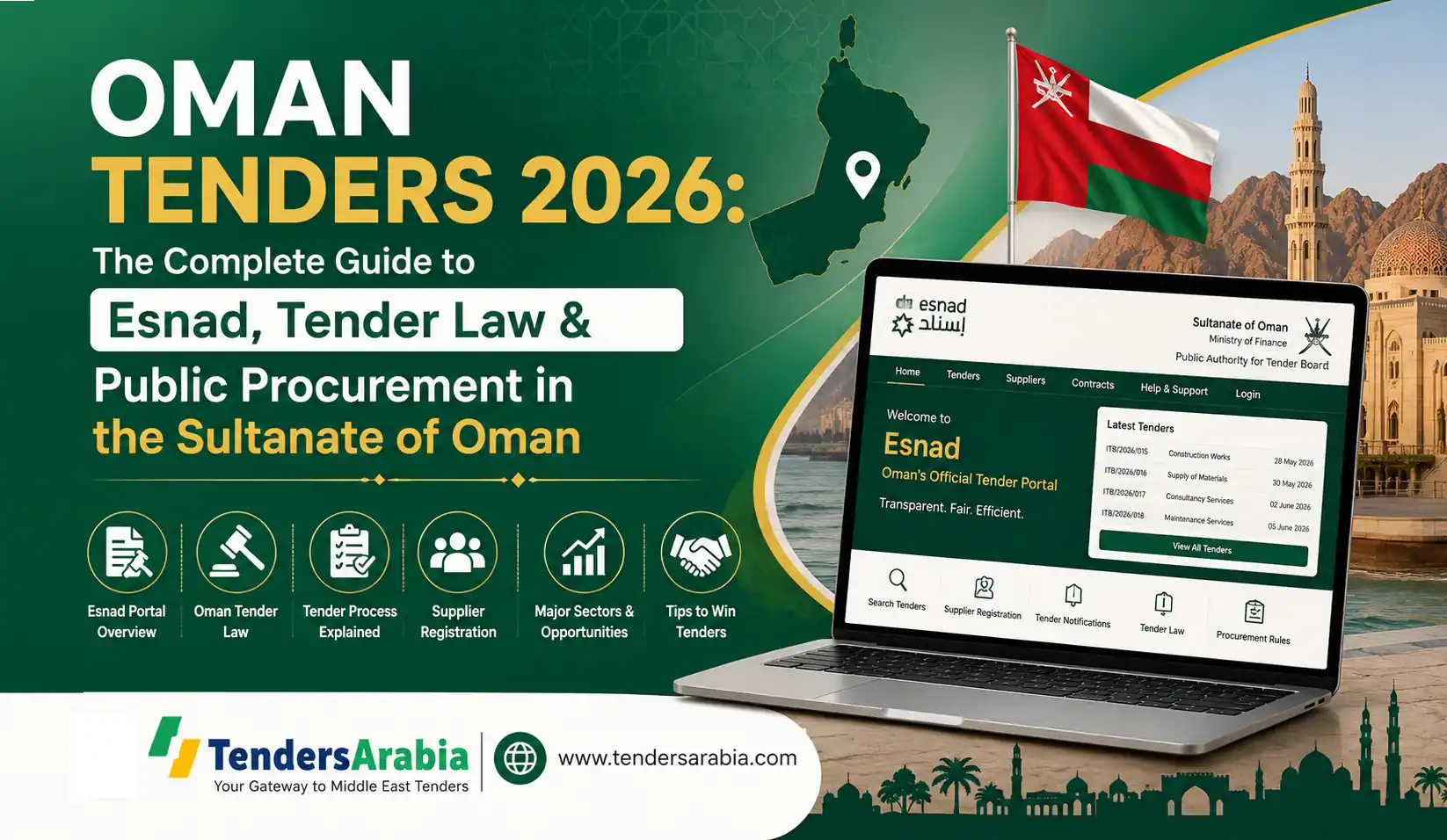
Esnad (إسناد), accessible at etendering.tenderboard.gov.om, is the official, mandatory electronic tendering platform through which all public tenders from ministries and government organisations under the Tender Board's jurisdiction must be published. Esnad's role in the Omani procurement system extends well beyond simple notice publication it is the platform's innovative design that allows government entities to publish their tenders directly, gives registered companies straightforward access to those opportunities and also provides bidders with direct access to the tender laws, registration requirements, regulations and related appendices governing the entire process all from within the platform itself.
The Tender Board has also extended Esnad's reach through a dedicated mobile application, reflecting an ongoing push to improve accessibility for registered suppliers. The stated purpose of this digital infrastructure is to simplify bidding procedures between government entities and suppliers, while improving both the efficiency and the transparency of the overall tendering process a theme that runs consistently through Oman's procurement modernisation efforts over the past decade.
In a significant strategic development, the Tender Board has been working on a new national initiative the National Procurement and Project Management System, known as Takamul that is intended to evolve and ultimately succeed elements of the current Esnad system. Businesses already registered on Esnad should monitor official Tender Board communications closely for guidance on this transition, as the underlying platform infrastructure supporting Oman's tendering ecosystem continues to develop.
A distinctive feature of Oman's procurement ecosystem one that sets it apart from the more reactive, tender-by-tender approach common in many markets is the Furas Platform, operated by the Oman Investment Authority (OIA). Furas is specifically designed to give the private sector advance visibility into upcoming government and state-owned enterprise projects, typically three to six months before a formal tender is floated on Esnad.
For contractors, EPC firms and consultants, this advance notice window is strategically valuable in a market where local content compliance, classification preparation and joint venture or local partnership arrangements with Omani entities can take considerable time to put in place. Businesses that monitor Furas systematically gain a meaningful planning advantage over competitors who only begin preparing once a tender notice formally appears on Esnad.
Before bidding on any Oman government tender, a company must complete registration and obtain a Tender Board classification appropriate to its sector and the nature of the work it intends to bid on. Oman's framework draws a clear distinction between two participation categories:
Tenders themselves are categorised based on the breadth of participation the procuring entity intends to invite:
No discussion of Oman's procurement environment is complete without a thorough understanding of In-Country Value (ICV) arguably the single most consequential policy framework for any contractor or supplier evaluating the Omani market in 2026. ICV is the Government of Oman's structured policy effort to incentivise companies, both Omani and foreign, to invest in Oman through the procurement of local goods and services and through the training and employment of Omani nationals.
While ICV was originally conceived specifically for oil and gas contracts, the principle has since been embedded into government tenders across virtually all sectors, including transportation and tourism, as part of Oman's broader Vision 2040 economic diversification strategy. Several converging facts illustrate how seriously this policy is being implemented in practice:
For any contractor or supplier without an existing ICV certification or a clear strategy for achieving one, competing for major Omani contracts particularly in oil and gas, but increasingly across infrastructure, manufacturing and renewable energy will be structurally difficult regardless of technical capability or pricing competitiveness.
Beyond the broader ICV framework, Oman's procurement system incorporates a specific Mandatory List mechanism designed to reserve defined categories of goods and services for Omani SMEs and local suppliers. This Mandatory List operates as one of the more direct tools available to the PTLC and the Tender Board for channelling government spending toward Omani businesses, complementing the broader ICV scoring and price preference mechanisms that apply more generally across larger contracts. Bidders particularly international firms should check whether any element of a given tender's scope falls within categories covered by the Mandatory List, as this can materially affect eligibility or require structured partnership arrangements with qualifying Omani suppliers.
Oman's procurement landscape spans central ministries, regional municipalities and a substantial portfolio of state owned enterprises and authorities, each issuing its own programme of مناقصات حكومية عمان (Oman government tenders) and contract opportunities. A comprehensive directory of these issuing authorities is maintained on TendersArabia's authority listings, but the following overview reflects the principal categories of buyer that contractors and suppliers should track.
Additionally, as noted earlier, Petroleum Development Oman (PDO) operates its own independent tender board entirely separate from the central Tender Board structure, alongside the Royal Oman Police and the Diwan of the Royal Court meaning contractors targeting these specific entities must engage their procurement processes directly rather than relying solely on Esnad.
Oman's tender landscape under Vision 2040 spans a deliberately diversified set of sectors, reflecting the Sultanate's strategic push to reduce historical dependence on oil and gas revenue:
Based on the Tender Board's published registration and classification framework, businesses preparing to bid on Oman government tenders should expect the following core documentation and compliance requirements:
Search behaviour among procurement professionals tracking the Omani market reflects both the bilingual nature of Oman's administrative documentation and the international composition of its contractor and supplier base. In English, search activity clusters around terms including Oman tenders, Oman government tenders, Oman e-tendering, Esnad platform, Oman Tender Board, Oman tender law, Oman RFP, Oman procurement classification, Muscat tenders and increasingly specific terms like Oman In-Country Value, ICV Oman certification and Furas Platform Oman reflecting growing market sophistication around the localisation requirements that now shape contract eligibility. Long-tail variants frequently reference specific authorities directly PDO tenders Oman, Asyad Group tenders, Nama Water tenders, Omantel tenders indicating that experienced bidders increasingly search by procuring entity once they understand Oman's distributed institutional landscape.
In Arabic, the dominant search term is مناقصات عمان (Oman tenders), with closely related variants including مناقصات حكومية عمان (Oman government tenders), منصة إسناد (the Esnad Platform), مجلس المناقصات عمان (Oman Tender Board), القيمة المضافة المحلية (In-Country Value / local content value) and تصنيف المقاولين عمان (Oman contractor classification). A notable feature of Omani search behaviour distinguishing it from some neighbouring markets is the comparatively high search volume for ICV and local content terminology specifically, reflecting how deeply this policy framework has been embedded into both Arabic and English-language business discourse around the Omani market.
Successfully navigating Oman's procurement market requires monitoring multiple distinct systems simultaneously the central Esnad platform, the OIA's Furas Platform for advance project visibility, PDO's independent supplier and tender process and the individual procurement channels of major state-owned enterprises such as Asyad Group, Nama Water Services and Omantel. For businesses without an established in-market presence, tracking this distributed landscape consistently while also staying current on evolving local content and ICV requirements represents a genuine and ongoing operational challenge.
TendersArabia addresses this by providing daily updates aggregated from Esnad and all major Omani authorities, authority-specific alerts tailored to your sector for مناقصات عمان, dedicated guidance on local content and Mandatory List compliance, bilingual English and Arabic tender summaries and contract award intelligence to support competitive bid preparation. For businesses evaluating Oman alongside other Gulf markets, this sits within TendersArabia's broader coverage of Saudi Arabia, the UAE, Qatar, Kuwait, Bahrain and the wider Arab world enabling a single bid management team to track opportunities across multiple GCC jurisdictions without separately learning and monitoring each country's distinct institutional architecture.
Q1. What is the main law governing government tenders in Oman?
Public procurement in Oman is governed by the "Tender Law," promulgated by Royal Decree No. 36/2008 on 24 March 2008 and subsequently amended by Royal Decree No. 120/2011 and Royal Decree No. 60/2013. This law replaced the earlier Royal Decree No. 86/84 and established the framework requiring formation of the Tender Board to supervise public procurement. The Secretariat General of the Tender Board was further renamed the Projects, Tenders and Local Content Authority (PTLC) under Royal Decree No. 57/2025. Separately, Royal Decree No. 59/2024 established a new System for Signing Contracts and Financial Commitments of the State, effective 25 December 2024.
Q2. What is Esnad and how do I register on it?
Esnad (إسناد), accessible at etendering.tenderboard.gov.om, is Oman's official and mandatory eTendering platform, through which all government tenders falling under the Tender Board's jurisdiction must be published. Companies register directly on the platform, where they can also access tender laws, registration requirements and regulatory appendices. The Tender Board has indicated that a new national system, Takamul, is in development to evolve elements of the current Esnad platform registered users should monitor official communications for transition guidance.
Q3. What is the difference between a local and international company under Oman's Tender Board rules?
A local company is one registered in Oman and holding a Registration Certificate from the Ministry of Commerce, Industry and Investment Promotion; such companies must hold valid Tender Board registration before bidding. An international company may participate in eligible tenders without prior Omani registration, but if awarded a contract, must complete all Tender Board registration formalities within one month of the contract award.
Q4. What is the difference between a General Tender and a Limited Tender in Oman?
A General Tender (Open Tender) is announced publicly and open to all qualifying companies, local or international. A Limited Tender involves the Tender Board inviting a pre-selected group of qualified, classified companies holding the relevant degree or grade rather than opening the opportunity to the full market.
Q5. What is In-Country Value (ICV) and why does it matter for bidding in Oman?
In-Country Value (ICV) is the Government of Oman's policy framework incentivising companies to invest in Oman through local procurement, Omani employment and training. Originally focused on oil and gas, ICV is now embedded across most sectors under Vision 2040. Major operators like PDO (targeting 52% ICV by 2030) and OQ Group (offering a 10% price preference on Omani-manufactured goods) actively apply ICV scoring in contract evaluation, making ICV certification a near-essential credential for competing on major Omani tenders, particularly in energy and increasingly across infrastructure.
Q6. What is the Furas Platform and how does it help bidders?
The Furas Platform, operated by the Oman Investment Authority (OIA), gives the private sector advance visibility typically three to six months into upcoming government and state-owned enterprise projects before they are formally tendered on Esnad. This advance notice allows contractors and suppliers to prepare classification, local partnerships and ICV documentation well ahead of formal bid submission deadlines.
Q7. Do Petroleum Development Oman (PDO) tenders go through Esnad?
No. PDO operates its own independent tender board, entirely separate from the central Tender Board and Esnad system, as do the Royal Oman Police and the Diwan of the Royal Court. Contractors and suppliers targeting PDO contracts must register and engage directly with PDO's own supplier qualification and procurement process.
Q8. What is the Mandatory List in Oman's procurement system?
The Mandatory List is a mechanism within Oman's local content framework that reserves defined categories of goods and services specifically for Omani SMEs and local suppliers. It works alongside the broader ICV scoring system to channel a portion of government and state-enterprise spending directly toward qualifying Omani businesses. Bidders, particularly international firms, should check whether elements of a tender's scope fall under Mandatory List categories, as this can affect eligibility or necessitate partnership with a qualifying local supplier.
Oman's government procurement market in 2026 combines one of the Gulf's most mature legal and institutional procurement frameworks with an unusually explicit and deeply embedded local content policy. Success in this market depends on understanding the legal structure under the Tender Law and its 2024-2025 institutional updates, the practical mechanics of Esnad registration and Tender Board classification, the strategic value of monitoring the Furas Platform for advance project visibility and perhaps most importantly building a genuine, sustainable ICV and local content strategy rather than treating it as a compliance afterthought.
For contractors, suppliers and consultants whether Omani, GCC-based or international a systematic approach to classification, ICV certification and continuous tender monitoring across both the central Esnad platform and Oman's independent sectoral procurement systems is the foundation of sustainable participation in one of the Gulf's most institutionally structured public procurement markets.
Ready to explore opportunities in Oman? Register now or Subscribe for premium access and daily مناقصات عمان alerts.
This guide is intended for informational purposes only. Always verify current classification requirements, ICV compliance criteria and tender conditions directly with the Tender Board / Projects, Tenders and Local Content Authority (PTLC), the Esnad platform and qualified legal counsel familiar with Omani procurement law before submitting any bid.