Complete Guide...
October 15, 2026

Qatar is one of the wealthiest and most procurement active economies in the Gulf and its government's tendering environment reflects a deliberate, decade-long transformation. With the Public Works Authority (Ashghal) executing a five year infrastructure plan worth over QAR 80 billion (USD 22 billion) for 2025–2029, Qatar Energy's North Field expansion generating multi billion dollar EPC contracts and Lusail City's continued QAR 250 billion development pipeline, the volume of Qatar government tenders available to contractors, suppliers and consultants is exceptional by any regional standard.
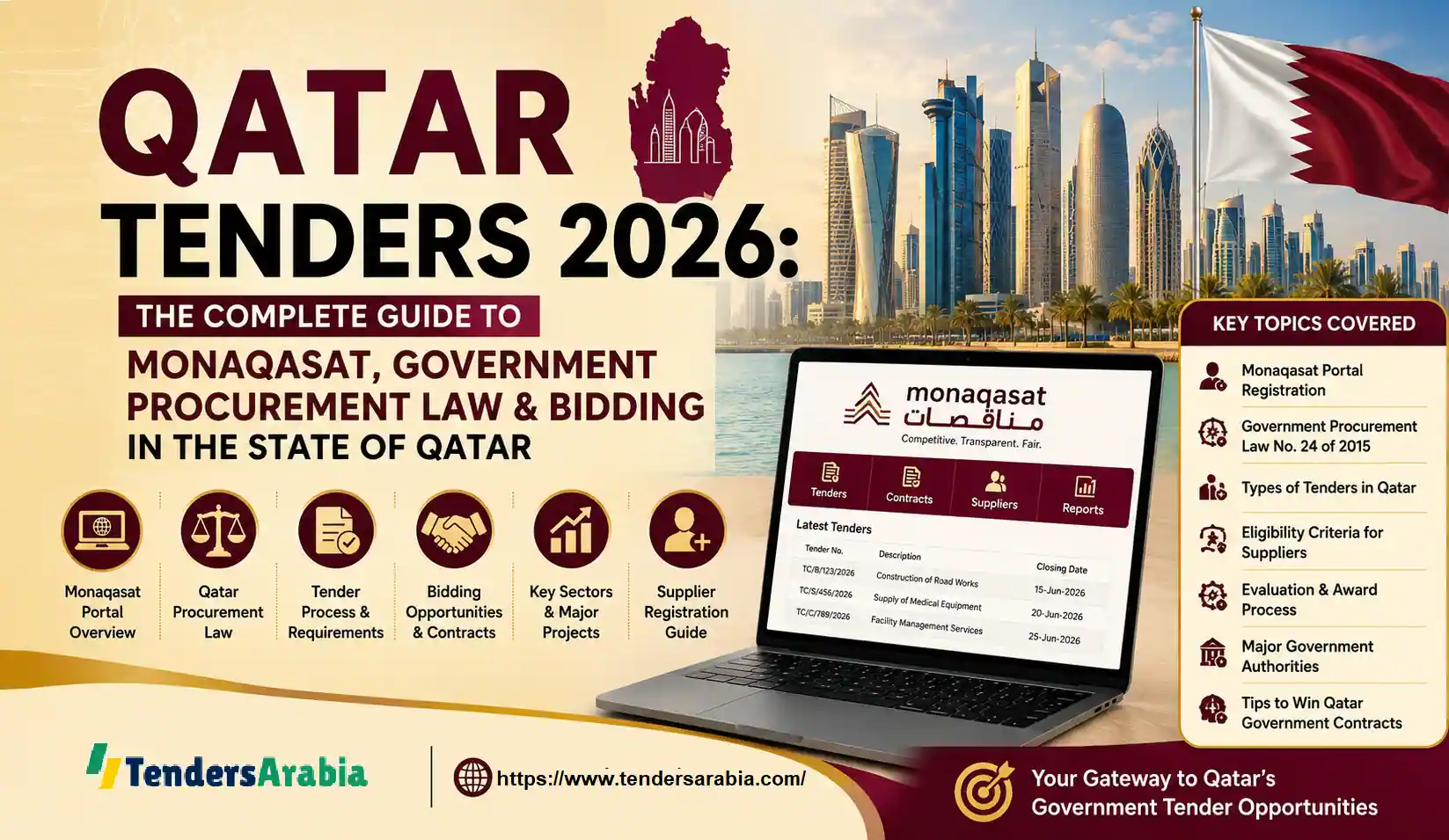
Unlike many Gulf states still digitising their procurement systems, Qatar operates a unified, legally codified tendering framework anchored by Law No. 24 of 2015 on the Regulation of Tenders and Auctions and centralised through the Monaqasat official webportal (monaqasat.mof.gov.qa), Qatar's official Ministry of Finance eTendering portal. For any business Qatari, GCC-based or international seeking to participate in مناقصات قطر (Qatar tenders), understanding this legal and procedural framework is the foundation of every successful bid.
This guide has been researched and written specifically for contractors, EPC firms, consultants, suppliers and service providers evaluating the Qatari procurement market. It covers the legal structure governing Qatar tenders, the classification and registration process, the major procuring authorities, sector opportunities and the practical realities of bidding without referencing any specific live tender, since active opportunities change daily and should always be verified directly on official portals.
Public procurement in the State of Qatar is governed primarily by Law No. 24 of 2015 on the Regulation of Tenders and Auctions, commonly referred to as the "New Procurement Law," which came into force on 13 June 2016. This law replaced the earlier Law No. 26 of 2005 promulgating the Tenders and Bids Regulatory Law and was further refined through Decree Law No. 18 of 2018, which amended several articles including the legal definition of "emergency" procurement circumstances.
The 2015 law applies to all government ministries, agencies, authorities and institutions in Qatar, with specific statutory exclusions for the Qatar Investment Authority, Qatar Energy (formerly Qatar Petroleum), the armed forces, police and other security institutions where procurement may involve confidential or classified contracts. These excluded entities maintain their own internal procurement frameworks rather than operating through the Central Tenders Committee structure.
The Council of Ministers issued the Executive Regulations of Law No. 24 of 2015 via Decision No. 22 of 2016, which sets out the detailed operational procedures referenced by every government ministry's procurement department, including the Ministry of Transport and Communications, Ministry of Finance, Ministry of Municipality, Ministry of Public Health and others that explicitly cite this regulation in their published tender conditions.
The stated objectives of Qatar's modern procurement law include several provisions of direct commercial relevance to bidders:
The Dispute Resolution Committee established under this framework is empowered to adjudicate administrative disputes arising prior to contract conclusion through a reasoned, urgent decision and its rulings are directly enforceable giving aggrieved bidders a genuine and timely avenue for redress without resorting to lengthy civil litigation.
Monaqasat (monaqasat.mof.gov.qa), operated by Qatar's Ministry of Finance, is the country's unified website for state procurement and the definitive digital gateway for anyone seeking to participate in government tenders in Qatar. The portal's stated purpose is to function as a single point of access where companies can register, view active tenders, submit bids and manage their entire procurement relationship with the Qatari government securely and electronically.
Monaqasat provides several distinct functional modules that every prospective bidder should understand before attempting registration:
Before any company Qatari or foreign can submit a bid on a Qatar government tender, it must complete classification through Monaqasat in one of two principal categories, each with further sector-specific specialisations:
Once classified, companies appear in Classified Company Listings that can be searched by company size, business activity or registration type explicitly including local, foreign and free zone registration categories, reflecting Qatar's openness to international participation in its tendering ecosystem alongside domestic Qatari enterprises.
Separately, companies are strongly encouraged to register in the Unified Government Procurement System, which is distinct from the classification process itself. Registration here enables a business to receive automatic notifications whenever a tender or auction announcement matching its registered business activity is published effectively the official, free notification mechanism that Monaqasat provides to registered companies and the natural first step toward eventual classification.
The documentary requirements for participating in Qatar government tenders differ materially depending on whether a company is locally registered in Qatar or is bidding as a foreign or offshore entity. Based on published tender conditions from Qatari ministries, the following requirements are consistently applied:
Qatar's procurement landscape, while unified under the Monaqasat legal framework, is operationally distributed across a number of major government bodies, each with its own tender publication channel and sector focus. Understanding this landscape is essential to targeting the right opportunities.
Qatar's Cabinet approved a dedicated Public-Private Partnership (PPP) law in April 2019, designed to support major infrastructure and social projects connected to Qatar National Vision 2030. The PPP framework spans a deliberately broad range of sectors, explicitly including healthcare, education, sports, real estate and infrastructure and represents a structural shift in how Qatar intends to deliver a portion of its development pipeline going forward moving select large-scale projects away from purely traditional government-funded tendering toward long-term private-sector partnership and operating structures.
Ashghal in particular has signalled active use of the PPP model for selected components of its current development plan, including projects for the development of residential areas for thousands of citizens, incorporating improved road networks, sewage systems and street lighting delivered through partnership arrangements rather than conventional standalone construction contracts. For contractors and investors with PPP delivery experience from other Gulf or international markets, this represents a distinct and growing procurement pathway alongside conventional tendering.
Qatar's tender landscape spans virtually every major economic sector, shaped by the dual legacy of FIFA World Cup Qatar 2022 infrastructure delivery and the ongoing execution of Qatar National Vision 2030. The principal sectors generating sustained government procurement activity include:
Understanding actual search behaviour is essential to appreciating how businesses both within Qatar and internationally locate relevant tender opportunities. Procurement professionals and bidding teams typically search using a combination of formal and informal terminology, in both English and Arabic, reflecting the bilingual nature of Qatar's official documentation and the international composition of its contractor and supplier base.
In English, search behaviour clusters around terms such as Qatar tenders, Qatar government tenders, Qatar e-tendering, Qatar public procurement, Qatar RFP, Qatar RFQ, Qatar EOI (Expression of Interest), Qatar tender classification, Doha tenders, Qatar construction tenders, Qatar tender registration, how to bid for Qatar government tenders and Qatar tenders and bids law. Long-tail variants frequently include explicit authority names Ashghal tenders, Kahramaa tenders, Qatar Energy tenders, Hamad Medical Corporation tenders reflecting that experienced bidders often search directly for the procuring authority rather than generic terms once they understand the market structure.
In Arabic, the dominant search term is مناقصات قطر (Qatar tenders), with closely related variants including مناقصات حكومية قطر (Qatar government tenders), منظومة المناقصات في قطر (Qatar's tendering system), تصنيف الشركات قطر (Qatar company classification), قانون تنظيم المناقصات والمزايدات (the Law on Regulation of Tenders and Auctions) and مناقصات الدوحة (Doha tenders) for businesses specifically targeting the capital.
A distinctive feature of Qatar tender search behaviour one that differentiates it somewhat from other Gulf markets is the prominence of legally-specific search terms. Because Qatar's procurement law is well-documented, codified and frequently amended, search volume for terms like "Qatar tender law amendments," "Qatar Decree Law 18 of 2018," and "Qatar SME tender exemption" is meaningfully higher than in markets where procurement regulation is less formally publicised. This reflects a more legally sophisticated bidder population, including international legal and compliance teams researching market entry requirements before committing resources to bid preparation.
Successfully participating in Qatar's tender market requires monitoring multiple distinct sources simultaneously the Monaqasat platform itself, individual ministry procurement pages such as MOTC and MOCI, Ashghal's dedicated tender portal, Kahramaa's supplier notification system, Qatar Energy's separate procurement channels and institutional portals such as Qatar Foundation's QF Supplier Portal. For businesses without a dedicated in-market presence, tracking this fragmented landscape consistently and accurately is a genuine operational challenge.
TendersArabia addresses this by aggregating tender notices, RFPs, RFQs, EOIs and contract award information from across Qatar's government and public sector procurement landscape into a single, searchable, regularly updated platform alongside equivalent coverage for Saudi Arabia, the UAE, Kuwait, Oman, Bahrain and the wider Arab world. For businesses evaluating Qatar alongside other Gulf markets, this comparative regional visibility is particularly valuable, allowing a single bid management team to track opportunities across multiple GCC jurisdictions without separately learning and monitoring each country's distinct portal architecture.
For companies new to the Qatari market, understanding the classification process, the documentation requirements for foreign bidders and the distinct procurement pathways of entities like Qatar Energy versus the Monaqasat-governed ministries is the essential first step and the foundation upon which any successful, sustained Qatar tendering strategy must be built.
Q1. What is the main law governing government tenders in Qatar?
Public procurement in Qatar is governed primarily by Law No. 24 of 2015 on the Regulation of Tenders and Auctions, which came into force on 13 June 2016 and replaced the earlier Law No. 26 of 2005. It applies to all government ministries, agencies, authorities and institutions, with specific exclusions for the Qatar Investment Authority, Qatar Energy and the armed forces and police for confidential procurement. The law was further amended by Decree Law No. 18 of 2018 and its detailed procedures are set out in the Executive Regulations issued under Council of Ministers Decision No. 22 of 2016.
Q2. What is Monaqasat and how do I register on it?
Monaqasat (monaqasat.mof.gov.qa) is Qatar's official, unified e-tendering and procurement platform, operated by the Ministry of Finance. To begin, companies should register in the Unified Government Procurement System to receive notifications matching their business activity and then submit a classification request either as a Contractor (with sector specialisations such as buildings, roads, sewage, water or agricultural areas) or as a Supplier/Service Provider in order to become eligible to view and bid on government tenders.
Q3. Can foreign and offshore companies participate in Qatar government tenders?
Yes. Monaqasat's classified company listings explicitly include local, foreign and free zone registration categories. Foreign and offshore companies are generally required to submit a certified abstract of their home-country Commercial Register and Memorandum of Association, properly notarised and attested by the competent diplomatic authorities, in place of the Qatari Commercial Registration required of local companies.
Q4. What is the difference between Monaqasat and Ashghal's own tender system?
Monaqasat is the overarching, Ministry of Finance-operated national platform covering the general legal and procedural framework for Qatari government procurement. Ashghal (the Public Works Authority), as Qatar's primary infrastructure delivery body, maintains its own dedicated e-tendering portal for the specific projects it manages, operating within the same overall legal framework but with its own document access, project brief previews and tender management workflow.
Q5. Are Qatar Energy tenders the same as government tenders under Monaqasat?
No. Qatar Energy (formerly Qatar Petroleum) is explicitly excluded from the scope of Law No. 24 of 2015 and does not procure through the Monaqasat/Central Tenders Committee framework. Qatar Energy operates its own independent, internationally structured procurement process for its upstream, midstream and downstream projects, including large EPC contracts associated with programmes such as the North Field expansion.
Q6. What classification do I need to bid on a Qatar construction tender?
Companies seeking to bid on construction-related government tenders must hold a Contractor Classification on Monaqasat in the specific specialisation relevant to the project Monaqasat recognises distinct specialisations including buildings, roads, sewage, water and agricultural areas. A company without the matching specialisation classification for a given tender's scope of work will not be eligible to bid on it, regardless of its general commercial registration status.
Q7. Do small and medium enterprises get any relief under Qatar's procurement law?
Yes. One of the explicitly stated objectives of Law No. 24 of 2015 is exempting qualifying SMEs from the requirement to provide performance bonds and payment guarantees on certain government contracts a deliberate policy measure intended to reduce the capital and financial guarantee burden that would otherwise disadvantage smaller Qatari businesses competing for public contracts.
Q8. What happens if I disagree with how a Qatar government tender was evaluated or awarded?
Qatar's procurement law established a dedicated Dispute Resolution Committee with the authority to adjudicate administrative disputes arising from the application of the tender law prior to contract conclusion, through a reasoned and urgent decision. Importantly, decisions issued by this Committee are directly enforceable, providing bidders with a faster, more specialised avenue for resolving procurement disputes than pursuing the matter through Qatar's general civil court system.
Qatar's government procurement market combines a mature, codified legal framework with an ambitious, multi-year infrastructure and development pipeline spanning construction, energy, healthcare, transport and urban development. Success in this market depends on understanding three things clearly: the legal structure under Law No. 24 of 2015 and its amendments, the practical mechanics of Monaqasat registration and company classification and the operational reality that major authorities like Ashghal, Kahramaa and Qatar Energy each maintain distinct procurement relationships requiring their own registration and monitoring effort.
For contractors, EPC firms, consultants and suppliers whether based in Qatar, elsewhere in the GCC or internationally building a systematic, well-documented approach to classification, compliance and continuous tender monitoring is the foundation of sustainable participation in one of the Gulf's most active and legally transparent public procurement markets.
This guide is intended for informational purposes only. Always verify current classification requirements, tender conditions and legal provisions directly with Monaqasat (monaqasat.mof.gov.qa), the relevant procuring authority and qualified legal counsel familiar with Qatari procurement law before submitting any bid.