
Complete Guide...
October 15, 2026

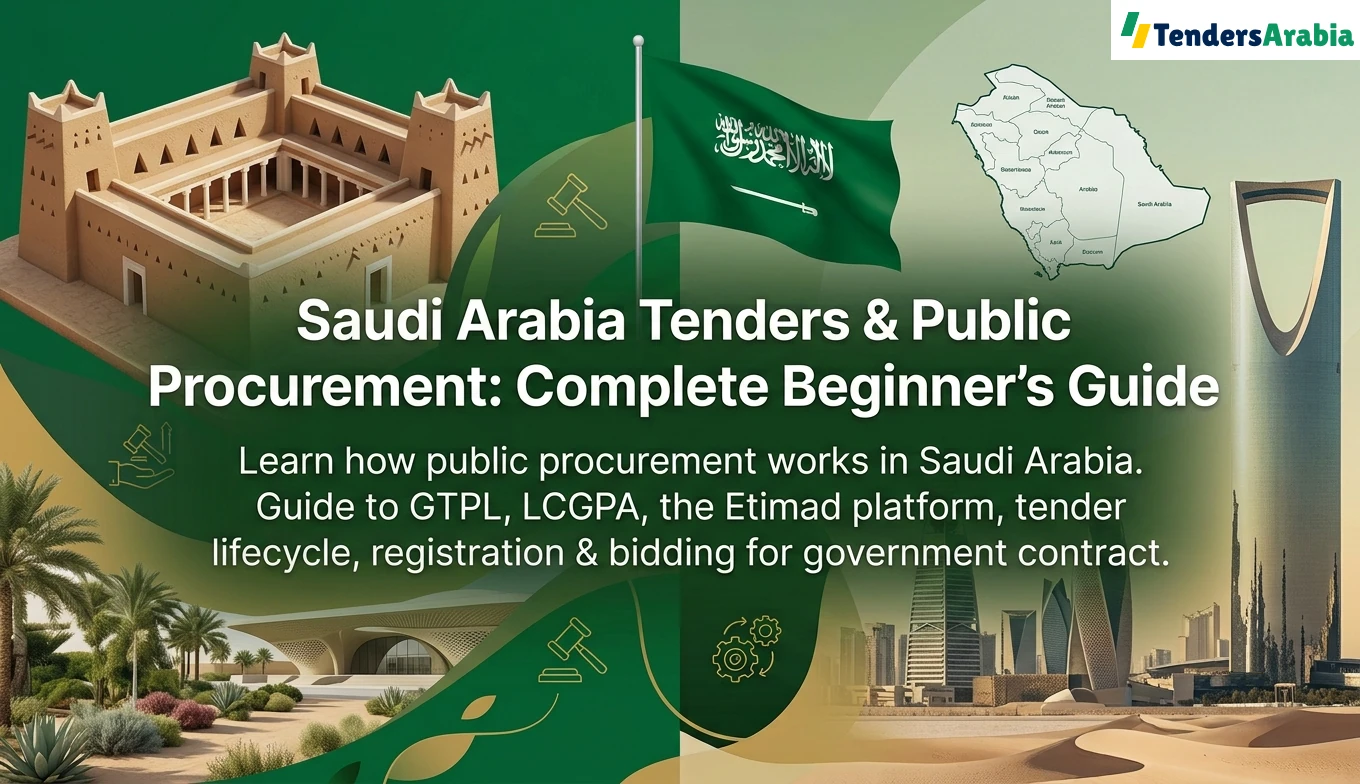
Saudi Arabia operates the largest and most active public procurement market in the Middle East, and government spending on goods, works, and services continues to expand every year under Vision 2030. For suppliers, contractors, and consultants, this represents one of the most valuable commercial opportunities in the region. However, the Saudi procurement system has its own laws, its own national electronic portal, and its own registration and local content rules. Without a clear understanding of how these pieces fit together, new bidders lose time, money, and tender opportunities before they even submit their first offer.
This beginner's guide explains the entire Saudi Arabia public procurement system in plain language. It covers the Government Tenders and Procurement Law (GTPL), the Local Content and Government Procurement Authority (LCGPA), the Etimad national platform, the tender lifecycle, registration requirements, and the practical steps a new supplier must take to participate with confidence. By the end, you will understand what public procurement means in Saudi Arabia, who regulates it, how tenders are published and awarded, and exactly where to begin your first bid.
Public procurement in Saudi Arabia refers to the process by which government entities purchase goods, commission works, and acquire services using public funds. Every ministry, authority, municipality, public university, government hospital, and state-owned company must follow a defined legal process when it spends public money. That process begins with a published tender or request for proposal (RFP) and ends with a signed contract, delivery, and payment.
The scope is enormous. Public procurement in Saudi Arabia covers construction and infrastructure, information technology, healthcare supplies, education services, oil and gas support services, operation and maintenance, consultancy, cleaning, catering, security, logistics, and much more. Because the state is the largest buyer in the economy, winning government contracts is a strategic growth path for both local and international companies. The entire system is designed around three principles: transparency, fair competition, and value for public money, with local content added as a fourth national priority.
Understanding the Saudi system is easier when you think of it in layers. Each layer has a different function, and a new bidder must engage with all of them to compete effectively.
| Layer | Function | Key Body or Platform |
|---|---|---|
| Legal layer | Sets the rules for tendering, evaluation, and awarding | Government Tenders and Procurement Law (GTPL) |
| Regulatory layer | Oversees policy, local content, and compliance | LCGPA and Ministry of Finance |
| Platform layer | Publishes tenders and manages bids electronically | Etimad (etimad.sa) |
| Buyer layer | Issues tenders and awards contracts | Ministries, authorities, municipalities, state companies |
| Supplier layer | Registers, bids, and delivers | Contractors, suppliers, consultants, SMEs |
| Project layer | Runs giga-projects with separate portals | NEOM, Qiddiya, Red Sea Global, Diriyah, PIF |
The important point for a beginner is that the legal and regulatory layers are national and mandatory, while the platform layer is where day to day activity happens. Almost all standard government tenders in Saudi Arabia now pass through Etimad, which makes it the single most important portal to learn.
The Government Tenders and Procurement Law, usually shortened to GTPL, is the foundation of all public procurement in Saudi Arabia. It sets out how government entities must announce tenders, how bidders must submit offers, how committees evaluate them, how contracts are awarded, and how disputes are handled. Its Executive Regulations provide the detailed procedures that sit underneath the law.
The law has been modernised in recent years. A new version was approved by the Cabinet under Royal Decree D/76, and the Ministry of Finance issued further amendments to the Executive Regulations under Ministerial Resolution No. 1097. These reforms matter to bidders because they change how quickly tenders move and how committees operate. Key changes include the merging of bid opening and bid evaluation committees into a single committee, a stronger direct procurement method with a higher financial threshold, expanded limited tendering to include practitioners of liberal professions, and a requirement that private sector dues be settled within prescribed timeframes before a government entity enters into new contractual commitments.
For a beginner, the practical takeaway is simple: the GTPL defines your rights and obligations as a bidder. Knowing the law helps you avoid disqualification and gives you grounds to challenge unfair treatment.
The LCGPA is the regulatory authority responsible for procurement policy and local content in Saudi Arabia. It publishes laws, regulations, local content requirements, and the Mandatory List of National Products. It also administers how local content is weighted during the financial evaluation of bids, which means it directly affects whether your offer wins or loses.
Local content is not a side issue in Saudi Arabia. It is a central pillar of procurement policy, governed by the GTPL and by the Regulations on Preference for Local Content and Local SMEs and Companies Listed on the Capital Market. Under these rules, a minimum local content requirement of 30 percent at the company level applies to management consulting tenders, and the Mandatory List of National Products covers a large number of product categories subject to minimum local content requirements. Suppliers need a local content certificate to benefit from the Mandatory List, and local content weighting is applied when financial bids are compared. For any serious bidder, understanding LCGPA rules is as important as understanding the tender documents themselves.
Etimad, known in Arabic as Etimad (اعتماد), is Saudi Arabia's unified electronic government procurement portal. Launched in 2018 by the Ministry of Finance, it manages all government tenders, procurement activity, and financial services across government entities. Unlike a simple tender listing site, Etimad is a full transaction platform. It handles tender search, supplier registration, RFP purchase, bid submission, proposal review, and supplier account management.
| Etimad Service | What It Does |
|---|---|
| Tender search | Search government tenders by activity, region, entity, and closing date |
| Supplier registration | Create and manage your vendor profile and classification |
| RFP purchase | Buy and download tender documents (the RFP or conditions book) |
| Bid submission | Submit technical and financial proposals electronically before the deadline |
| Financial services | Manage bid bonds, guarantees, and related financial instruments |
| Supplier portal | Track your bids, awards, and account status |
For beginners, Etimad is where your procurement journey begins and ends. If you are not registered and active on Etimad, you cannot meaningfully participate in standard Saudi government tenders. Learning the platform interface, the search filters, and the submission workflow is the single highest value investment a new bidder can make.
Every Saudi government tender follows a predictable lifecycle. Understanding each stage helps you plan resources and avoid last minute failures.
Saudi Arabia uses several procurement methods, and the method chosen by the government entity determines how competitive the process will be.
| Procurement Method | Description | Typical Use |
|---|---|---|
| Public tender | Open competition announced publicly on Etimad | Most standard government contracts |
| Limited tender | Restricted to invited or prequalified bidders | Specialised works and professional services |
| Direct procurement | Direct contracting without full competition | Urgent or low value needs within legal limits |
| Framework agreement | Pre agreed terms with selected suppliers over a period | Recurring goods and services |
| Electronic tender | Fully digital process through Etimad | Standard practice across government |
| Auction | Competitive bidding focused on price | Disposal of assets and specific procurements |
A beginner must recognise that Saudi Arabia runs two parallel procurement worlds. The first is the standard national system managed through Etimad, where ministries, municipalities, hospitals, universities, and authorities publish tenders under the GTPL. This is the world where most new bidders start, and it follows consistent rules and predictable timelines.
The second world is the giga-project ecosystem. NEOM, Qiddiya, Red Sea Global, Diriyah Gate, and Public Investment Fund initiatives operate their own supplier portals and procurement processes. These projects are massive in scale and often require international standards, joint ventures, and specialised prequalification. They are not managed through the standard Etimad flow in the same way, so bidders must register separately with each project. Companies in oil and gas also work through their own channels, including the Aramco IKTVA local content programme, SABIC supplier registration, and Maaden procurement. Knowing which world you are targeting shapes everything from your registration strategy to your pricing model.
Saudi government tenders are open to several categories of bidders, and each category faces different requirements.
Before you can bid, you must have your documentation in order. Saudi procurement is document driven, and missing paperwork is the most common reason new bidders are disqualified.
| Document | Purpose |
|---|---|
| Commercial Registration (CR) | Proves your company is legally registered and licensed |
| Saudization certificate | Confirms compliance with nationalisation of the workforce |
| Zakat certificate | Confirms Zakat compliance, mandatory for government contracts |
| VAT registration | Confirms tax registration and compliance |
| Local content certificate | Enables benefits under the Mandatory List and local content rules |
| IBAN form | Enables electronic payment of contract amounts |
| Classification certificate | Establishes your company grade and eligible contract size |
| Bid bond | Financial guarantee submitted with your offer |
Local content and Saudization are not optional extras in Saudi procurement. They are evaluated, weighted, and enforced. Local content refers to the proportion of value created inside Saudi Arabia through local manufacturing, local services, local workforce, and local supply chains. Saudization refers to the employment and development of Saudi nationals within your company.
For bidders, these requirements affect both eligibility and scoring. A higher local content percentage can improve your position in financial evaluation. A strong Saudization record supports your technical and compliance profile. Companies that ignore these factors often submit competitive prices and still lose, because the evaluation formula rewards local value creation. Beginners should treat local content planning as part of bid strategy from day one, not as an afterthought.
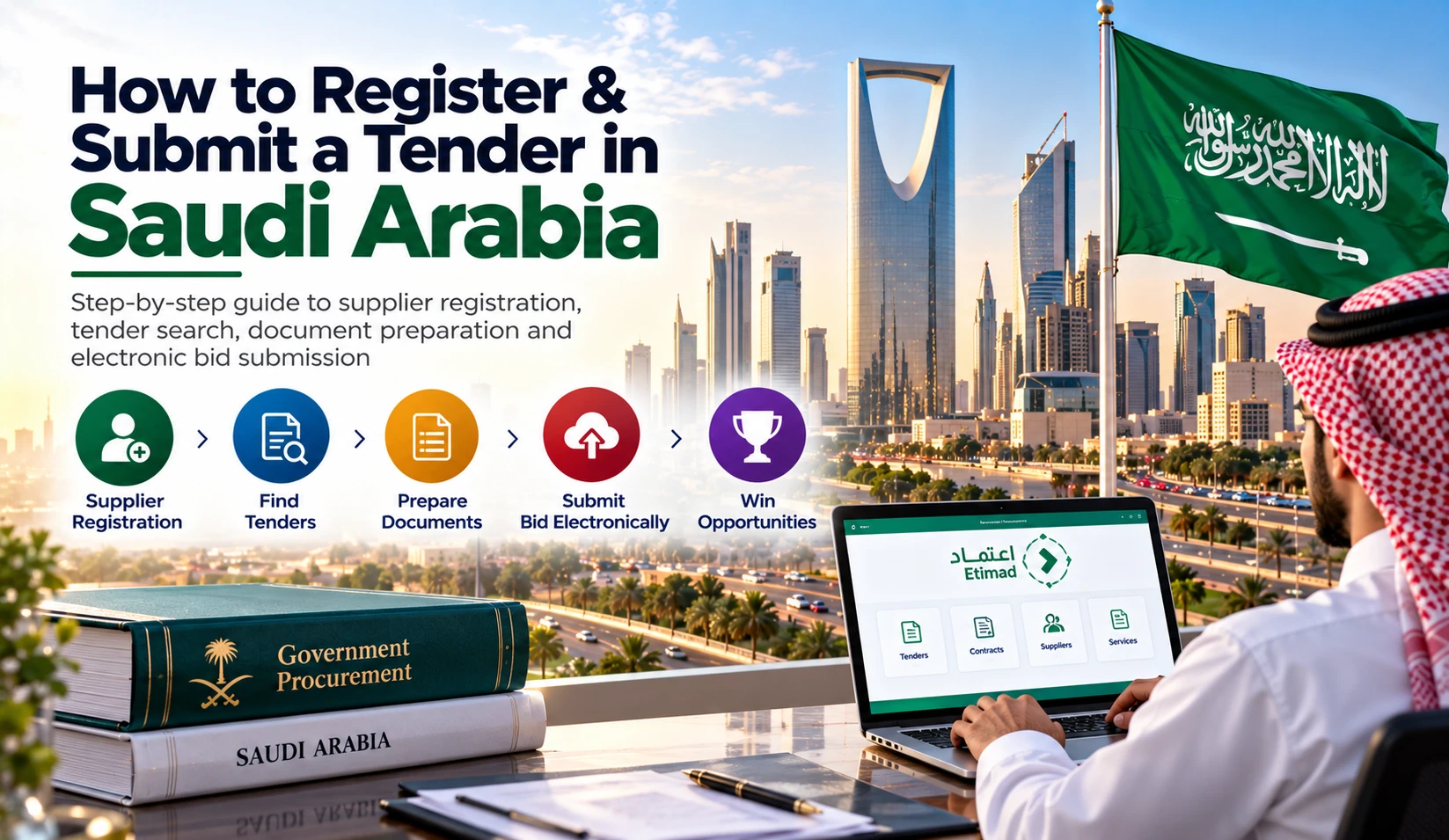
If you are starting from zero, follow a structured sequence rather than jumping straight into bidding.
TendersArabia.com gives new and experienced bidders a single place to track Saudi Arabia procurement opportunities without manually searching multiple portals every day. You can browse live opportunities through Tenders, review awarded contracts and market activity through Contract Awards, and understand buyer entities through the Authorities directory. This saves hours of research and helps you focus on tenders that genuinely match your classification, activity, and capacity.
Beyond tender discovery, the TendersArabia.com bidding consultancy team supports suppliers, contractors, and consultants through the entire bid cycle. That includes supplier registration guidance, document preparation, technical and financial proposal structuring, local content and compliance review, and pricing strategy. If you are new to Saudi procurement, you can create an account at Register, compare plans at Pricing and subscribe now, or reach the team directly through Contact Us or by email at info@tendersarabia.com.
Saudi Arabia's public procurement market rewards prepared bidders. If you want daily tender alerts, contract award intelligence, and expert bidding support in one place, subscribe now through TendersArabia Pricing, create your account at Register, and explore live opportunities at Tenders. For personalised guidance, contact the team at Contact Us or email info@tendersarabia.com.
Public procurement in Saudi Arabia is a structured, regulated, and highly rewarding market for bidders who take the time to learn the system. The Government Tenders and Procurement Law defines the rules, the LCGPA drives local content and compliance, and the Etimad platform connects buyers and suppliers electronically. Understanding the tender lifecycle, the procurement methods, the required documents, and the difference between national tenders and mega-project procurement gives a beginner a genuine competitive advantage. With the right registration, the right documents, and the right bid strategy, your first Saudi government contract is achievable, and it can become the foundation of long term growth in the Kingdom.
To continue building your knowledge, explore the live Saudi tenders list, study recent contract awards, review the government authorities directory, and prepare your account through registration. Detailed guides on the Etimad platform, LCGPA local content, GTPL law, vendor registration, tender documents, and mega-project procurement are covered in the following articles of this series.
Public procurement in Saudi Arabia is the process by which government entities purchase goods, works, and services using public funds, following the Government Tenders and Procurement Law and its Executive Regulations, with tenders published and managed through the Etimad platform.
Etimad is Saudi Arabia's unified electronic government procurement portal, launched in 2018 by the Ministry of Finance. It manages government tenders, supplier registration, RFP purchase, bid submission, and financial services across all government entities.
You register by creating a supplier account on Etimad, completing your vendor profile, and uploading required documents such as your Commercial Registration, Saudization certificate, Zakat certificate, and VAT registration.
The Government Tenders and Procurement Law, or GTPL, is the legal framework governing all public procurement in Saudi Arabia. It defines tender procedures, evaluation rules, contract awards, and bidder obligations, supported by detailed Executive Regulations.
LCGPA is the Local Content and Government Procurement Authority. It regulates procurement policy, publishes local content rules and the Mandatory List of National Products, and administers local content weighting in bid evaluation.
Local content refers to the proportion of value created inside Saudi Arabia through local manufacturing, services, workforce, and supply chains. It is weighted during financial evaluation and supported by a local content certificate.
Yes, foreign companies can bid for Saudi government contracts, but they must meet additional requirements including the regional headquarters rule, local partnership considerations, and compliance with Saudization and local content provisions.
Required documents typically include Commercial Registration, Saudization certificate, Zakat certificate, VAT registration, local content certificate where applicable, IBAN form, classification certificate, and a valid bid bond.
A bid bond, known in Arabic as the initial guarantee, is a financial guarantee submitted with your bid to confirm serious intent. It is usually a percentage of the bid value and is returned to unsuccessful bidders.
Timelines vary by complexity, but a standard tender typically runs from announcement through document purchase, clarification, submission, evaluation, and award over several weeks to a few months, depending on the entity and scope.
The main types are public tender, limited tender, direct procurement, framework agreement, electronic tender, and auction. The method chosen determines how open or restricted the competition will be.
The Mandatory List is a list of product categories subject to minimum local content requirements. Suppliers need a local content certificate to benefit from the preference given to national products on this list.
Saudization is the national policy of employing Saudi nationals. Compliance is verified through a Saudization certificate and affects your eligibility and evaluation score in government tenders.
NEOM, Qiddiya, Red Sea Global, and Diriyah operate their own supplier portals and procurement processes. They are separate from the standard Etimad flow, so bidders must register with each project individually.
You can find Saudi Arabia tenders daily by monitoring Etimad and subscribing to a tender intelligence service such as TendersArabia.com, which provides live tender listings, contract award data, and bidding consultancy support.