Complete Guide...
October 15, 2026

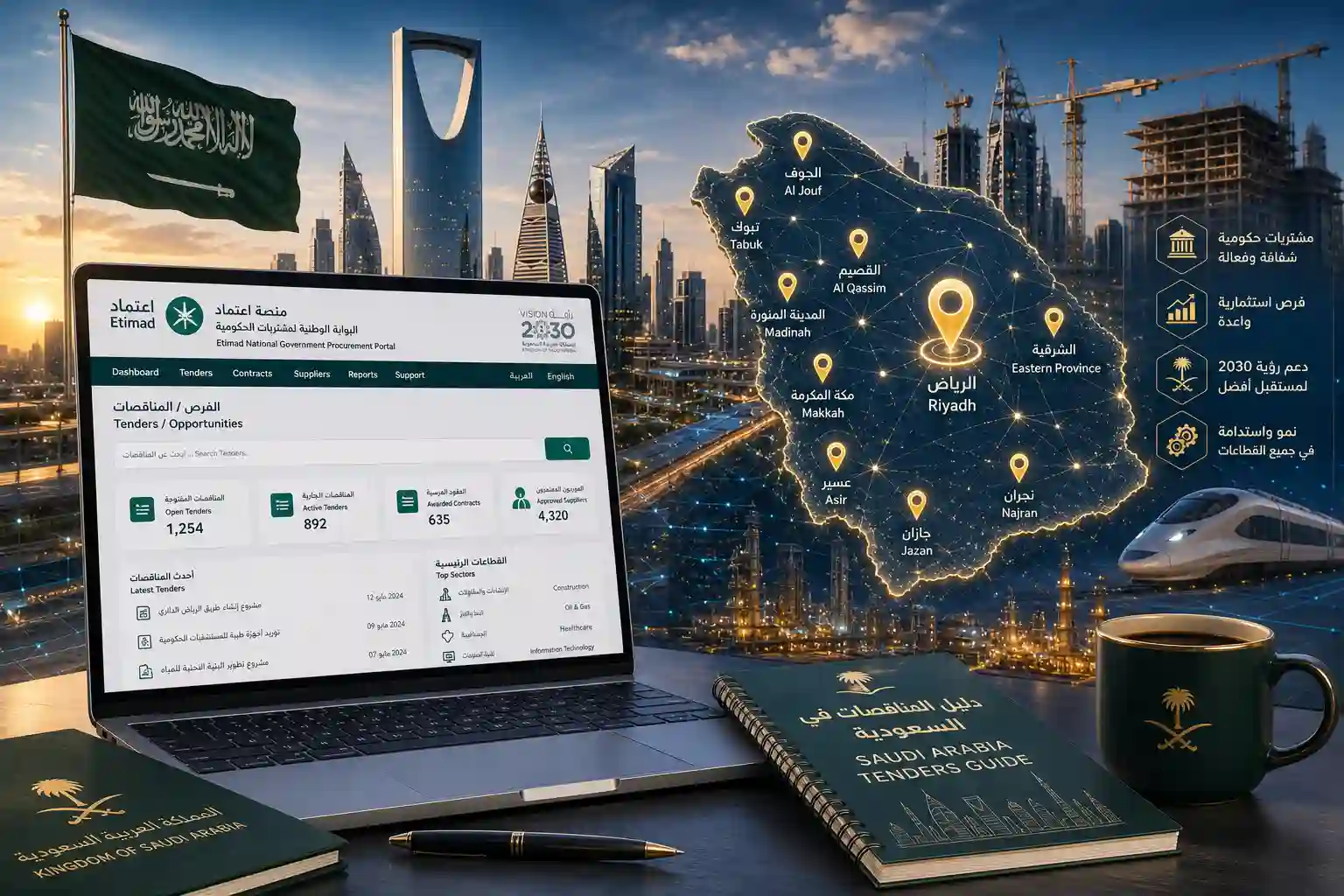
Saudi Arabia represents one of the world's most lucrative and rapidly growing procurement markets. As the largest economy in the GCC and a cornerstone of the Arab World and Middle East, the Kingdom offers unparalleled opportunities across infrastructure, energy, technology, healthcare and defence sectors under its ambitious Vision 2030 program. There is no procurement market in the Arab world quite like Saudi Arabia's - in the current year, the Kingdom is not merely issuing tenders but reshaping entire industries and building cities from scratch in the desert.
Whether you are a local contractor in Riyadh, Jeddah or Dammam or an international supplier seeking to enter the KSA market, understanding the Government Tenders and Procurement Law (GTPL), mastering the official Etimad portal and complying with local content requirements are essential for success. This comprehensive guide provides deep knowledge for contractors, suppliers and consultants on how to participate in Saudi Arabian tenders and turn the Kingdom's extraordinary procurement pipeline into your most valuable contract portfolio.
Driven by Crown Prince Mohammed bin Salman's Vision 2030 blueprint, Saudi Arabia has unleashed one of the most audacious public spending programmes in modern history: a pipeline of government contracts spanning construction, renewable energy, digital transformation, healthcare, defence, education and municipal services that collectively represents an estimated SAR 600 billion (approximately $160 billion USD) in annual procurement volume.
For contractors, suppliers, EPC companies, consultants and service providers worldwide, the scale of opportunity in Saudi Arabia tenders is extraordinary. The Saudi Power Procurement Company (SPPC) alone is targeting the award of 14 gigawatts of new renewable energy projects in 2026. Giga-projects like NEOM, the Red Sea Project, Diriyah Gate and Qiddiya are in advanced construction phases, generating thousands of active tender notices. By 2026, over 90% of government procurement is conducted digitally, facilitating easier access for global suppliers.
Key reasons Saudi Arabia's tender market stands out:
For businesses that strategically track and bid on Saudi government contracts, this market offers a stable, high-value, long-term revenue stream unlike any other in the region.
The Government Tenders and Procurement Law (GTPL) is the primary legislation governing all procurement procedures in the Kingdom. It establishes the standards for transparency, fairness and efficiency in public contracts.
Key provisions of the GTPL include:
The Expenditure and Project Efficiency Authority (EXPRO) has developed seven government procurement manuals aligned with the GTPL, including the Manual for Tender Announcements, Manual for Estimated Cost and Manual for Ongoing Tenders. These resources provide best practice knowledge for both government entities and private sector service providers.
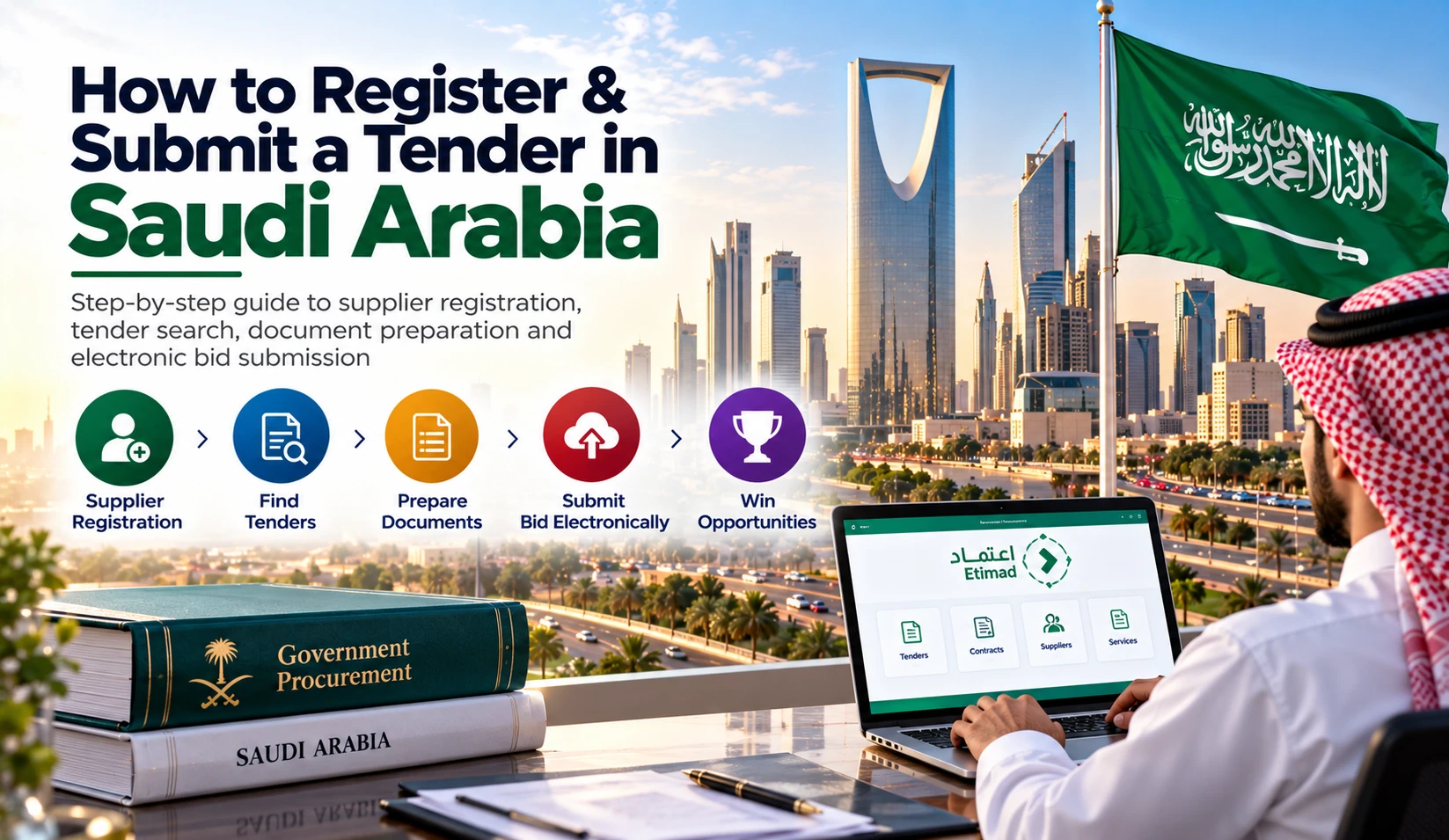
The Etimad platform (etimad.sa), managed by the Ministry of Finance, is the Kingdom's central e-platform for government tenders and procurement. It is the official route through which all public procurement must pass, making it essential for any company looking to win government contracts in Saudi Arabia.
What you can do on Etimad:
Registering on Etimad is a multi-step process requiring local validation and detailed documentation:
Step 1: Establish a Saudi Registered Entity
Obtain an active Commercial Registration (CR) issued by the Ministry of Commerce. For international companies, establishing a Regional Headquarters (RHQ) in Saudi Arabia or partnering with a local entity is required.
Step 2: Verify Identity Through Absher
Absher is Saudi Arabia's national digital ID system. Foreign firms need a Saudi partner or local representative for verification. Registration requires a real-time link with the Nafath system to verify identity and the Absher unified national account for authentication.
Step 3: Access the Etimad Portal
Visit etimad.sa and create an account under the 'Suppliers' section. Companies pay an annual subscription fee of SAR 1,500.
Step 4: Add Financial and Banking Information
Required for bid bond submissions (Kafalah) and contract payments.
Step 5: Authorize Users
Assign internal team members or external consultants who can manage your submissions.
Article 13 of the Executive Regulations outlines the essential documentation for engaging in Saudi government tenders. Compliance is non-negotiable for securing contracts.
Mandatory Documents for All Bidders:
المستندات المطلوبة Required Documents Summary: Valid commercial register, registration on Etimad platform and the supplier must not be on the blacklist issued by the Ministry of Finance.
The Local Content & Government Procurement Authority (LCGPA) enforces local content requirements in government contracts, drawing on the IKTVA (In-Kingdom Total Value Add) model pioneered by Saudi Aramco. These requirements are becoming increasingly stringent and are critical for winning tenders.
Key Updates on Local Content (2025-2027):
Products and Services Covered by Mandatory Local Content List:
Saudi Arabia issues tenders at both central (national) and local (municipality/region) levels. Understanding the issuing authorities across different cities is crucial for targeted bidding.
Central/Federal Level Entities:Riyadh Region (الرياض):
Makkah Region (منطقة مكة المكرمة):
Eastern Province (المنطقة الشرقية):
Asir Region (منطقة عسير): Asir Region Municipality - Abha, Khamis Mushayt sub-municipality
Medina Region (منطقة المدينة المنورة): Medina Municipality, General Directorate of Civil Status
Tabuk Region (منطقة تبوك): Tabuk Municipality, Ground Forces - Tabuk
Najran Region (منطقة نجران): Najran Municipality, Ground Forces - Najran, Security Forces Housing - Sharurah
By Tender Type (Method):
By Business Nature (Category):
Yes, foreign companies can participate in Saudi government tenders, but they must meet specific requirements:
Step 1: Find Opportunities on Etimad
Use the Etimad dashboard to filter tenders by sector, region (Riyadh, Jeddah, Dammam, etc.) and contract value. Search is Arabic-based, so linguistic accuracy matters. Also monitor planned tenders through the "Future Tenders" feature.
Step 2: Review and Purchase Tender Documents
Most bids require payment to access full RFP documentation. Ensure your technical and financial teams review these in Arabic.
Step 3: Prepare Your Bid (Two Envelope System)
Prepare technical and financial proposals separately. Ensure all required documentation is complete and certified. Secure a bid bond (Kafalah) from a bank licensed in Saudi Arabia. Verify local content compliance for mandatory list products.
Step 4: Submit Your Bid Electronically
Upload both technical and commercial proposals via Etimad portal. Ensure bid bond (Kafalah) is submitted digitally. Submit well before the deadline - portal server time is the legal reference point.
Step 5: Electronic Bidding Round (Where Applicable)
For eligible tenders, the e-bidding process allows registered vendors to submit and modify prices in real time during a designated bidding window, with rankings displayed to participants.
Step 6: Follow Up
Track award announcements, clarifications and evaluation updates through Etimad. Government entities select bids through the Bid Selection Service on the National Platform.
Bid Bond (الضمان المؤقت / Kafalah):
Typically 1% to 5% of the bid value. Must be issued by a bank licensed in Saudi Arabia. Required to show seriousness of participation. Refunded to unsuccessful bidders after award. Local SMEs registered under national SME support programmes may be eligible for exemption.
Performance Bond (الضمان النهائي):
Typically 5% to 10% of the contract value upon award. Some smaller direct purchase tenders may not require a performance bond. Held until contract completion and acceptance.
TendersArabia.com is purpose-built for the Gulf procurement market - and its Saudi Arabia coverage is unmatched. Here is how the platform transforms your bidding results.
Centralised Access to Saudi Tenders:
Our platform aggregates tenders from over 500 government entities across all 13 regions of Saudi Arabia, including Riyadh, Jeddah, Dammam, Mecca, Medina, Abha, Tabuk and Najran. You no longer need to monitor multiple portals separately.
Real Time Etimad Integration & Alerts:
TendersArabia provides daily updates from the official Etimad platform. Configure personalized alerts by sector, authority, region, contract value and keywords. The moment a matching tender is published, you receive an immediate notification.
Bilingual Support (English & Arabic):
For international bidders, navigating Arabic-only portals like Etimad is challenging. TendersArabia provides English translations of key tender information, including titles, descriptions, deadlines and requirements.
Local Content Compliance Tools:
With the LCGPA mandatory list expanding to over 1,500 products, our platform helps you identify tenders where your products can qualify as local content. We provide alerts for local content requirements and minimum percentage thresholds.
City and Region Level Filtering:
Target specific regions efficiently: filter tenders by city (Riyadh tenders, Jeddah tenders, Dammam tenders, Mecca tenders, Medina tenders, Abha tenders) or by issuing authority.
Contract Awards Database & Planned Tender Tracking:
Analyse who won past tenders, understand pricing benchmarks and identify subcontracting opportunities. Monitor "Future Tenders" announcements on Etimad to prepare bids in advance of formal release.
Gulf-Wide Procurement Coverage:
Unlike Etimad, which covers only Saudi government entities, TendersArabia.com aggregates bid opportunities from Saudi Arabia, UAE, Qatar, Kuwait, Oman and Bahrain - giving contractors and suppliers visibility across the entire GCC market from a single subscription.
| Feature | Etimad Portal Only | TendersArabia.com |
|---|---|---|
| Coverage | Saudi government entities only | Saudi Arabia + all GCC countries |
| Real-Time Alerts | Manual search required | Personalised email/mobile alerts |
| Corrigendum Tracking | Manual monitoring | Automated alerts |
| Language Support | Arabic primary | Arabic + English optimised |
| Local Content Guidance | Raw policy documents | Practical compliance guidance |
| Planned Tenders | Basic listing | Advanced tracking & preparation alerts |
Join thousands of contractors and suppliers who use TendersArabia.com to find, bid on and win high-value government contracts across the Kingdom.
Register for Free →View Premium Plans for complete tender documents and advanced analytics
Renewable Energy Will Dominate Procurement Through 2030:
Saudi Arabia is targeting 58.7 GW of renewable capacity by 2030. Between now and that target, the procurement pipeline for solar, wind, green hydrogen and battery storage is essentially uninterrupted.
Giga-Projects Are Entering Peak Construction Phase:
NEOM, the Red Sea Project, Diriyah Gate, Qiddiya and Roshn are all transitioning from master planning into intensive construction - meaning the highest-value tender volumes are arriving now and through 2028.
Digital Transformation Procurement Will Accelerate:
With over 90% of government procurement conducted digitally by 2026, SDAIA and digital authorities will be among the most active issuers of high-value IT tenders - AI, cloud infrastructure, cybersecurity and smart city solutions.
PPP Expansion Creates New Contract Models:
Over 200 PPP projects valued at approximately $133 billion are in progress across transportation, healthcare and education. Businesses equipped for PPP participation will access long-term contracts.
Local Content Will Intensify as a Competitive Factor:
The LCGPA has begun applying local content requirements to progressively smaller government contracts. Companies establishing manufacturing, R&D or training operations in Saudi Arabia now are building the local content credentials that will differentiate their bids in 2028 and beyond.
1. What is the Etimad platform and why is it mandatory?
The Etimad platform (etimad.sa) is Saudi Arabia's official e-procurement portal, overseen by the Ministry of Finance. It is mandatory for all government entities to publish tenders on Etimad and all bidders must register on the platform to view detailed tender documents and submit bids electronically. The platform serves over 500 government entities.
2. What does "مناقصات السعودية" refer to?
مناقصات السعودية (Saudi Arabia Tenders) refers to all government and public sector bidding opportunities released by Saudi authorities, including central government ministries, municipalities, state-owned enterprises and other public entities governed by the GTPL.
3. Can international companies bid on Saudi government tenders?
Yes, but with requirements. International companies must either establish a Regional Headquarters (RHQ) in Saudi Arabia or qualify for an exemption (available for contracts up to SAR 1 million or specialized projects). Over 700 multinational companies have already established RHQ in Riyadh.
4. What are the local content requirements for Saudi tenders?
The LCGPA enforces mandatory local content requirements. The National Product Mandatory List (NPML) covers over 1,500 products across 16 sectors. From March 1, 2026, contractors on public projects must procure listed goods from domestic manufacturers. Minimum local content percentages apply to 233 products from August 1, 2026.
5. How do I register on the Etimad platform?
Registration requires: (1) a valid Saudi Commercial Registration (CR), (2) verification through Absher, (3) financial and banking information and (4) user authorization. Foreign firms need a Saudi partner for Absher verification. Annual subscription: SAR 1,500.
6. What is the role of EXPRO in Saudi procurement?
The Expenditure and Project Efficiency Authority (EXPRO) supports government entities in enhancing expenditure efficiency and has launched seven government procurement manuals providing best practice guidance.
7. What documents are required to bid on KSA tenders?
Valid Commercial Registration (CR), Zakat and Tax Certificates, GOSI registration, Chamber of Commerce membership, specialized licenses, Saudization compliance proof and project-specific requirements like ISO certifications.
8. Which cities and regions issue the most tenders?
Highest volume comes from: Riyadh Region (capital, government ministries), Makkah Region (Jeddah, Mecca, Taif), Eastern Province (Dammam, Khobar energy sector), Asir Region (Abha), Medina Region and Tabuk Region.
9. What are the different types of tenders in Saudi Arabia?
General Competition (open to all), Direct Purchase (smaller value, no bid bond often required), Initiatives Committee (for consulting services) and Two Stage Competition (complex projects requiring prequalification).
10. How does TendersArabia help with Saudi tenders?
TendersArabia provides centralized access to all Saudi tenders, real-time updates from Etimad, bilingual support (English & Arabic), city and region level filtering, local content compliance tools, contract awards database, planned tender tracking and bid preparation guidance - saving time, avoiding mistakes and helping you win more contracts.
11. What is the NREP renewable energy programme?
The National Renewable Energy Program (NREP) is managed by SPPC under the Ministry of Energy. Tenders are structured as Independent Power Producer (IPP) agreements with 25-year Power Purchase Agreements. SPPC is targeting 14 GW of new projects in 2026.
12. What is the bid bond (EMD) requirement?
Most Saudi tenders require a bid bond of 1-3% of the estimated contract value, submitted as a bank guarantee from a Saudi-licensed bank. Saudi SMEs meeting qualification criteria are typically exempt.
13. What is the most common reason for bid rejection?
Top disqualification reasons include: late submission (portal server time is final), non-compliance with local content requirements, insufficient or invalid bid bond, modifying the BOQ template, incomplete technical documentation and Nitaqat non-compliance.
14. Can SMEs win Saudi government contracts?
Yes. The GTPL gives direct preference to local SMEs over larger competitors. Qualifying SMEs are exempt from bid bond requirements. Certain contracts require a minimum share of work to be subcontracted to Saudi-owned SMEs.
15. How do I get Saudi tender alerts for my specific sector?
Register on TendersArabia.com, select Saudi Arabia as your target country, choose your sector (construction, IT, energy, healthcare, etc.) and relevant keywords. You will receive immediate notifications matching your profile the moment new tenders are published.
Saudi Arabia's government tender market in 2026 is not just active - it is historically exceptional. The convergence of Vision 2030 ambition, a proven digital procurement infrastructure, a modernised legal framework and once in a generation investment in infrastructure, energy and technology has created a procurement environment that rewards prepared, informed and strategically positioned bidders like no other market in the world.
The advantage no longer lies in who you know - it lies in who has the best information, the fastest alerts and the strongest bid execution. That is precisely what TendersArabia.com delivers.
Your Roadmap to Winning Saudi Arabia Government Contracts:
The window to establish a strong procurement track record in Saudi Arabia - before competition intensifies further - is open right now. The giga-projects are in full swing. The renewable energy pipeline is unprecedented. The digital transformation contracts are flowing.
Subscribe on TendersArabia.com today and start turning Saudi Arabia's extraordinary procurement market into your most valuable contract portfolio.
This guide is intended for informational purposes. Always refer to official tender documents published on the Etimad platform (etimad.sa) and consult qualified legal and compliance advisors for guidance on Saudi Arabia procurement law, LCGPA requirements and Nitaqat compliance.