Complete Guide...
October 15, 2026

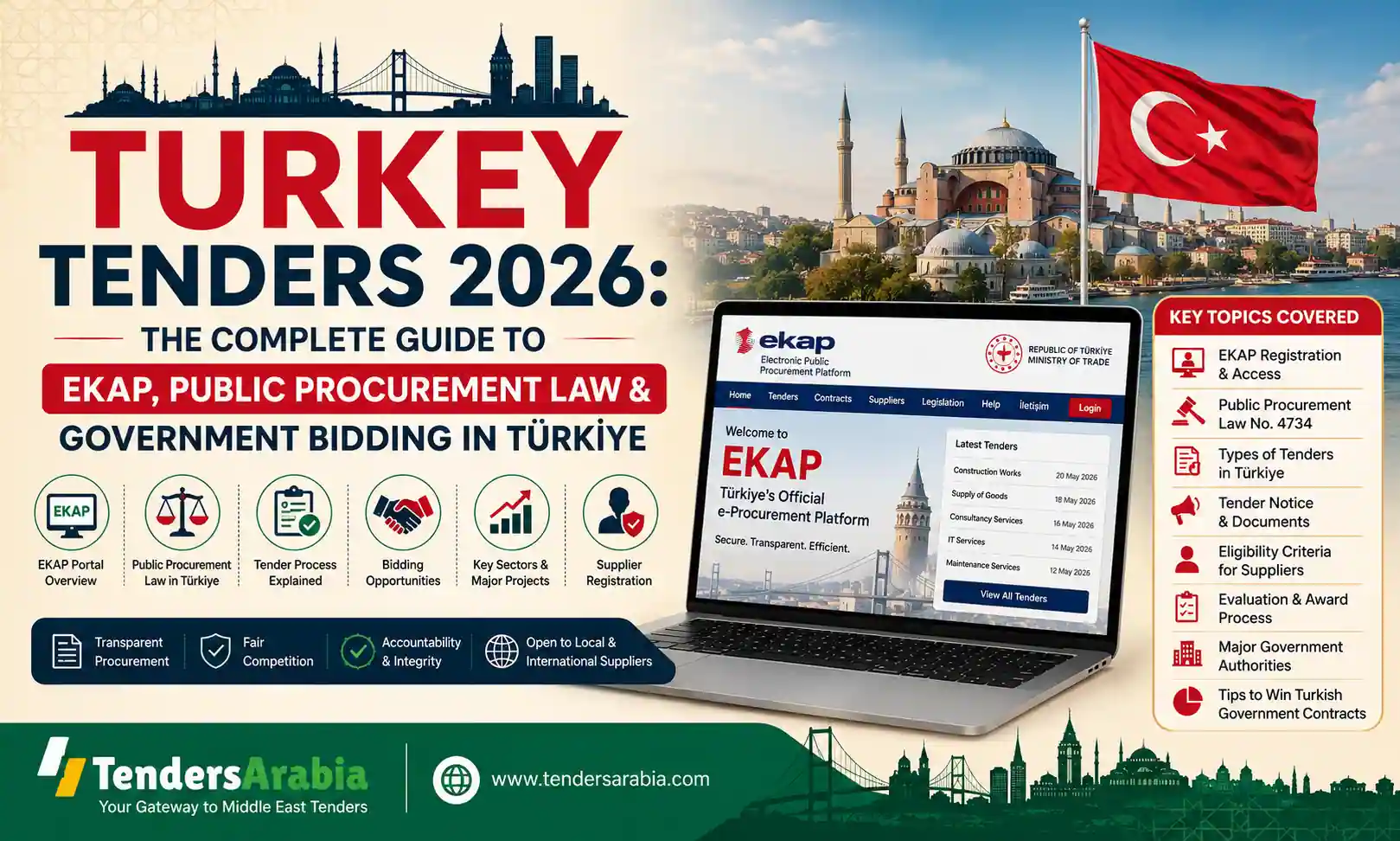
Turkey's public procurement market is one of the largest and most consequential in Europe and Asia, estimated at approximately 10 percent of GDP roughly USD 200 billion annually spanning infrastructure, defence, healthcare, energy, IT, construction and municipal services. For contractors, suppliers, consultants and international firms evaluating Turkey government tenders, this scale is matched by a genuinely codified, EU-influenced legal framework and a single, mandatory electronic procurement platform that every bidder domestic or foreign must navigate correctly from day one.
This guide has been researched and written for businesses preparing to bid on Türkiye kamu ihale (Turkey public tenders) whether Turkish companies seeking to understand registration and classification requirements, regional suppliers from the EU, Gulf or wider Eurasia exploring cross border opportunities or international firms targeting Turkey's construction, energy, transport, healthcare and technology sectors. It covers the legal framework governing public procurement, the institutions that administer it, the EKAP registration process for both domestic and foreign bidders, the bidding procedures and bond requirements, the national preference rules that materially affect foreign bid pricing and the major 1 February 2026 legislative amendments without referencing any specific live tender, since active opportunities change daily and should always be verified directly on the official EKAP platform.
Public procurement in Turkey for contracts that incur expenses to the state is governed primarily by Public Procurement Law No. 4734, which entered into force in 2002, together with Public Procurement Contract Law No. 4735, which governs the implementation and contractual phase following contract award. The purpose of Law No. 4734 is to determine the principles and procedures applied in tenders conducted by public institutions and organisations subject to public law, under public control or using public resources, covering the procurement of goods, services and construction works.
It is important to distinguish this from State Procurement Law No. 2886, which governs an entirely different category of tendering transactions that generate revenue for the state, such as the sale or leasing of state-owned movable and immovable property, rather than the expenditure-based procurement that is the focus of most commercial bidding activity and of this guide.
Turkish public procurement legislation has been deliberately prepared in accordance with European Union and broader international legislation. Notice periods, procurement thresholds and competitive bidding principles closely mirror the structure found under EU procurement directives, reflecting Turkey's participation in the EU pre-accession process even though Türkiye is not yet an EU member state and is therefore not directly subject to EU directives. Separately, while Turkey has been a WTO member since 1995, it has not signed the WTO Government Procurement Agreement (GPA), instead maintaining observer status a relevant consideration for international bidders, particularly from GPA member states, assessing market access and reciprocity expectations.
Turkey's procurement framework underwent a significant legislative update effective 1 February 2026, when amendments to Law No. 4734 introduced revised tender thresholds, restructured post-award contract variation procedures and expanded the powers of the Public Procurement Authority's governing Board. These amendments apply to tenders whose notices were published on or after that date; tenders published earlier continue to be governed by the prior rules, though subsequent Board decisions may still influence their interpretation. Bidders and contract managers should always confirm which regime applies to a specific tender before relying on either the old or new procedural requirements.
The Public Procurement Authority (Kamu İhale Kurumu or KIK) is Turkey's central regulatory body for public procurement, established under Article 3 of Law No. 4734. KIK's responsibilities span the full regulatory lifecycle of Turkish public procurement:
A critical and frequently overlooked point for bidders targeting Turkey's defence sector: the Presidency for Defence Industries (SSB) and the Ministry of National Defence maintain entirely separate procurement regulations for defence tenders and contracts. SSB procurement is financed off budget through special taxes and is explicitly not subject to the public procurement laws that govern civilian government contracting meaning defence sector suppliers must engage SSB's own procurement channels directly rather than relying on KIK or EKAP.
EKAP (Elektronik Kamu Alımları Platformu the Electronic Public Procurement Platform), accessible at ekap.kik.gov.tr, is Turkey's centralised electronic public procurement system, administered by KIK under the framework of Law No. 4734. Every contracting authority in Turkey government ministries, municipal bodies, state-owned enterprises and public institutions alike publishes tender notices, receives bids and communicates with bidders through this single platform. Registration on EKAP is mandatory for any entity wishing to submit a bid and this obligation applies equally to domestic and foreign bidders.
EKAP enables the complete electronic procurement transaction, allowing companies and real persons to search active tenders and tender documents including specifications and draft contracts, search information announced by the Public Procurement Authority such as tender results, KIK Board decisions and the list of prohibited bidders and submit required documents including work completion certificates, balance sheets, electronic guarantee letters and accreditation documents all without needing to engage with each contracting authority separately.
It is important to distinguish EKAP from Turkey's e-Devlet (e-Government) portal: e-Devlet provides citizen-level access to general government services, while EKAP is a purpose-built procurement system with its own registration pathway, login infrastructure and e-signature requirements. Turkish citizens and domestic companies may use e-Devlet credentials for certain initial steps, but foreign bidders must follow EKAP's dedicated foreign registration process. An EKAP mobile app is also available, providing access to tender listings, though it does not replace the full web-based registration and bidding workflow.
The platform has continued to evolve, with the rollout of EKAP v2 introducing a revised interface with restructured field structures and updated threshold values for direct procurement (doğrudan temin), alongside updated guidance on acceptable foreign-entity document equivalences and e-signature certificate standards changes that industry observers expect to reduce processing delays for compliant applications while tightening rejection criteria for incomplete filings.
For domestic Turkish companies, EKAP registration is completed via the platform's dedicated registration interface, where companies enter their corporate credentials, register the authorised signatory officers of the company and sign the protocol generated based on the submitted information. Following this electronic procedure, the signed protocol and accompanying documents demonstrating the company's credentials must be physically posted to the Public Procurement Authority to complete registration. In 2025, KIK announced simplifications to EKAP registration specifically for domestic firms by integrating the platform more closely with national business registration systems, streamlining what had previously been a more document-heavy process.
Foreign companies face a more structured, document-intensive onboarding process. Understanding how to register for EKAP is the essential first step for any foreign company that wants to participate in tenders in Turkey and the process can be summarised in the following stages:
Foreign companies established in Turkey, including subsidiaries of foreign parent companies, can register their company on EKAP under largely the same pathway as domestic firms, which is one reason many international bidders choose to establish a local subsidiary rather than navigate the foreign natural/legal person registration route directly. Companies established in Türkiye, including foreign companies' subsidiaries, can register on the EKAP website and documents entered under a company name must be submitted as scanned, official documents with original physical documents sometimes required to mitigate fraud risk.
For bids submitted by consortia, work completion certificates from each participating company are accepted by tender evaluation committees and certificates obtained from previously completed work remain valid for five years. Foreign documents bearing an apostille or documents approved by Turkish consulates, are accepted as part of the foreign bidder documentation package.
Turkey's procurement law sets out three principal procedures applicable to public tenders, with the choice of procedure governed largely by the estimated value of the contract relative to KIK's published annual thresholds:
Additionally, framework agreements, valid for a maximum of two years, are permitted for recurring procurement needs, following amendments introduced in 2023 a useful mechanism for suppliers seeking longer-term, repeat-order relationships with Turkish contracting authorities rather than competing tender by tender.
Notice periods are calibrated according to threshold and procedure type, designed in consideration of the notice periods found in EU procurement legislation to ensure tenderers have sufficient preparation time to submit responsible, realistic bids. A standard forty-day notice period can be shortened by seven days if the announcement is prepared and sent electronically and by a further five days if the announcement is duly obtained from EKAP reducing the effective minimum notice period to twenty-eight days in qualifying cases. For restricted procedures, an invitation letter must be sent to pre-qualified tenderers forty days prior to the tender date, a period similarly reducible by five days where pre-qualification documents are obtained through EKAP.
One of the most commercially significant features of Turkey's procurement system for international bidders is its national preference framework, which has been progressively reinforced through recent legislative amendments. Understanding this mechanism is essential before pricing any bid:
Given this structural pricing disadvantage, international firms and particularly U.S. companies, according to official U.S. trade guidance are strongly advised to work closely with a local Turkish partner, representative or legal consultant, both to analyse tender specifications for technical and documentation compliance and to better navigate the national preference calculus when structuring a competitive bid.
Financial security instruments are a mandatory feature of Turkish public procurement, with distinct requirements at the bidding and contract execution stages:
Turkey's procurement framework provides a structured, time-bound escalation pathway for bidders who believe a tender process has not been conducted correctly, triggered by notifications received via EKAP:
Bidders can also file cases at KIK if they believe wrongdoing occurred after bid evaluation has been finalised but before a bid bond is collected from the awarded party an important additional checkpoint within the overall award process. Separately, where a contracting authority identifies an unlawfulness through EKAP after a procurement notification, an application can be made first to the contracting authority and then to the Public Procurement Authority; if approved, the authority may proceed by issuing an addendum, provided any changes to the procurement document are made at least 10 days before the procurement takes place otherwise the procurement date is postponed or the procurement is cancelled outright.
Turkey's procurement landscape shifted materially on 1 February 2026, when amendments to Law No. 4734 took effect, introducing several changes that bidders and contract managers should understand clearly:
Turkey's public procurement spans virtually every major economic sector, with construction works, goods and supplies, services, IT and telecommunications equipment, medical equipment and pharmaceuticals, energy and infrastructure projects and defence and security equipment among the most consistently procured categories. Within this broad landscape, several themes stand out for 2026:
Small and medium-sized enterprises play a significant role in Turkey's procurement landscape, supported in part by the SME Development Organisation of Turkey (KOSGEB), which provides broader business support for SMEs in research and development, innovation, expansion and internationalisation, including grant programmes for entrepreneurs. While KOSGEB's mandate is not procurement-specific, the broader ecosystem of SME support it provides combined with the below-threshold domestic-bidder restrictions described above means that Turkish SMEs occupy a structurally favourable position for lower-value public contracts, particularly at the municipal and provincial level where below-threshold, domestically-restricted tenders are most common.
Search behaviour among procurement professionals tracking the Turkish market reflects both the platform-specific terminology unique to EKAP and the broader international vocabulary used across global tender intelligence platforms. In English, search activity clusters around terms including Turkey tenders, Turkey government tenders, EKAP registration, Turkey public procurement, Turkey e-procurement, KIK Turkey, Turkey RFP, Turkey EOI, Turkey tender alerts, Turkey municipal tenders, Turkey construction tenders and increasingly specific terms tied to the 2026 reforms such as EKAP v2, Turkey procurement thresholds 2026 and Turkey national preference tender reflecting a search population that includes legal and compliance professionals tracking the post-1 February 2026 regulatory environment closely, alongside contractors and suppliers searching by sector or contracting authority once they understand KIK's institutional structure.
In Turkish, the dominant search terms are kamu ihale (public tender) and kamu ihale kurumu (Public Procurement Authority), with closely related variants including EKAP kayıt (EKAP registration), ihale ilanları (tender announcements), elektronik kamu alımları platformu (the Electronic Public Procurement Platform spelled out in full), doğrudan temin (direct procurement) and 4734 sayılı kamu ihale kanunu (Public Procurement Law No. 4734). A distinguishing feature of Turkish-language search behaviour is the prominence of article-specific legal search terms reflecting that the tender search engine and bulletin search engine on KIK's own website are available only in Turkish, making fluent Turkish-language search and document comprehension a genuine competitive advantage for both domestic and foreign bidders who invest in it.
Turkey's government procurement market in 2026 combines genuine scale an estimated USD 200 billion annually, around 10 percent of GDP with one of the more codified, EU-influenced legal frameworks in the wider region, anchored by Law No. 4734, administered by KIK and channelled entirely through the mandatory EKAP platform. Success in this market depends on understanding the institutional split between civilian procurement under KIK and the entirely separate SSB defence procurement regime, completing the correct EKAP registration pathway for either a domestic entity or a foreign bidder, pricing bids with a clear understanding of the national preference framework and its up to 15 percent domestic price-evaluation advantage and tracking the practical implications of the 1 February 2026 legislative amendments on thresholds, post-award documentation and cost-adjustment provisions.
For contractors, suppliers and consultants Turkish, regional or international a systematic approach to EKAP registration, bond preparation, national preference-aware pricing and continuous monitoring of KIK's evolving regulatory communiqués is the foundation of sustainable, long-term participation in one of Europe and Asia's largest public procurement markets.
Q1. What is the main law governing government tenders in Turkey?
Public procurement for expenditure-based contracts in Turkey is governed primarily by Public Procurement Law No. 4734, in force since 2002, together with Public Procurement Contract Law No. 4735, which governs contract implementation after award. A separate law, State Procurement Law No. 2886, governs revenue-generating transactions such as the sale or leasing of state property and is distinct from the procurement process most contractors and suppliers engage with.
Q2. What is EKAP and how do I register on it?
EKAP (Elektronik Kamu Alımları Platformu), accessible at ekap.kik.gov.tr, is Turkey's mandatory centralised electronic public procurement platform, administered by the Public Procurement Authority (KIK). Domestic companies register directly on the platform, sign a generated protocol and post the signed protocol with supporting documents to KIK. Foreign bidders follow a more structured process: determining their legal approach, preparing apostilled and translated documents, obtaining a Turkish tax identification number, securing a qualified electronic signature and completing the EKAP registration form before validation by KIK.
Q3. What is the difference between EKAP and Turkey's e-Devlet portal?
e-Devlet is Turkey's general citizen-facing e-government portal for a wide range of public services. EKAP is a purpose-built procurement system with its own dedicated registration pathway, login infrastructure and e-signature requirements. While Turkish citizens and domestic companies may use e-Devlet credentials for certain initial steps, foreign bidders must follow EKAP's separate, dedicated foreign registration process rather than relying on e-Devlet.
Q4. What bidding procedures are available under Turkey's Public Procurement Law?
Law No. 4734 provides three principal procedures: the Open Procedure (Açık İhale) under Article 17, the default method for above-threshold contracts, open to all qualified bidders; the Restricted or Limited Procedure (Kapalı İhale) under Article 18, typically used for consultancy and specialised services; and Negotiated or Direct Procurement (Pazarlık/Doğrudan Temin) under Articles 21–22, used for lower-value or urgent procurement needs. Framework agreements, valid for up to two years, are also permitted for recurring requirements.
Q5. What is the national preference rule and how does it affect foreign bidders?
Turkey's national preference framework gives domestic bidders a price-evaluation advantage of typically up to 15 percent on above-threshold tenders, meaning a foreign bidder must price materially lower to remain competitive on an evaluated basis for example, bidding TRY 85 or lower against a Turkish competitor's TRY 100 bid to match it after adjustment. On below-threshold tenders, contracting authorities may restrict participation to domestic bidders entirely. This is why working with a local Turkish partner or legal consultant is widely recommended for foreign bidders.
Q6. What are bid bonds and performance bonds in Turkish public tenders?
A bid bond, issued by a Turkish bank and counter-guaranteed by the bidder's own bank, guarantees that a winning bidder will sign the contract under agreed terms; it is not required for consultancy tenders and must remain valid for the bid validity period, usually three months. A performance bond, typically 6 percent of the contract value, must be provided once a contract is awarded, remaining valid through delivery or final acceptance and must likewise be issued by a Turkish bank and counter-guaranteed by the contractor's bank.
Q7. How do I file a complaint or objection about a Turkish government tender?
Bidders must first file an objection with the contracting authority within 7 calendar days of the relevant tender notice or act. If unsatisfied with the response or if none is received, a complaint can be lodged with KIK within 10 calendar days and KIK must issue a decision within 20 days. A final appeal to the administrative courts is possible within 10 days of KIK's decision, including the option to request a stay of execution.
Q8. What changed in Turkey's procurement law on 1 February 2026?
The 1 February 2026 amendments to Law No. 4734 raised the monetary thresholds distinguishing below- from above-threshold procurement, tightened post-award documentation requirements within EKAP, strengthened the national preference framework for domestic bidders and introduced new provisional clauses allowing contract termination or reassignment in response to unforeseen material cost increases. These amendments apply to tenders published on or after 1 February 2026; earlier tenders remain governed by the prior rules.
Q9. Are defence tenders in Turkey procured through EKAP and KIK?
No. Defence tenders and contracts are procured separately through the Presidency for Defence Industries (SSB) and the Ministry of National Defence, which maintain their own procurement regulations. SSB procurement is financed off-budget through special taxes and is explicitly not subject to the public procurement laws Law No. 4734 and EKAP that govern civilian government contracting.
Q10. How large is Turkey's public procurement market?
Turkey's government procurement market is estimated at approximately 10 percent of GDP or roughly USD 200 billion annually, spanning construction, defence, healthcare, energy, infrastructure, IT and municipal services making it one of the largest public procurement markets in Europe and Asia.
This guide is intended for informational purposes only. Always verify current thresholds, registration procedures and specific tender conditions directly with the Public Procurement Authority (KIK), the EKAP platform and qualified legal counsel familiar with Turkish procurement law before submitting any bid.