
UAE Federal...
October 21, 2026


Federal Decree-Law No. 11 of 2023 on Procurement in the Federal Government is the single most important piece of legislation for any supplier, contractor or service provider targeting UAE federal contracts. It replaced the previous framework under Cabinet Decision No. 4 of 2019, entered into force on 1 December 2023, and introduced a unified digital procurement system administered by the Ministry of Finance through a Central Procurement Unit.
The law is implemented through Cabinet Decision No. 122 of 2024, which sets out the Executive Regulation in detail. Together, the law and its regulation govern how federal entities plan, announce, evaluate and award procurement contracts. They also establish the rules for supplier registration, bid bonds, performance guarantees, framework agreements, reverse auctions, green procurement, SME support and grievance procedures. This guide explains what the law says, how it applies in practice, and what every bidder must know before participating in a federal tender.
Federal Decree-Law No. 11 of 2023 regulates the general framework for procurement in the federal government. It applies to all procurement and contracting activities and procedures of federal entities, including ministries, federal authorities, central agencies and subsidiaries operating under federal supervision. The law covers the full procurement cycle, from annual procurement planning and tender announcement to bid evaluation, contract award, contract management and grievance handling.
The law is supported by two key instruments. The first is the Executive Regulation under Cabinet Decision No. 122 of 2024, which provides the detailed rules for implementing the law. The second is the Federal Government Procurement Procedures Guide, launched by the Ministry of Finance in February 2025, which provides a step-by-step operational roadmap for federal entities and suppliers. The Procedures Guide introduced a Procurement Centre of Excellence, a clear governance framework, standardised contract templates and updated bid evaluation criteria.
The Ministry of Finance administers the law through a Central Procurement Unit. This unit oversees the Digital Procurement Platform, manages framework agreements, sets procurement standards and monitors compliance across federal entities.
The law applies broadly to federal government procurement, but it expressly excludes certain entities and transactions. Understanding these exclusions is important because suppliers targeting defence, security or international agreement work may fall outside the standard federal procurement framework.
| Category | Status Under the Law |
|---|---|
| Ministries, federal authorities and central agencies | Covered |
| Subsidiaries under federal entities | Covered |
| Ministry of Defence and Armed Forces | Exempted |
| State security entities | Exempted |
| Construction projects | Exempted |
| Military or security purchases | Exempted |
| International agreements | Exempted |
| Pharmaceutical procurements | Exempted |
| Public-private partnerships | Exempted |
| Any entity exempted by Cabinet decision | Exempted |
Exempted entities are still encouraged to follow the principles of the law, including transparency, competition and value for money, even where the law does not formally apply. Suppliers should not assume that an exempted entity has no procurement rules; most operate under separate internal or sector-specific frameworks.
Article 2 of the law sets out its core objectives. These objectives are not just aspirational language; they shape how federal entities evaluate bids and manage contracts. The law aims to:
For suppliers, these objectives translate into practical expectations. Federal entities must treat bidders equally, publish clear evaluation criteria, use the digital platform and give due consideration to sustainability, innovation and SME participation.
The law authorises several contract award methods. Each method has distinct stages and is suited to different procurement scenarios. The choice of method depends on the estimated value, the nature of the requirement and whether pre-qualification is appropriate.
| Method | How It Works | Typical Use |
|---|---|---|
| Open Tendering | Publicly announced; suppliers submit bids; bids are evaluated and compared; contract awarded to the successful bidder | Most large contracts; default method for competitive procurement |
| Selective Tendering | Pre-qualification of potential suppliers; prequalified suppliers invited to bid; bids evaluated and compared; contract awarded | Complex or specialised requirements where a limited supplier pool is appropriate |
| Request for Proposals (RFP) | RFP document issued; technical and financial proposals submitted; evaluations take place; negotiations with shortlisted suppliers; contract awarded | Consultancy, professional services and complex solutions where quality and methodology matter |
| Single-Source Procurement | Justification documented; direct negotiations with the selected supplier; contract awarded | Emergency situations, proprietary goods or where only one supplier is available |
| Direct Order | Purchase made directly within defined financial thresholds | Low-value purchases and routine items |
| Framework Agreements | Pre-agreed terms and conditions for recurring purchases over a set period | Frequently purchased goods and services |
| Electronic Reverse Auctions | Suppliers compete by lowering prices in a live online auction | Price-driven procurement with multiple qualified suppliers |
Open tendering is the default method and the most accessible route for new suppliers. Selective tendering and RFPs are used where the purchasing entity needs to control the supplier pool or evaluate qualitative factors. Single-source procurement and direct orders are subject to stricter justification and approval requirements.
The law and its Executive Regulation set financial thresholds that determine which procurement method applies. These thresholds are important because they define when a federal entity must run a competitive tender and when it may use a more limited procedure.
Where the estimated value of a procurement exceeds AED 10,000,000, open tendering or limited tendering is mandatory. Below that threshold, federal entities have discretion to use other procurement methods, subject to the conditions and approval limits set out in the Delegation of Authority Matrix. Direct orders are permitted only within specific financial limits, which are defined in the matrix issued by the Minister of Finance.
Suppliers should note that the Delegation of Authority Matrix is updated periodically. The Ministry of Finance launched an updated matrix in February 2025 to clarify decision-making authorities, enhance oversight and improve operational efficiency. The applicable threshold for a given tender will always be stated in the tender documents.
Bid bonds and performance bonds are financial guarantees that protect the federal entity if a supplier withdraws, fails to sign the contract or fails to perform. The law sets clear rules on when these guarantees are required, how they must be issued and how much they should be worth.
| Requirement | Rule Under the Law |
|---|---|
| Goods and services bids below AED 1,000,000 | Exempt from bid bond and performance bond |
| Consultancy services bids below AED 3,000,000 | Exempt from bid bond |
| Companies where government holds at least 51% capital | Exempt from bid bond and performance bond for competition-method purchases |
| Bid bond value | Not less than 5% of the bid value |
| Bid bond validity | At least 90 days from submission; must be extended if bid validity is extended |
| Form of bid bond | Unconditional and irrevocable bank letter of guarantee issued by a bank operating in the UAE |
| Form of performance bond | Unconditional, irrevocable and automatically renewable bank letter of guarantee |
Even where a bid is below the exemption threshold, the federal entity retains the authority to demand a bid bond or performance bond if it considers this to be in its interest. Suppliers should always check the tender documents rather than assuming an exemption applies. The value of all letters of guarantee is calculated on the pre-tax amount stated in the quotation.
The law requires federal procurement to be conducted through a digital procurement system. In practice, this means the Digital Procurement Platform administered by the Ministry of Finance. Suppliers must register in the Federal Supplier Register and use UAE PASS digital identity to access the platform.
The Procedures Guide launched in February 2025 introduced new provisions for managing supplier relationships, including a structured framework for collaborative partnerships and clearer rules on supplier information disclosure. Supplier registration is annual, and suppliers must maintain accurate information in their profiles. The law treats the information on a supplier profile as the sole responsibility of the supplier.
The Digital Procurement Platform supports the entire procurement cycle, including tender announcement, bid submission, evaluation, award, purchase orders, invoices and electronic contract signing. The law's emphasis on digital procurement is intended to reduce processing times, improve transparency and create a verifiable audit trail for every procurement decision.
Bids are evaluated according to the criteria and methodology published in the tender announcement. The law requires federal entities to disclose the evaluation criteria in advance and to apply them consistently to all bidders. The Procedures Guide updated the bid evaluation criteria to align with the law and its Executive Regulation.
One notable development is the treatment of innovation. Article 28 of the Executive Regulation establishes innovation as a key criterion in evaluating bids. This means suppliers who propose innovative technical solutions, improved methodologies or value-added approaches may receive higher scores, particularly in RFPs and consultancy procurements.
Federal entities must also consider sustainability criteria when making procurement decisions, in line with the law and Cabinet Resolution No. 122 of 2024. Suppliers should ensure that their technical proposals address both innovation and sustainability where these are stated as evaluation factors.
Green procurement is a core principle under the Executive Regulation. Article 16 requires federal entities to prioritise sustainable products whenever possible, ensuring that procurement meets operational needs while promoting environmental preservation.
The Procedures Guide sets out guidelines for integrating environmental objectives into government procurement policies. Federal entities are required to consider sustainability standards in purchasing and contracting, particularly for digital products and services. The regulations also require federal entities to support green businesses and sustainable initiatives that reduce carbon emissions and minimise environmental impact, in line with UAE Net Zero 2050.
For suppliers, this creates both an opportunity and a compliance requirement. Suppliers that can demonstrate credible environmental credentials, sustainable supply chains or low-carbon products may gain an advantage in evaluation. Suppliers that cannot demonstrate sustainability may be disadvantaged where green criteria are weighted in the tender.
The law explicitly supports small and medium-sized enterprises and Emiratisation. Federal entities are required to prioritise SMEs, encourage local suppliers and advance Emiratisation policies. This is reflected in evaluation preferences, set-asides and registration incentives.
Suppliers should ensure that their registration and bid documents accurately reflect their SME status and Emiratisation credentials where these are relevant to the evaluation. False or inflated claims can lead to disqualification or penalties.
The law and its Executive Regulation place significant emphasis on integrity and conflict-of-interest management. Article 11 of Cabinet Resolution No. 122 of 2024 distinguishes three forms of conflict of interest and sets out the obligations of suppliers and evaluation teams. Suppliers must disclose any relationship, financial interest or personal connection that could compromise the fairness of a procurement process.
The Procedures Guide introduces guidelines for conduct and professional ethics for both federal employees and suppliers. It also establishes reporting mechanisms for conflict-of-interest situations and defines circumstances where supplier information can be disclosed.
Suppliers who believe that a procurement process has breached the law may file a complaint with the federal entity that issued the decision. This triggers an internal review. If the supplier is dissatisfied with the outcome, it may pursue judicial review through the courts. The Procedures Guide establishes clear guidelines for grievance procedures and defines the responsibilities of grievance committees within federal entities.
The law includes penalties for practices that undermine competition, integrity or transparency. The Procedures Guide addresses practices that undermine competition and outlines the penalties associated with them. Suppliers can face disqualification, financial penalties, suspension from federal procurement or other sanctions depending on the nature and severity of the violation.
Common compliance risks for suppliers include submitting false information during registration, failing to disclose a conflict of interest, colluding with other bidders, withdrawing a bid after the deadline without justification and failing to meet contractual obligations. Suppliers should treat compliance as an ongoing obligation, not a one-time registration step.
TendersArabia.com is a comprehensive online platform providing tender and procurement intelligence across 26 countries in the Arab World, GCC and Middle East. For bidders, local suppliers and contractors navigating the federal procurement framework under Federal Decree-Law No. 11 of 2023, the platform offers several practical advantages that complement the official procurement system.
For any tender-related inquiries, contact the TendersArabia support team via contact us or email info@tendersarabia.com.
Federal Decree-Law No. 11 of 2023 and its Executive Regulation under Cabinet Decision No. 122 of 2024 set a clear and modern framework for federal procurement in the UAE. The law applies to ministries, federal authorities, central agencies and their subsidiaries, with specific exemptions for defence, security, construction, pharmaceutical and international agreement procurements. It establishes competitive procurement methods, clear bid bond rules, digital procurement through the Ministry of Finance platform, evaluation criteria that include innovation and sustainability, SME preferences and grievance procedures.
For suppliers, the practical implications are straightforward. Register correctly in the Federal Supplier Register, maintain accurate information, disclose any conflicts of interest, check the tender documents for the applicable thresholds and bid bond requirements, address innovation and sustainability where they are evaluated, and use the grievance process if a procurement decision appears unlawful. The Ministry of Finance continues to update the Procedures Guide and Delegation of Authority Matrix, so suppliers should review the current rules regularly. Platforms like TendersArabia.com simplify the discovery and tracking of federal and emirate-level opportunities, helping suppliers stay compliant and competitive under the new law.

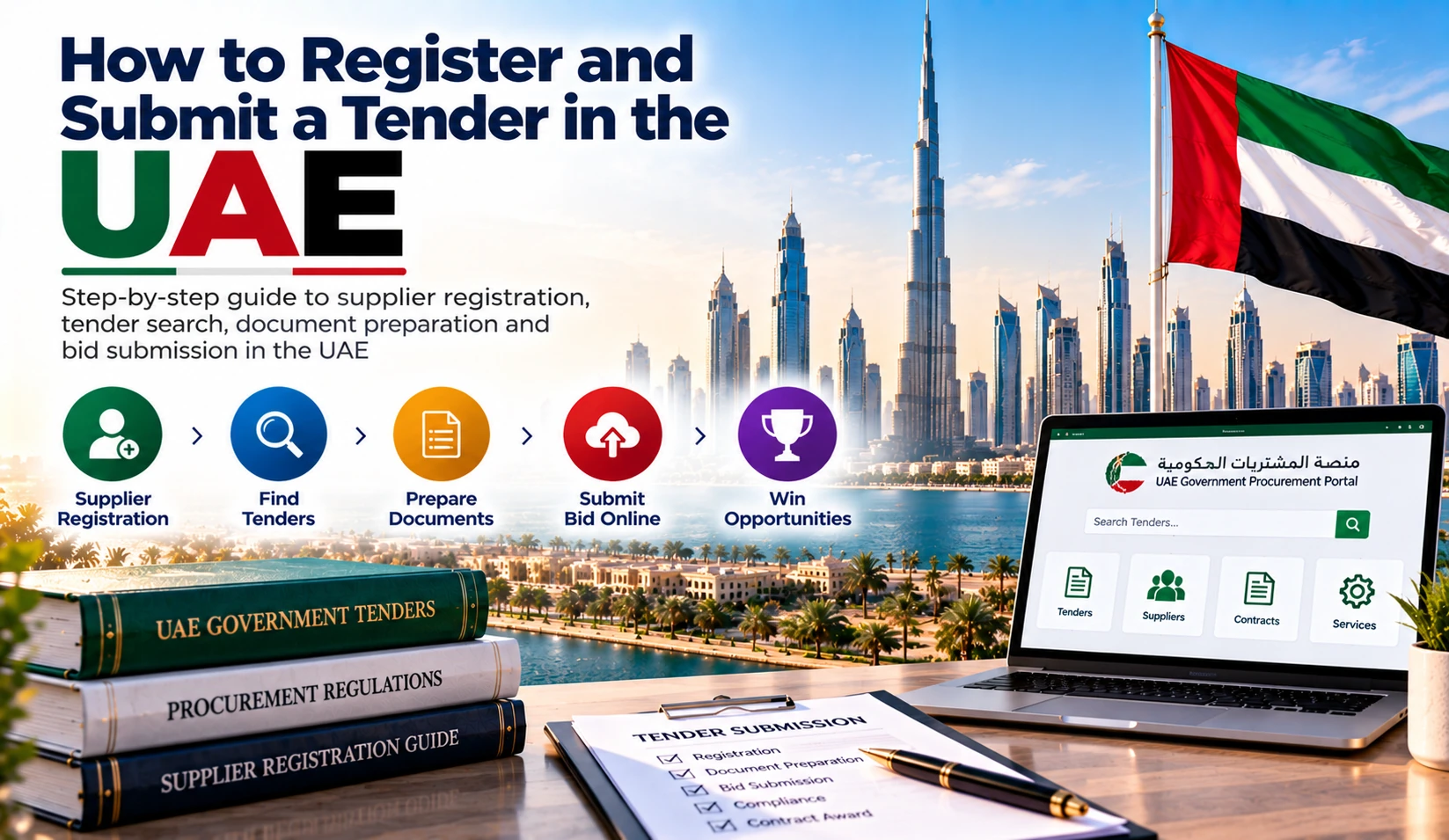
Federal Decree-Law No. 11 of 2023 on Procurement in the Federal Government is the primary legislation governing how UAE federal entities purchase goods, services and works. It replaced the previous framework under Cabinet Decision No. 4 of 2019 and entered into force on 1 December 2023. The law is implemented through its Executive Regulation under Cabinet Decision No. 122 of 2024 and administered by the Ministry of Finance through a Central Procurement Unit.
The law applies to all federal entities, including ministries established under Federal Law No. 1 of 1972, federal authorities and institutions with legal personality and independent budgets operating under federal supervision, as well as subsidiaries under these entities. It governs the full procurement cycle from planning and tender announcement to bid evaluation, contract award and grievance handling.
The law expressly excludes several entities and transaction types. These include the Ministry of Defence and Armed Forces, state security entities, construction projects, military or security purchases, international agreements, pharmaceutical procurements, public-private partnerships and any entity exempted by Cabinet decision. Exempted entities are still encouraged to refer to the law as a guide for best value, but they are not formally bound by its provisions.
The law authorises several contract award methods: open tendering, selective tendering, request for proposals (RFP), single-source procurement, direct order, framework agreements and electronic reverse auctions. Open tendering is the default method for most large contracts. Selective tendering and RFPs are used where pre-qualification or qualitative evaluation is appropriate. Direct orders and single-source procurement are subject to stricter justification and financial thresholds.
All bids with a value less than AED 1,000,000 are exempt from both the bid bond and the performance bond. All consultancy services bids with a value less than AED 3,000,000 are exempt from the bid bond. Public institutions and companies in which the government holds at least 51% of capital are also exempt from bid and performance bonds for competition-method purchases. The federal entity retains discretion to demand a bid bond even below the threshold if it considers this to be in its interest.
Where a bid bond is required, its value must not be less than 5% of the bid value. The bid bond must be in the form of an unconditional and irrevocable bank letter of guarantee issued by a bank operating in the UAE. It must be valid for at least 90 days from submission and must be extended if the bid validity period is extended.
The law requires federal entities to allocate at least 10% of total annual procurement to SMEs. During evaluation, an additional 10% is added to the final score of SMEs. SMEs also receive facilitated registration and qualification processes, simplified procedures and reduced documentation requirements. A dedicated section in the digital procurement catalogue displays SME products and services, marked with a red label for easy identification.
Article 38 of the law grants participating suppliers the right to file a grievance before the federal entity regarding any decision taken prior to the award decision. The grievance must be filed within 5 working days of notification of the decision. Each federal entity establishes a Grievance Committee to review supplier complaints. If the supplier is dissatisfied with the outcome, it may pursue judicial review through the courts.
The law and its Executive Regulation require federal entities to establish mechanisms that support impartiality and prohibit conduct that distorts competition. Suppliers must disclose any relationship, financial interest or personal connection that could compromise the fairness of a procurement process. Conflict of interest, anti-corruption and sanctions screening are key compliance points, and bidders can be disqualified before price is even considered.
The law mandates digital procurement through the platform administered by the Ministry of Finance. Suppliers must register in the Federal Supplier Register and use UAE PASS digital identity to access the platform. The Digital Procurement Platform supports tender announcement, bid submission, evaluation, award, purchase orders, invoices and electronic contract signing. The law's digital mandate is intended to reduce processing times, improve transparency and create a verifiable audit trail.
Yes. Article 16 of the Executive Regulation requires federal entities to prioritise sustainable products whenever possible and to integrate environmental objectives into procurement policies. Federal entities must support green businesses and sustainable initiatives that reduce carbon emissions and minimise environmental impact, in line with UAE Net Zero 2050. Suppliers with credible environmental credentials may gain an advantage where sustainability criteria are weighted in a tender.
The law includes penalties for practices that undermine competition, integrity or transparency. Suppliers can face disqualification, financial penalties, suspension from federal procurement or other sanctions depending on the nature and severity of the violation. Common compliance risks include submitting false registration information, failing to disclose a conflict of interest, colluding with other bidders, withdrawing a bid after the deadline without justification and failing to meet contractual obligations.
Article 28 of the Executive Regulation establishes innovation as a key criterion in evaluating bids. Suppliers who propose innovative technical solutions, improved methodologies or value-added approaches may receive higher scores, particularly in RFPs and consultancy procurements. The Procedures Guide launched in February 2025 updated the bid evaluation criteria to align with the law and its Executive Regulation.
The Procedures Guide is a document launched by the Ministry of Finance in February 2025 that provides a step-by-step operational roadmap for implementing the law. It introduced a Procurement Centre of Excellence, a clear governance framework, standardised contract templates and updated bid evaluation criteria. The guide is owned by the Ministry of Finance, and any amendments require the approval of the Minister of Finance under Article 42 of the law.
No. It is prohibited during the tendering process to negotiate the basic aspects of the contract. Communication with suppliers is limited to requests for clarification only. Any attempt to negotiate fundamental terms outside the permitted clarification process can undermine the integrity of the procurement and expose the supplier to compliance risk.
TendersArabia.com helps bidders, local suppliers and contractors by consolidating federal and emirate-level tenders into a single platform. You can browse active tenders at https://www.tendersarabia.com/tenders/, track contract awards at https://www.tendersarabia.com/contract-awards/, explore verified authorities at https://www.tendersarabia.com/authorities/ and subscribe for unlimited access at https://www.tendersarabia.com/pricing/. For support, contact https://www.tendersarabia.com/contact-us/ or email info@tendersarabia.com.