
Complete Guide...
October 15, 2026

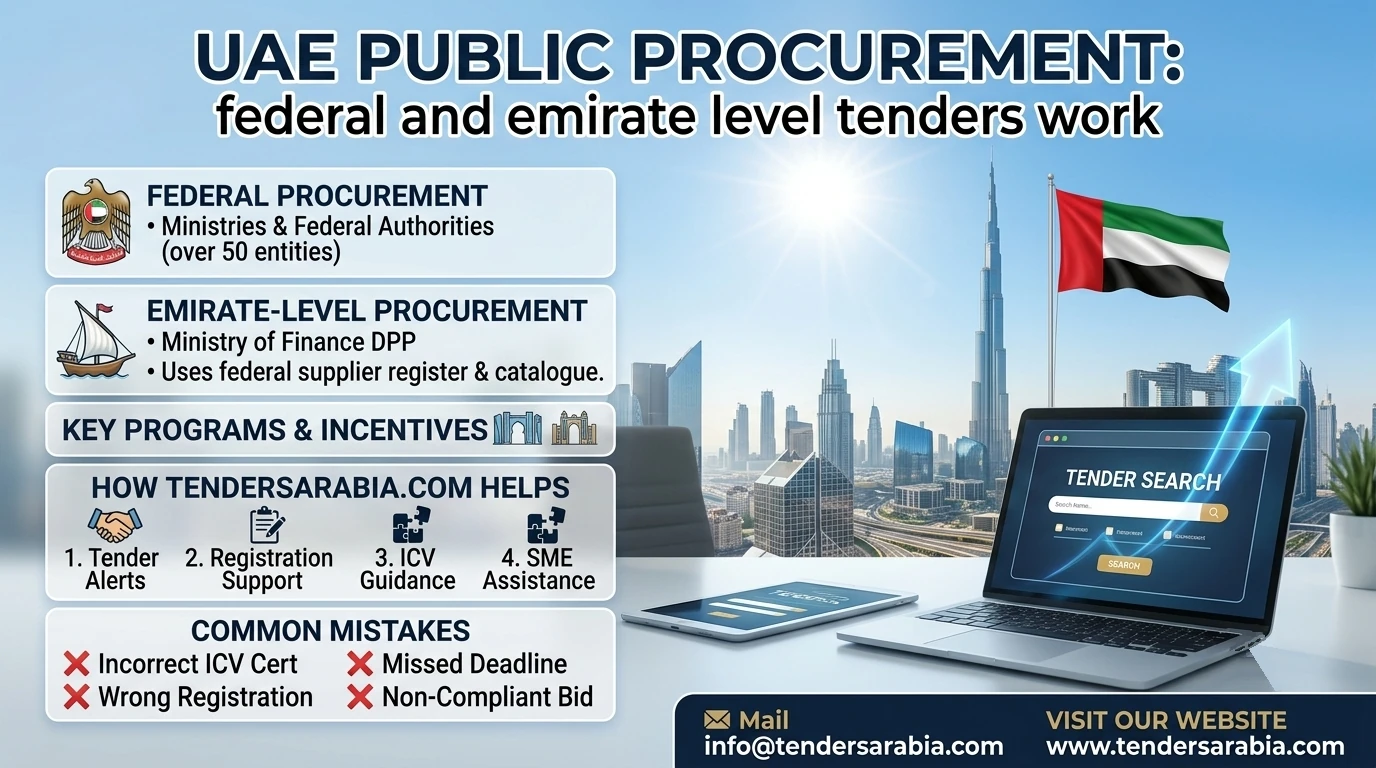
Public procurement in the UAE represents a significant opportunity for suppliers of all sizes. With a multi-layered ecosystem spanning federal entities, seven emirates, and sector-specific authorities, the UAE government market is one of the most accessible and rewarding in the region. However, navigating this landscape requires a clear understanding of the legal framework, the digital platforms, and the registration processes involved.
This guide provides a complete beginner's overview of UAE public procurement. It covers the distinction between federal and emirate-level procurement, the governing legislation under Federal Decree-Law No. 11 of 2023, the Digital Procurement Platform (DPP), the Federal Supplier Register, the In-Country Value (ICV) program, procurement methods, bid bond requirements, emirate-level platforms, sector-specific portals, SME preferences, and the practical steps to get started as a registered supplier.
Public procurement is the process by which government entities purchase goods, services, and works from private-sector suppliers. In the UAE, public procurement represents a significant portion of government spending, covering everything from construction and infrastructure to IT services, healthcare supplies, and defence equipment. For suppliers, winning government contracts offers stability, prestige, and long-term revenue opportunities. For the government, a transparent and competitive procurement system ensures value for public money, fosters innovation, and supports national economic objectives.
The UAE government operates a fair and transparent system for tendering and awarding contracts. All invitations to bid are made public and are accompanied by clear guidelines that bidders must follow. To bid for government contracts, all bidders must register on the respective eProcurement system. This guide provides a complete beginner’s overview of how UAE public procurement works, the legal framework governing it, the platforms you need to know, and the steps to become a registered supplier.
Unlike some countries in the region that operate a single centralised procurement platform, the UAE has a multi-layered procurement ecosystem. This structure spans federal entities, the seven individual emirates, and sector-specific authorities. Understanding this distinction is the first step to navigating UAE public procurement successfully.
Federal procurement applies to UAE federal government entities, including ministries, federal authorities, and central agencies. These entities follow Federal Decree-Law No. 11 of 2023 and its Implementing Regulation. Federal procurement is managed through the Ministry of Finance’s Digital Procurement Platform (DPP).
Emirate-level procurement applies to government entities within each of the seven emirates: Abu Dhabi, Dubai, Sharjah, Ajman, Ras Al Khaimah, Fujairah, and Umm Al Quwain. Each emirate has its own procurement regulations, platforms, and registration systems. For example, Dubai uses the eSupply platform, while Abu Dhabi uses the Abu Dhabi Government Procurement Gate (ADGPG).
Sector-specific procurement applies to major government-owned companies and authorities operating in key sectors such as oil and gas, defence, and healthcare. These entities often have their own supplier registration and pre-qualification processes.
| Procurement Level | Examples of Entities | Primary Platform |
|---|---|---|
| Federal | Ministries, federal authorities, central agencies | Digital Procurement Platform (DPP) |
| Emirate-Level | Dubai Government, Abu Dhabi Government, Sharjah Government | eSupply (Dubai), ADGPG (Abu Dhabi), Sharjah eProcurement |
| Sector-Specific | ADNOC, Tawazun, Emirates Health Services | ADNOC Commercial Directory, Tawazun Supplier Portal, EHS Purchases System |
The legal foundation of UAE federal procurement is Federal Decree-Law No. 11 of 2023 on Procurement in the Federal Government. This law sets the general framework for the procurement of products and services by UAE government entities. It aims to enhance integrity, trust, transparency, and competitiveness in all procurement procedures while providing public value and public interest that align with global quality standards and sustainable development.
The law applies to all procurement and contracting activities and procedures of federal entities, including ministries, authorities, central agencies, as well as subsidiaries under them. It entered into force on December 1, 2023. The law does not apply to federal entities’ procurement contracts concluded before that date. However, the provisions of Federal Decree-Law No. 11 of 2023 must be followed upon amendment, renewal, or extension of these existing contracts.
The law is implemented through Cabinet Decision No. 122 of 2024, which provides the Executive Regulation detailing how the law is applied in practice. Together, these instruments replace the previous framework under Cabinet Decision No. 4 of 2019 and introduce a unified digital procurement system administered by the Ministry of Finance through a Central Procurement Unit.
Certain entities and transactions are exempted from the scope of the law. These include the Ministry of Defence and Armed Forces, state security entities, construction projects, military or security purchases, international agreements, pharmaceutical procurements, public-private partnerships, and any entity exempted by Cabinet decision.
The Digital Procurement Platform (DPP) is the UAE’s unified federal procurement platform, developed by the Ministry of Finance. It connects all federal entities with suppliers registered with the Ministry of Finance, enabling the entire procurement cycle electronically - from announcing tenders and submitting bids to tracking awards, generating purchase orders, and evaluating supplier performance.
The DPP brings together e-sourcing systems, catalogues, supplier management, sustainability assessments, and real-time analytics within a unified digital ecosystem. More than 50 federal entities have been unified under a single AI-powered system, contributing to a 75% reduction in procurement cycle times and shortening processing times for catalogue-listed items from more than 60 days to less than 6 minutes.
The platform has generated savings exceeding 30% in federal spending, with total savings surpassing AED 100 million during the first year alone. Supplier satisfaction rates rose to 85%, while more than 17,000 suppliers joined the fully digital, transparent, and integrated procurement ecosystem. Participation by small and medium-sized enterprises more than doubled from 22% to 47%, supported by the adoption of national content standards in procurement evaluations.
A key feature of the DPP is the Federal Procurement Catalogue, a government purchasing solution that provides a unified list of products and services at competitive prices. It is based on framework agreements between the Ministry of Finance’s Central Procurement Unit and registered suppliers. The catalogue offers federal entities a simple online shopping experience, with access to a wide range of products and services that meet their different needs.
| DPP Feature | Description |
|---|---|
| E-Sourcing | Announcement and management of tenders, RFPs, and auctions |
| Electronic Catalogue | Unified list of products and services at competitive prices |
| Supplier Management | Registration, qualification, and performance evaluation |
| Sustainability Assessments | Evaluation of suppliers against national content and sustainability criteria |
| Real-Time Analytics | Data and reporting on procurement activity and spending |
Registering your company in the Federal Supplier Register is the essential first step to contracting and working with federal government entities in the UAE. Registered suppliers are eligible to submit bids, participate in tenders, and offer their products and services to federal entities.
The registration process is fully online and straightforward. Companies can register through the Ministry of Finance’s website using the “Supplier Registration” e-service or via MoF’s smart application. If all requirements are met, the account will be activated within 30 working days. In practice, the supplier registration time has been reduced to as little as one working day for straightforward applications.
Suppliers must renew their registration annually to maintain eligibility. Once approved, suppliers can submit technical and financial bids, participate in tenders, and showcase their products and services in the electronic catalogue available on the DPP.
The Ministry of Finance has streamlined the registration process, increasing the number of companies registered in the Federal Supplier Register to over 10,000. Suppliers can register if they fall into one of the following categories:
Registration involves three main stages: Registration (submitting basic information including supplier category, trade license number, tax registration status, and license issuing authority), Qualification (providing additional information such as banking details and uploading documents), and Activation (account activated upon review and approval as a qualified supplier).
The National In-Country Value (ICV) Program is the cornerstone of the UAE’s local content policy in procurement. Launched as part of “Projects of the 50,” it redirects government procurement expenditures and those of leading national companies to the UAE economy through industrial and services sectors. The program has redirected AED 473 billion into the national economy since its launch and continues to expand.
The ICV score is calculated using a formula that rewards companies for contributing to the local economy. The key components are:
| ICV Component | Weight |
|---|---|
| Local supplier spending | 50% |
| Emiratization / Emirati cost | 25% |
| Investment in assets within the UAE | 15% |
| Manufacturing activities and other eligible contributions | 10% |
An ICV Certificate is issued by an Approved ICV Certifying Body after assessing a company’s financial and operational information. The foremost requirement to obtain an ICV certificate is International Financial Reporting Standards (IFRS) compliant audited financial statements issued by a Ministry of Economy licensed auditor. Each ICV certificate is valid for 14 months from the date of issuance of the audited financial statements.
Documents typically required for ICV certification include audited financial statements, a valid UAE trade license, VAT certificate, employee information, fixed asset register, supplier information, and an organizational chart. The cost of obtaining an ICV certificate depends on the company’s details but can range from AED 500 to AED 10,000.
The Ministry of Finance introduced a procurement evaluation framework that allocates up to 25% of the total score to certified ICV suppliers. An ICV certificate from an approved certifying body has been mandatory for ADNOC tenders since 2018 and is increasingly required across federal and emirate-level procurement.
The UAE federal procurement framework authorises several contract award methods. Understanding which method applies to a given opportunity helps suppliers prepare appropriately.
| Method | Description |
|---|---|
| Open Tendering | Publicly announced and open to all qualified suppliers |
| Selective Tendering | Pre-qualification of potential suppliers, followed by invitation to bid |
| Direct Order | Limited to specific thresholds (AED 1 million, AED 500,000, or AED 250,000 depending on category) |
| Framework Agreements | Pre-agreed terms and conditions for recurring purchases |
| Electronic Reverse Auctions | Suppliers compete by lowering prices in a dynamic bidding environment |
Open tendering is the most common method for large contracts and is the most accessible for new suppliers. Selective tendering is used when the purchasing entity wants to limit competition to pre-qualified suppliers. Direct orders are reserved for smaller purchases within defined thresholds.
When submitting a bid for a UAE government tender, suppliers are often required to provide a bid bond (also known as a final guarantee or tender bond). This is a financial guarantee that demonstrates the bidder’s seriousness and provides recourse to the government if the bidder withdraws or fails to honour the bid.
Exemptions from the obligation to submit a final guarantee are available for bids to supply goods for less than AED 1 million and for bids for consulting services of less than AED 3 million. The exemption also applies to companies in which the Government contributes at least 51% of their capital.
Suppliers should carefully review the tender documents to determine the exact bid bond amount, the acceptable form (typically a bank guarantee or certified cheque), and the deadline for submission. Failure to provide the required bid bond in the correct form can result in disqualification.
While federal procurement is governed by Decree-Law No. 11 of 2023, each emirate operates its own procurement system for its government entities. Suppliers targeting emirate-level contracts must register separately on the relevant platform.
| Emirate | Platform | Key Details |
|---|---|---|
| Dubai | eSupply | Official procurement portal for Dubai Government tenders; displays tenders from over 40 major Dubai Government entities; entire bidding process managed online. Registration at esupply.dubai.gov.ae |
| Abu Dhabi | ADGPG (Abu Dhabi Government Procurement Gate) | SAP Ariba-based system linked to Department of Finance; ICV scoring integrated throughout. Registration at adgpg.gov.ae |
| Sharjah | Sharjah eProcurement Platform | Governed by Law No. 8 of 2017 on Procurements, Tenders, Auctions and Warehouses |
| Ajman | Ajman Tawreed | Supplier registration and procurement activities platform |
| Ras Al Khaimah | RAK Finance Supplier Register | Supplier registration and tender management |
| Fujairah | Municipal portals | Tender announcements through municipal channels |
For Abu Dhabi, suppliers interested in doing business with Abu Dhabi government entities must complete registration on the Abu Dhabi Government Procurement Gate portal. The registration is a one-time activity, and it is centralized by the Department of Government Support – Abu Dhabi (DGS). The National ICV Program is now being implemented for all government procurement in the Emirate of Abu Dhabi under the umbrella of the Ministry of Industry and Advanced Technology (MOIAT).
Major government-owned companies and authorities in the UAE operate their own procurement systems, often with more complex registration and pre-qualification requirements.
| Entity | Portal | Sector |
|---|---|---|
| ADNOC | ADNOC Commercial Directory (SAP Ariba) | Oil & Gas |
| Tawazun | Tawazun Supplier Portal | Defence & Security |
| Emirates Health Services | EHS Purchases System | Healthcare |
| Digital Dubai | iSupplier | Technology & Digital |
ADNOC supplier registration requires a two-stage process: Registration and Pre-qualification. Access to multi-million Dirham tenders requires successful pre-qualification, which adds the supplier to the official ADNOC Supplier List. An ICV certificate from an approved certifying body has been mandatory for ADNOC tenders since 2018.
The UAE government actively supports small and medium-sized enterprises through various procurement preferences designed to increase SME participation in government contracts.
These preferences make the UAE an attractive market for small and medium-sized suppliers seeking government contracts. SMEs registered with the Federal Supplier Register can also benefit from the electronic catalogue on the DPP, which allows government entities to browse and select services that meet their needs.
For a supplier new to UAE public procurement, the following steps provide a clear path to participation:
UAE public procurement is evolving rapidly with the implementation of Federal Decree-Law No. 11 of 2023 and its Implementing Regulation. The Digital Procurement Platform continues to expand its capabilities, and the ICV Program is adding new entities regularly. Suppliers who invest the time to understand the framework, register correctly, and prepare compliant bids will find the UAE government market to be one of the most accessible and rewarding in the region.
TendersArabia.com is a comprehensive online platform that provides tender and procurement intelligence across 26 countries in the Arab World, GCC, and Middle East. For bidders, local suppliers, and contractors targeting UAE government contracts, the platform offers several practical advantages that complement the official procurement portals.
For any tender-related inquiries, contact the TendersArabia support team via contact us or email info@tendersarabia.com.
UAE public procurement offers significant opportunities for suppliers, contractors, and bidders at federal, emirate, and sector levels. By understanding the legal framework, registering on the correct platforms, and preparing compliant bids, suppliers can position themselves competitively. Platforms like TendersArabia.com simplify the discovery and tracking process, giving bidders a consolidated view of opportunities across the region.
The official portal for UAE federal government tenders is the Digital Procurement Platform (DPP), developed by the Ministry of Finance. It connects all federal entities with registered suppliers, enabling the entire procurement cycle electronically - from announcing tenders and submitting bids to tracking awards, generating purchase orders, and evaluating supplier performance. The DPP is accessible through the Ministry of Finance website and requires registration in the Federal Supplier Register before suppliers can participate in tenders.
Registering your company in the Federal Supplier Register is the essential first step to contracting with UAE federal government entities. The registration process is fully online through the Ministry of Finance's website using the "Supplier Registration" e-service. If all requirements are met, your account will be activated within 30 working days, though the process has been reduced to as little as one working day for straightforward applications. Once approved, you can submit technical and financial bids, participate in tenders, and showcase your products and services in the electronic catalogue on the DPP.
The registration process involves three main stages: Registration (selecting supplier category, trade license number, tax registration status, license issuing authority, and supplier representative information), Qualification (providing banking information and uploading supporting documents), and Activation (account activated upon review and approval). Eligible supplier categories include local companies, SMEs, free zone companies, productive families, freelancers, foreign companies based outside the UAE, and government entities.
ICV certification requirements vary by entity. At the federal level, the Ministry of Finance allocates up to 25% of the total evaluation score to certified ICV suppliers, making it a significant competitive advantage. For Abu Dhabi government procurement, applying for an ICV certificate is optional, but companies without a certificate receive a score of zero (0) during financial evaluation. However, ICV certification is mandatory for companies wishing to participate in tenders issued by strategic partners such as ADNOC, Etisalat, Mubadala, and the Department of Economic Development (DED).
An ICV Certificate is issued by an Approved ICV Certifying Body after assessing a company's financial and operational information. The foremost requirement is International Financial Reporting Standards (IFRS) compliant audited financial statements issued by a Ministry of Economy licensed auditor. Each ICV Certificate is valid for 14 months from the date of issuance of the audited financial statements. The cost depends on the company's details but can range from AED 500 to AED 10,000.
Yes, foreign companies can and regularly do bid on UAE government contracts, particularly in sectors such as construction, technology, defence, and professional services. Many large UAE tenders explicitly invite international suppliers. However, foreign firms must understand the tendering rules, including registration, local partnerships, documentation, and dispute resolution. To bid on most tenders, foreign firms must meet local presence requirements, which may include establishing a local branch or partnering with a UAE-owned entity. Foreign companies based outside the UAE are eligible to register in the Federal Supplier Register.
UAE tenders are published across multiple portals. Federal entities use the Digital Procurement Platform (DPP). At the emirate level, Dubai operates eSupply, Abu Dhabi uses the Abu Dhabi Government Procurement Gate (ADGPG) based on SAP Ariba, and Sharjah has its own eProcurement Platform. Major government-related entities such as ADNOC, DEWA, and RTA run their own supplier portals. There is no single central platform covering all UAE government procurement, so suppliers must register and monitor multiple platforms depending on which buyers they target.
Bids with a value less than AED 1,000,000 are typically exempted from the bid bond requirement. For bids exceeding this threshold, a bid bond must be enclosed with the bid. The bid bond is usually in the form of an unconditional and irrevocable bank letter of guarantee issued by a bank operating in the UAE. The bid bond is typically valid for at least 90 days from the date of submission. Exemptions from the final guarantee obligation are also available for bids to supply goods for less than AED 1 million and for consulting services of less than AED 3 million.
The Federal Supplier Register registration process typically takes up to 30 working days for account activation if all requirements are met. However, the Ministry of Finance has streamlined the registration process, reducing the supplier registration time to as little as one working day for straightforward applications. Registration is also available via the Ministry of Finance's smart application, offering seamless digital procedures. Suppliers must renew their registration annually to maintain eligibility.
The UAE federal procurement framework authorizes several contract award methods: Open Tendering (publicly announced, open to all qualified suppliers), Selective Tendering (pre-qualification of potential suppliers, followed by invitation to bid), Direct Order (limited to specific thresholds of AED 1 million, AED 500,000, or AED 250,000 depending on category), Framework Agreements (pre-agreed terms for recurring purchases), and Electronic Reverse Auctions (suppliers compete by lowering prices). Open tendering is the most common method for large contracts and the most accessible for new suppliers.
Yes, the UAE government actively supports SMEs through procurement preferences. A 10% price preference is granted to bids by UAE companies that receive support from SME funds, provided their capital does not exceed AED 10 million. A 10% set-aside of federal procurement is reserved for SMEs. Companies receiving support from SME funds are also exempt from registration fees in the Federal Suppliers Register. Dubai Law No. 16 of 2016 mandates that government departments allocate 10% of their procurement spending to Dubai SME members. In 2025, this facilitated AED 1.78 billion in contracts to Emirati SMEs.
Federal procurement applies to UAE federal government entities, including ministries, federal authorities, and central agencies, and follows Federal Decree-Law No. 11 of 2023. Emirate-level procurement applies to government entities within each of the seven emirates, each with its own procurement regulations, platforms, and registration systems. For example, Dubai uses eSupply, while Abu Dhabi uses ADGPG. Sector-specific procurement applies to major government-owned companies such as ADNOC, Tawazun, and Emirates Health Services, which operate their own supplier registration and pre-qualification processes.
For limited tenders, the minimum period granted to suppliers to submit their responses typically ranges between 5 to 15 working days, depending on the estimated contract value. This period is calculated from the date of tender publication (excluding the publication date itself). Suppliers should carefully review each tender notice to determine the exact submission deadline and ensure all required documents are prepared in advance.
Federal Decree-Law No. 11 of 2023 on Procurement in the Federal Government sets the general framework for the procurement of products and services by UAE government entities. It aims to enhance integrity, trust, transparency, and competitiveness in all procurement procedures while providing public value and public interest aligned with global quality standards and sustainable development. The law entered into force on December 1, 2023, and is implemented through Cabinet Decision No. 122 of 2024. It applies to all procurement activities of federal entities, including ministries, authorities, central agencies, and their subsidiaries.
Yes, suppliers must log in to the Government Procurement Platform using the UAE Digital Identity (UAE PASS). This unified digital identity simplifies access across multiple government platforms and is required for completing the supplier registration process and participating in tenders on the Digital Procurement Platform.