Complete Guide...
October 15, 2026

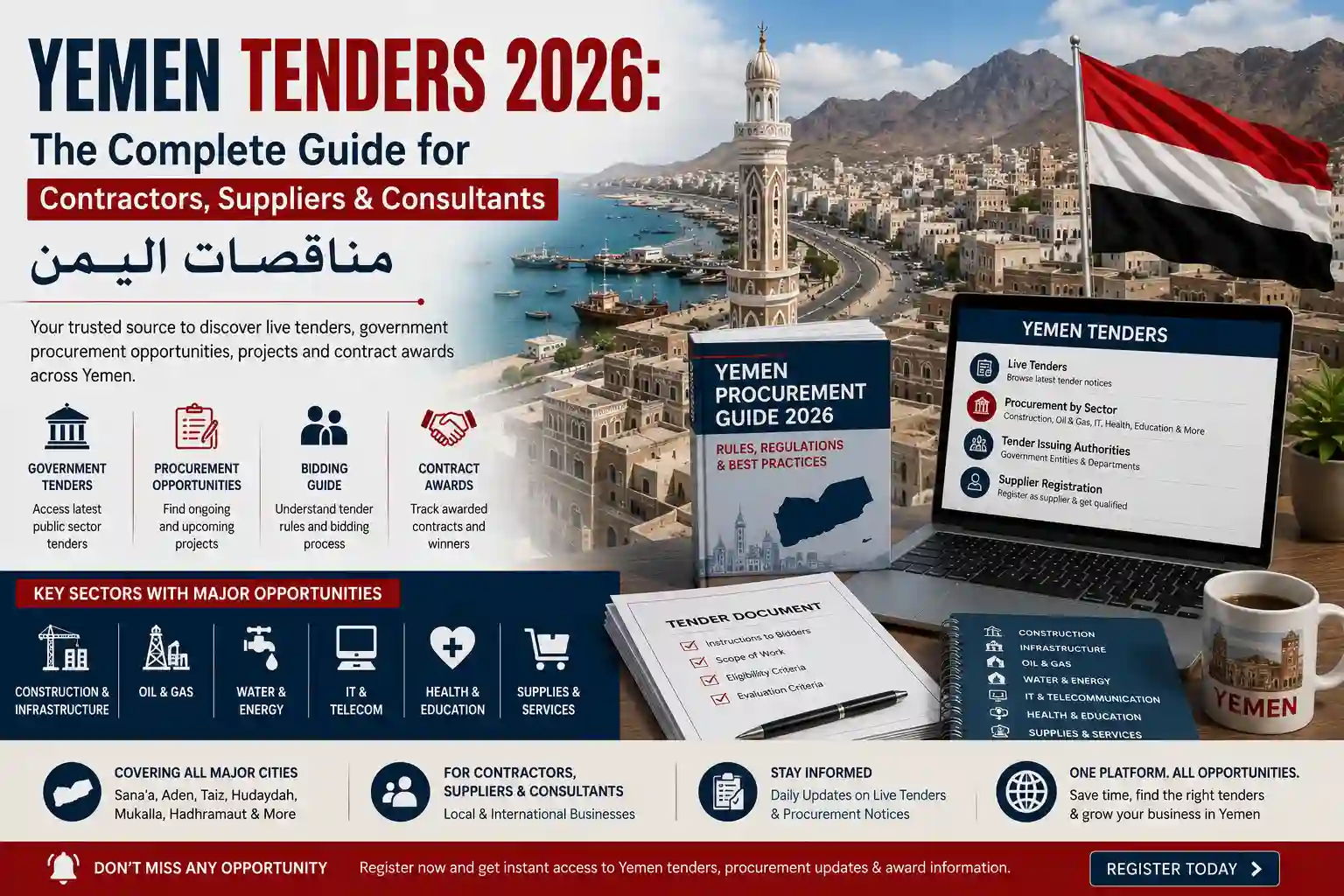
Everything you need to know about finding, understanding, and winning procurement opportunities in one of the Arab world's most complex and most active - tender markets.
If you have ever searched "Yemen tenders" or "مناقصات اليمن" and walked away more confused than when you started, you are not alone.
Yemen is not a straightforward procurement market. There is no single portal, no single government, and no single rulebook. There are two competing authorities, more than a dozen active UN agencies, dozens of international NGOs, and billions of dollars in donor funding flowing through procurement channels that most suppliers and contractors never even know exist.
That complexity is precisely why the opportunity is real.
While other contractors give up on Yemen because it seems "too difficult to navigate", the ones who understand the market - who know which authority issues which tender, which Arabic keyword to search, which donor portal to monitor, and which governorate is generating the most procurement activity right now - are winning contracts consistently.
This guide gives you everything they know.
By the time you finish reading, you will understand Yemen's procurement landscape from the ground up: the legal framework, the key issuing authorities, the most active sectors, the correct Arabic and English search terms, and the precise steps to start bidding whether you are a local Yemeni supplier, a regional contractor from the Gulf, or an international company targeting UN and donor funded opportunities.
Before we get into the mechanics, it is worth understanding why Yemen generates such a significant volume of tender opportunities - because the answer explains everything that follows.
Yemen has been in active conflict since the Houthi takeover of the capital Sana'a in 2014. More than a decade of war has devastated infrastructure, collapsed public services, and created one of the world's most severe humanitarian crises. An estimated 19.5 million people required humanitarian assistance and protection - an increase of 1.3 million compared to the previous year. Approximately 17 million people experienced acute food insecurity, with 5 million at emergency levels. That is nearly half the country's entire population.
What does a crisis of this scale require? An enormous, sustained, and diversified procurement effort.
Food must be procured and distributed. Water systems must be built and repaired. Health facilities must be stocked and rehabilitated. Schools need supplies. Displaced families need shelter and non-food items. All of this - every single item, every service, every construction contract goes through a procurement process. And that procurement process creates bidding opportunities for contractors, suppliers, consultants, and service providers.
The World Bank alone has provided more than $3.9 billion in grants to Yemen through its concessional arm IDA since re-engaging in 2016. The United Nations system, bilateral donors including the USA, Germany, the UK, and the Gulf states, and hundreds of international NGOs collectively spend billions more every year. That funding does not sit in bank accounts - it flows through tenders, RFPs, RFQs, and contracts.
Yemen's tender market is large, active, and - for those who know how to navigate it - genuinely accessible.
Most suppliers and contractors who attempt to enter Yemen's procurement market make the same mistake: they treat it as a single, unified market.
It is not.
Yemen is effectively governed by two separate and competing authorities, each with its own institutions, legal framework, commercial registration system, and procurement processes.
The internationally recognised Government of Yemen (IRG) operates primarily from Aden in the south. It is the legitimate government in the eyes of the United Nations, the World Bank, the EU, and bilateral donors. Its procurement flows through the High Tender Board (HTB), the Ministry of Finance (MOF), and national implementation agencies like the Social Fund for Development and the Public Works Project. This is where you go for formal government contracts and most donor-funded projects.
The Houthi-controlled de facto authority administers the north including Sana'a, Hodeidah, Saada, and Hajjah governorates under a parallel administrative and legal structure. The humanitarian situation in this zone became significantly more complicated after Houthi forces raided UN offices in Sana'a and Hodeidah, detaining 11 UN staff from WFP, WHO, and UNICEF. This has caused most UN agencies to substantially scale back their operational presence in the north, shifting the bulk of internationally tendered procurement southward toward Aden, Marib, Hadhramaut, and Taiz.
What this means for you as a bidder: Always verify before you spend a single hour on bid preparation - which authority issued a tender, which legal jurisdiction applies to the contract, and whether you actually have operational access to deliver in the required area. Getting this wrong is not a minor administrative error. It can lead to disqualification, contract non-performance, or worse.
Yemen's primary procurement law is Law No. 3 of 1997 on Government Bids, Tenders and Warehouses - a 60-article statute that applies to all government organisations and ministries and establishes the rules for competitive tendering, restricted bidding, direct contracting, and government auctions.
Three institutions sit at the heart of Yemen's formal procurement structure:
The High Tender Board (HTB) is the apex government procurement body. It sets all procurement policies, procedures, and standards, oversees the tendering process for all federal government contracts, and publishes official tender notices and award notifications. If you are bidding on an IRG-funded government contract, the HTB is your primary institutional counterpart.
The Ministry of Finance (MOF) approves all government contracts and provides budget funding. Every major contract regardless of which ministry or agency issued the tender - requires MOF clearance before it can be executed. Factor this into your timeline: MOF approval typically adds two to four weeks to the contracting process.
The Supreme Authority for Tenders Control (HATC) is the independent oversight and audit body, monitoring compliance with the Tenders and Auctions Law and investigating procurement irregularities. Its existence reflects Yemen's commitment on paper to procurement transparency - though implementation has been constrained by the conflict.
What About Donor-Funded Tenders?
Here is a critical nuance that most guides miss entirely. When a tender is funded by UNDP, the World Bank, WFP, USAID, the EU, or an international NGO, the donor's own procurement rules take precedence over Yemeni national law on that specific project. This means:
Understanding which rulebook applies to each tender is not optional - it is one of the most important pieces of due diligence you can do before deciding whether to bid.
This section matters whether you are a supplier trying to find opportunities or a platform trying to rank for them. Understanding real search behaviour - in both Arabic and English - is the foundation of smart tender intelligence.
Local Yemeni businesses predominantly search in Arabic. International contractors and NGO vendors search in English. The gap between these two user groups is significant, and most tender platforms serve only one of them well.
Here are the most important keyword pairs you need to know:
High search volume terms:
Medium volume, high-intent terms:
City and governorate-level searches (often underserved by major platforms):
A key insight for Arabic-speaking bidders: The two most common Arabic words for tender - "عطاء" (Ata'a) and "مناقصة" (Munaqasah) - are both actively used in Yemen. "عطاءات" is more common in official Yemeni government and UN procurement documents; "مناقصة" is the pan-Arab standard term that appears in formal legal texts. When searching online, use both to capture the full range of opportunities. Government procurement overall is called "المشتريات الحكومية" (Al-Mushtarayat al-Hukumiyah).
Not all sectors are equally active. If you are a contractor or supplier deciding where to focus your Yemen bid strategy, the following breakdown - based on verified current year procurement data tells you where the real volume is.
This is Yemen's single largest procurement category by value, and it is not close. When 17 million people are experiencing acute food insecurity and 5 million are at emergency levels, the procurement machine to address that need operates at an extraordinary scale. WFP, FAO, and UNICEF drive massive procurement of food commodities, ready-to-use therapeutic food (RUTF), nutrition supplements, and the entire logistics chain needed to distribute them. If your company is in food supply, cold chain logistics, transport, or warehousing, Yemen's food security procurement pipeline is among the largest in the world for a single country context.
Water system rehabilitation, borehole drilling, water tank construction and repair, distribution point infrastructure, hygiene kits, and sanitation facilities. UNICEF, UNOPS, and international NGOs are the primary buyers. Recent active procurements include water tank construction in Al-Dhalea and Al-Shuaib districts, water supply systems in Taiz governorate, and solar-powered water pumping across multiple governorates. If you work in civil construction, water engineering, or WASH supply chains, this sector offers consistent and high-volume tender activity.
Medical equipment, drugs, health supply kits, therapeutic feeding centre construction and rehabilitation, hospital wards, cold chain equipment, and laboratory supplies. WHO, UNICEF, and the ICRC are primary procurement drivers. A recent active tender included the supply and installation of solar systems for a health institute in Aden - illustrating how health sector procurement increasingly overlaps with renewable energy.
Community infrastructure, school and health centre construction, water infrastructure, small roads, and rehabilitation works. The Social Fund for Development (SFD) and the Public Works Project (PWP) - Yemen's two most active national procurement institutions - are the primary issuers of civil works tenders in partnership with the World Bank and UNDP. If you are a civil works contractor, these two institutions should be at the top of your vendor registration list.
Seeds, fertilizers, irrigation systems (including floodwater harvesting infrastructure that proved vital in Marib's flood response), agricultural tools, and livestock support. FAO and bilateral programmes funded by Germany's KfW and USAID drive this sector. Marib, Hadhramaut, Abyan, and Lahj governorates are the most active locations.
This is a sector that many suppliers overlook but that generates significant procurement. Cash distribution service providers, money transfer agent networks, mobile payment platforms, and vocational training facility operators are all procured through formal tender processes. UNICEF's emergency cash transfer programme has supported millions of vulnerable households across Yemen, and UNDP's livelihood recovery projects generate additional procurement in this space.
Yemen's national electricity grid has effectively collapsed across much of the country. The response has been a rapid expansion of solar energy procurement - solar systems for health centres, water pumping stations, community facilities, and offices. This sector is growing quickly, and a year-long renewable energy project funded by KSRelief and implemented through UNDP specifically targeting Yemeni women demonstrates the direction of travel. If you are in solar installation, supply, or maintenance, Yemen is an emerging and largely underserved market.
Programme evaluations, monitoring and evaluation (M&E) assignments, institutional assessments, market analysis, conflict sensitivity advisory services, and capacity building. UNDP, FAO, WFP, OCHA, and bilateral donors issue these tenders regularly. For consulting firms and individual specialists, Yemen offers consistent demand for technical expertise - particularly in areas like food security analysis, WASH sector assessment, and conflict-sensitive programming.
Understanding the full ecosystem of tender-issuing authorities is what separates occasional bidders from consistent winners. Here is the complete picture.
The Government of Yemen (IRG) - Aden
The apex procurement institution for all IRG government contracts. Sets procurement rules, oversees tendering, and publishes federal tender notices. Your first port of call for government-funded contracts.
Approves all government contracts and provides budget funding. MOF clearance is a mandatory final step before any government contract is executed.
One of Yemen's highest-volume national procurement entities. Issues tenders for civil works, consultancy, and goods supply funded through World Bank and UNDP partnerships. Has its own portal at sfd-yemen.org and a dedicated consultant database. If you do civil works, WASH, or social infrastructure in Yemen, SFD should be registered on your monitoring list today.
Partners with the World Bank, UNDP, and bilateral donors on community infrastructure. Issues tenders for small and medium civil works including road construction, water points, and community buildings. Among the most accessible and reliable national procurement bodies for civil works contractors.
Independent oversight body monitoring compliance and transparency across all government procurement.
Coordinates donor-funded development projects. Issues RFPs and EOIs for development consultancy and capacity building.
Ministry of Health, Ministry of Education, Ministry of Electricity and Energy, Ministry of Water and Environment, Ministry of Agriculture, and Ministry of Transport each issue sector-specific tenders funded through their own budgets and donor project grants.
Each of Yemen's 22 governorates has its own procurement structure. The most active in the current year are Aden, Marib, Hadhramaut, Taiz, Al-Dhalea, Abyan, and Shabwah.
One of the largest single procurement spenders in the country. Programmes span livelihoods, economic recovery, renewable energy, infrastructure, governance, peacebuilding, and food security. Partners with SFD and PWP for civil works. Operational headquarters in Aden. Register on UNGM to access all UNDP procurement.
The largest UN agency in Yemen by procurement volume. Food commodities, logistics, transport, warehousing, cash transfer services. If food, logistics, or transport is your sector - this is your most important relationship to build.
Health, nutrition, WASH, education, emergency cash transfers, and protection supplies. Uses its own e-submissions system via UNGM. Recent active procurement includes dignity kits for southern governorates and nutrition supplies for health centres.
Medical equipment, pharmaceuticals, cold chain logistics, laboratory supplies, health facility rehabilitation. Maintains procurement activity for accessible areas despite northern operational constraints.
Agricultural inputs, irrigation systems, livestock support, fishing equipment, food market assessments. Strong operational presence in Marib, Hadhramaut, Lahj, and Abyan.
Acts as a procurement and project management service for other UN agencies and donors. High-value contracts in WASH and community infrastructure. One of the most transparent and process-driven buyers in the Yemen market.
Vehicle hire, non-food items, shelter, transit facilities, displacement monitoring, and migration response. Active across Marib, Aden, Hadhramaut, and Taiz.
Shelter, NFIs, protection supplies, solar systems for offices, vehicles, and transport services.
Urban infrastructure and housing rehabilitation in Aden, Taiz, and accessible urban centres.
OCHA does not issue goods tenders directly, but its YHF funding allocations are a leading indicator of where NGO-level procurement will occur. Monitor YHF grant decisions to anticipate upcoming procurement pipelines - this is intelligence most competitors do not use.
Over $3.9 billion committed since 2016. Active portfolio spans food security, water, education, and financial inclusion. Tenders published on the World Bank Projects and Operations portal. Follow World Bank Procurement Regulations for IPF Borrowers.
Infrastructure, education, health, and water projects. Yemen is a member country with active programme lending. Tenders follow IsDB procurement guidelines.
Humanitarian response, food security, health systems, and economic recovery. RFPs published on SAM.gov. Partners with NGOs who subcontract goods and services.
Development, governance, food security, and humanitarian aid. Tenders on the EU F&T portal under DEVCO and ECHO.
Among the most active bilateral donors. GIZ implements WASH and technical assistance; KfW finances water, sanitation, and energy infrastructure. A recent KfW-funded UNDP project covered irrigation system rehabilitation and water harvesting in Taiz.
Major Gulf bilateral funder across health, food, WASH, and renewable energy. Has funded renewable energy and women's empowerment projects implemented through UNDP.
Development and governance programming. Tenders on the UK Find a Tender Service.
Infrastructure rehabilitation and humanitarian assistance in southern and eastern governorates.
Yemen hosts one of the largest concentrations of international NGO operations in the world. Each organisation issues tenders for goods, services, and civil works. The most active in current year: CARE International - food security, livelihoods, WASH, women's empowerment, protection. Save the Children - child protection, health, nutrition, education. Oxfam - WASH, food security, livelihoods, cash assistance. International Rescue Committee (IRC) - health, WASH, nutrition, economic recovery, protection. Norwegian Refugee Council (NRC) - shelter, WASH, education in emergencies, legal aid. Médecins Sans Frontières (MSF) - medical supplies, surgical equipment, healthcare infrastructure. ICRC - medical supplies, water and habitat infrastructure, detention management. Mercy Corps - livelihoods, WASH, food security, cash assistance. Relief International - health, nutrition, WASH, protection. Action Against Hunger (ACF) - nutrition, WASH, food security.
For local Arabic language NGO tenders issued by organisations operating within Yemen, YemenHR.com (يمن HR) is a useful supplementary source alongside international aggregators.
Yemen's 22 governorates are not equally active for procurement. Your bid strategy should be informed by geography.
You now understand the market, the legal framework, the sectors, and the authorities. Here is exactly what to do next.
1.Where are Yemen government tenders published online?
The right source depends on who issued the tender. The High Tender Board (HTB) publishes IRG government procurement notices. The Social Fund for Development (SFD) publishes at sfd-yemen.org. UN tenders are on UNGM and each agency's procurement page. World Bank tenders appear on the World Bank's Projects and Operations portal. NGO tenders are on individual organisation websites and aggregated on platforms including TendersArabia. Given the fragmentation of Yemen's institutional landscape, monitoring all of these simultaneously through an aggregator is the most practical approach for active bidders.
2.What is the difference between مناقصة and عطاء in Yemen?
Both are actively used. "عطاء" (Ata'a) and its plural "عطاءات" are more common in Yemeni government documents and UN agency notices. "مناقصة" (Munaqasah) appears more frequently in legal texts and is the standard pan-Arab term recognised across the region. When searching for Yemen tenders online, use both "مناقصات اليمن" and "عطاءات اليمن" to capture the widest range of opportunities. For procurement broadly, "المشتريات الحكومية" (government procurement) is the formal institutional term.
3.Can international companies bid on Yemen tenders?
Yes. Most donor-funded tenders - from UNDP, World Bank, WFP, UNICEF, EU, USAID, and international NGOs - are fully open to qualified international bidders. For IRG government contracts under Law No. 3 of 1997, local supplier preference rules may apply and a local partnership is often required. Operationally, international companies should assess access and security conditions in the required governorates as part of their bid decision - the ability to actually deliver is as important as legal eligibility.
4.Why is Yemen's procurement market split between Aden and Sana'a?
Yemen is governed by two competing authorities - the internationally recognised Government (IRG) based in Aden, and the Houthi de facto authority in the north. Each maintains parallel procurement institutions and legal frameworks. The operational environment in the north deteriorated significantly after Houthi raids on UN offices in Sana'a and Hodeidah, causing most UN agencies to scale back northern operations. The bulk of internationally tendered procurement has consequently shifted toward southern and eastern governorates - particularly Aden, Marib, Hadhramaut, and Taiz.
5.What documents are required to bid on Yemen tenders?
Standard requirements include: valid commercial or business registration certificate, tax compliance certificate (for IRG government tenders), audited financial statements for the past two to three years, past performance references from similar projects - ideally in conflict-affected contexts, technical capability statement, sector-specific certifications, and signed stamped bid documents in the required format. For UN tenders, active UNGM vendor registration at the relevant category level is a prerequisite. NGO tenders often additionally require evidence of in-country operational presence or a local partnership agreement.
6.What is the Yemen Humanitarian Fund (YHF) and why does it matter for procurement?
The YHF is managed by OCHA and channels donor funding to national and international NGOs for priority humanitarian interventions across Yemen. It is governed by a board including donors, national and international NGOs, and UN agencies. While OCHA itself does not issue goods and services tenders, the organisations that receive YHF grants subsequently issue their own procurement. Monitoring YHF allocation decisions - published on OCHA's website - gives contractors and suppliers advance intelligence on upcoming NGO procurement activity that most competitors overlook entirely.7.How is the World Bank involved in Yemen procurement?
The World Bank has provided more than $3.9 billion in IDA grants to Yemen since 2016, with priorities including food security, health, education, water, and livelihoods. It partners primarily with UNDP, the Social Fund for Development, and the Public Works Project as implementing agencies. Procurement for World Bank-funded projects follows the World Bank Procurement Regulations for IPF Borrowers and is published on the World Bank's Projects and Operations portal. Contractors and suppliers targeting World Bank-funded Yemen opportunities must understand these specific rules, which differ meaningfully from Yemeni national procurement law.
8.How can TendersArabia help me win in Yemen?
TendersArabia provides the only bilingual Arabic and English Yemen tender intelligence platform built specifically for the MENA procurement market. It offers daily automated monitoring of the High Tender Board, SFD, PWP, all UN agencies, World Bank projects, USAID, EU, KSRelief, and more than 25 international NGOs operating in Yemen. You receive authority-specific and sector-specific email alerts for مناقصات اليمن and عطاءات اليمن, with English summaries of Arabic-only government notices. The platform also provides expert guidance on UNGM registration, donor procurement rules, and local partnership strategy specific to Yemen's complex environment - and governorate-level filtering for Aden, Marib, Hadhramaut, Taiz, Al-Dhalea, and Abyan.
Yemen is not the easiest procurement market in the Arab world. Anyone who tells you otherwise has not bid there seriously. The dual governance structure, the evolving operational environment, the multiple donor rulebooks, the Arabic-English language divide - these are real complexities that real bidders have to navigate.
But complexity is also a filter. It keeps out the unprepared. The contractors and suppliers who take the time to understand this market - who register on UNGM, who monitor the SFD portal, who track YHF allocations, who prepare conflict-sensitive proposals, who search in both Arabic and English - are operating with a significant advantage over those who rely on a single English-language portal and a generic bid template.
Yemen's procurement market is active, well-funded in key sectors, and generating consistent opportunities across food security, WASH, health, construction, agriculture, and renewable energy. The opportunity is real, and it is available to those who are prepared to engage with it seriously.
Start today. Register on UNGM. Set up your TendersArabia alerts. Shortlist the authorities and sectors most relevant to your business. And the next time someone searches مناقصات اليمن and walks away confused, you will be the one who already knows exactly what to do.
Discover Yemen tenders daily - in Arabic and English - at TendersArabia. Register now or subscribe for premium alerts.